The Questions Paintings Leave Behind — Edith Holden
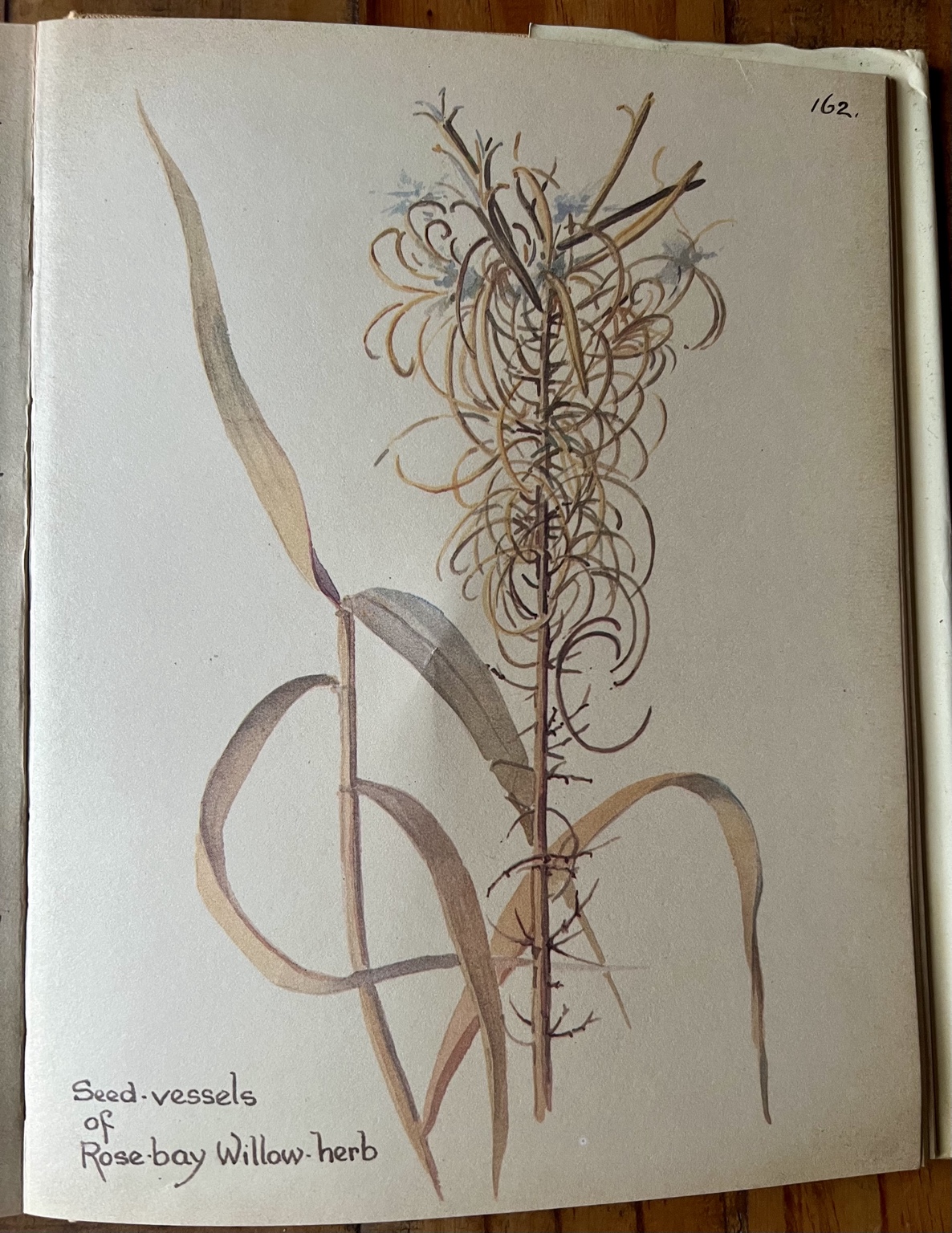
Towards the end of the November pages of Edith Holden’s The Country Diary of an Edwardian Lady is a painting of the seed vessels of rosebay willowherb, a plant whose familiar pink flowers have long since disappeared, leaving drying leaves and empty seed pods that have curled into fine, almost weightless spirals. Against the unpainted paper, we become aware of the extraordinary intricacy of these structures, of the delicacy of something that has survived the wind and rain of an English autumn, and although we are looking at a painting, we can almost feel the texture of the leaves between our fingers and imagine the movement of the slender stems in the wind. I have encountered rosebay willowherb countless times on my walks, yet looking at Holden’s painting this morning, I realise how little attention I have given to its appearance at this particular stage of its life, how often I must have recognised the familiar outline of the plant and continued walking, satisfied that I knew what it was without becoming acquainted with what it had become.
It is one of the more curious aspects of human perception that familiarity, which we might expect to bring us into a closer relationship with something, can sometimes have the opposite effect. As we become accustomed to recognising the things around us from a relatively small amount of information, our attention becomes available for other things, an immensely useful ability that nevertheless carries the possibility of gradually impoverishing our experience of the familiar. We know the name of the plant, we know where it grows, we have seen it many times before, and yet the plant itself has been undergoing a continuous process of change, much of which has taken place beyond our awareness. What I love about Holden’s painting is that she has made visible something that was never hidden, and when I next encounter rosebay willowherb along one of the lanes near my home, my experience of it will be influenced by the attention another human being gave to a similar plant a hundred and twenty years ago.
I have been turning the pages of Holden’s November this morning, enjoying the freedom with which she moves between painting and poetry, scientific enquiry and the ordinary events of her days, and the sense of continuity between her life outdoors and her life of the mind. A description of fungi growing amongst dead wood sits within a few pages of Shelley’s Ode to the West Wind, an account of cycling home through the autumn landscape is followed by a painting of a song thrush accompanied by the words of two poets, and throughout the journal there is a wonderful sense of the different aspects of her curiosity enriching one another, of the things she encounters in books accompanying her into the woods, and the things she encounters in the woods accompanying her back into the pages of her books.

On 3 November 1906, Holden writes of buying a book about British fungi containing photographs of sixty-five different varieties, and that afternoon she goes to Violet Wood to see how many kinds she can discover for herself, finding ten species within half an hour. Her account moves between the orange and yellow of sulphur tuft growing amongst dead wood, the beauty of the autumn foliage in the warm afternoon light and what she has learnt about the fine network of threads from which the visible fruiting bodies emerge. I like to imagine her returning to the woodland with this new knowledge, walking over ground that would have looked much as it had before, yet experiencing it differently through an awareness of the life beneath her feet, of the activity taking place within the soil and decaying wood, and of the relationships between organisms whose existence she might previously have considered independently of one another.
Our senses bring us into contact with only a small part of what is happening around us, but through knowledge and imagination we can extend that contact into dimensions of existence we cannot directly perceive, becoming aware of the biological activity beneath a woodland floor, of the immense distances travelled by the light of the stars we see on a clear November evening, or of the evolutionary history contained within the structure of a bird’s feather. Far from diminishing the mystery of the world, knowledge can make us increasingly conscious of how much of it remains mysterious, and there is a particular pleasure in discovering that something we have known all our lives possesses qualities and relationships of which we have barely begun to be aware. Holden’s paintings of fungi seem to belong to this experience of discovery, her pleasure in their colours and forms inseparable from her growing understanding of their lives, and her understanding, in turn, opening up further possibilities for observation.

A few pages further into November, Holden has painted a branch of bramble, its leaves moving through shades of crimson, russet and brown, and opposite the painting she has copied passages from Shelley’s Ode to the West Wind:
O wild West Wind, thou breath of Autumn’s being,
Thou, from whose unseen presence the leaves dead
Are driven, like ghosts from an enchanter fleeing…
On 15 November, walking home from Solihull in a gale, she describes the leaves falling from the trees in their hundreds and dancing along the road before her, and I wonder whether their movement brought Shelley’s words to mind, or whether his words had already become part of the way she experienced their movement. We cannot know, but the proximity of the poem and the observation touches upon something that fascinates me about the nature of human experience, the extent to which our encounters with the world are influenced by things that are no longer immediately present, by the books we have read, the paintings we have spent time looking at, the places we have visited and the conversations whose significance we may not have appreciated at the time. A poem read thirty years ago can return to us through the movement of a tree in the wind, a painting can alter our perception of the light falling across a field, and a piece of music can become so intimately associated with a particular landscape that we can scarcely think of one without recalling something of the other.
Some of the people who have most profoundly influenced the way we experience the world may be people we have never met, whose lives ended long before our own began, but whose observations, questions and imaginative discoveries have become part of the way we inhabit it. And the relationship is reciprocal, for just as poetry can deepen our experience of the natural world, our encounters with nature can bring us closer to the experience from which a poem emerged, allowing words that once seemed beautiful to acquire, after years of living, a meaning that we could not previously have understood. It is one of the pleasures of returning to a much-loved book after a long absence that we sometimes discover within it something we are convinced was not there before, although the words remain exactly as they were and what has changed is the accumulation of experiences we bring to our reading.
Towards the end of November, Holden records cycling to Solihull and returning through the lanes past the oak woods, where the sunlight illuminates the dying fronds of bracken and the remaining foliage of the trees, the fallen leaves lying thick along the way. From a large beech tree at the top of Kineton Lane she hears a thrush singing, and on the following pages she has painted a song thrush perched upon a bare branch that extends across the central fold of the book, bringing together the words of Robert Burns and Edmond Holmes.

Burns writes:
Sing on sweet bird, I listen to thy strain.
And Holmes, hearing in the song of a thrush in winter something of the possibility of renewal, ends his poem with the words:
Life’s blackest frost would blossom into Spring.
I love this double-page spread, the way the branch extends between the words of the two poets, and the thought of three people, separated by time and circumstance, becoming absorbed in the song of a bird and each preserving something of that experience in a form that allows others to share in it. Yet what moves me equally is the awareness that the thrush knows nothing of the meaning its song has acquired in human lives, nothing of our poetry, our associations with winter and spring or our need to find hope in the midst of difficult experiences. Somewhere beyond the reach of our imagination is the experience of being a thrush, of inhabiting a world whose sounds, colours and significance we can only begin to understand, and whose richness exists independently of our ability to perceive it.
When we become absorbed in the song of a bird, we are in the presence of another centre of experience, another life unfolding alongside our own, and although we cannot enter that life, we can become sufficiently interested in it for the boundaries of our immediate concerns to become less apparent. Our thoughts about ourselves, which occupy so much of our waking lives that we scarcely notice their persistence, are interrupted by an encounter with something whose existence has nothing to do with those thoughts, and for a little while we are released from the continual activity of interpreting the world in relation to ourselves. I am increasingly interested in this aspect of our encounters with nature, because although we often speak of their restorative effects in terms of reductions in stress, improvements in mood and the recovery of our capacity to concentrate, there is also the experience of discovering that the world is infinitely more interesting than the small part of it that happens to be occupying our minds.
Much of my own attention this week has been occupied by the practicalities of preparing my house for sale, by the things that need to be done before I can move and the possibilities of a life somewhere else, and I have become conscious of how easily, during periods of change, we can become absorbed in a life that exists largely in our imagination whilst scarcely noticing the one taking place around us. Yet while I have been occupied with these things, the river has continued to flow past my garden, the leaves have continued to fall and the birds have continued to move between the trees, and none of these events has required my attention in order to happen. The awareness of this brings with it a sense of relief, not because the circumstances of my life have altered, but because my experience of those circumstances changes when I become aware of the much larger world in which they are taking place, a world containing innumerable other lives, other movements and other possibilities, much of whose existence I will never know.

Looking through Holden’s November, I am struck by how much life there is in a month we tend to associate with its disappearance. She notices new catkins on the alder and hazel trees, sees a kingfisher cross a roadside pool and describes a crimson sun suspended against a curtain of grey cloud, and towards the end of the month, when much of the landscape has lost its colour, she paints the seed vessels of cow parsnip and beaked parsley, the slender stems of nipplewort and the reddish-brown remains of dock. I have always loved the appearance of dried seed heads in winter, when the absence of flowers allows us to appreciate the structure of a plant in a way that is more difficult during the abundance of summer, when the spaces between the stems become more apparent and we can see the fine branching patterns and the intricate structures that once supported flowers and now carry, or have already released, the seeds of another generation.
Our perception of beauty is so closely bound up with our understanding of time that we tend to think of a plant as having reached its culmination when it is in full flower, regarding everything that follows as a process of decline, although the changes we associate with the loss of its beauty are integral to the continuation of its life. Holden’s paintings allow us to spend time with these later forms, and in doing so we become aware of qualities that were less visible when the plants were in flower, of a beauty that belongs specifically to this stage of their existence and could not have been present in the same way during the summer. I wonder how much of our experience of ageing, both in ourselves and in the world around us, is influenced by our tendency to regard one particular stage of life as the point against which all the others are measured, and how differently we might experience the passage of time if we were more receptive to what becomes visible as a consequence of change.
I have been thinking a great deal recently about the journals I would like to keep myself, and what draws me to Holden’s is the way the different aspects of her life have found a home within its pages, her reading, her curiosity about science, her pleasure in poetry and her experiences of the natural world becoming so closely interwoven that it would be difficult to separate them without losing something of the richness of each. There are books I have read whose ideas have remained with me for years without my being fully conscious of their influence, and there are encounters with the natural world that have brought together thoughts that had previously seemed unrelated, moments when the significance of something I read long ago has suddenly become apparent through the experience of something as ordinary as watching a bird or examining the structure of a leaf. Many of these associations are fleeting, disappearing as the demands of the day draw our attention elsewhere, but within the pages of a journal they have somewhere to remain, and in returning to them months or years later we may discover connections that were not apparent to us when we first recorded them.
There is an intimacy to Holden’s journal that is quite different from that of a conventional diary, for although she reveals relatively little of her private thoughts in these November entries, we come to know something of her through the things she considered worth noticing, the passages of poetry she chose to preserve and the care with which she painted the fragile structures of plants that many people would have passed without seeing. A record of the things to which we have given our attention over the course of a lifetime might reveal as much about us as a record of the things that have happened to us, particularly when we consider that attention is also one of the means by which we participate in our own development, that the things we spend time looking at, thinking about and becoming acquainted with gradually become part of the experience we bring to our next encounter with the world. Holden’s journal is a record of this unfolding relationship, of a woman becoming more intimately acquainted with the world through the combined pleasures of looking, reading, thinking and painting, and of the way each of these activities enlarges the possibilities of the others.
The particular November that Holden recorded has long since passed, the thrush she heard in the beech tree, the fungi she found amongst the fallen leaves and the individual stem of rosebay willowherb she painted have all completed their lives, yet something of her encounter with them has survived, and this morning it has become part of mine, just as the words of Shelley and Burns once became part of hers. I find this deeply moving, the thought that the attention we give to something during an ordinary afternoon might, through a few lines of writing or a painting on a page, enter the experience of someone whose life we could never have imagined, bringing them into a closer relationship with a world we once knew and which, in so many of its particulars, we continue to share.
I close the book and look towards the garden, where the last days of another November are unfolding. Somewhere along the lanes I walk, there will be a stem of rosebay willowherb, its seed vessels open to the wind, and although I may have passed it many times in recent weeks, I have yet to become acquainted with it.
Books Mentioned
The Country Diary of an Edwardian Lady — Edith Holden. A beautiful companion through the changing seasons, bringing together botanical watercolours, poetry and observations of the living world. Find a copy on Amazon.
As an Amazon Associate I earn from qualifying purchases.
Further Reading
Support Nature Speaks
Choose an amount
Or enter a custom amount
Nature Speaks has been growing since 2011. Each essay may begin with something small — a leaf, a feather, a bird or a familiar path — but behind it are hours of observation, reading, research, reflection and revision. I keep this writing freely available because I believe that beauty, curiosity and a deeper relationship with the living world should be open to everyone. If something you have read has stayed with you, or changed what you notice, a small contribution helps me continue this independent work. Thank you for reading, whether or not you are able to give.