Small Observations | Bodnant Garden, November
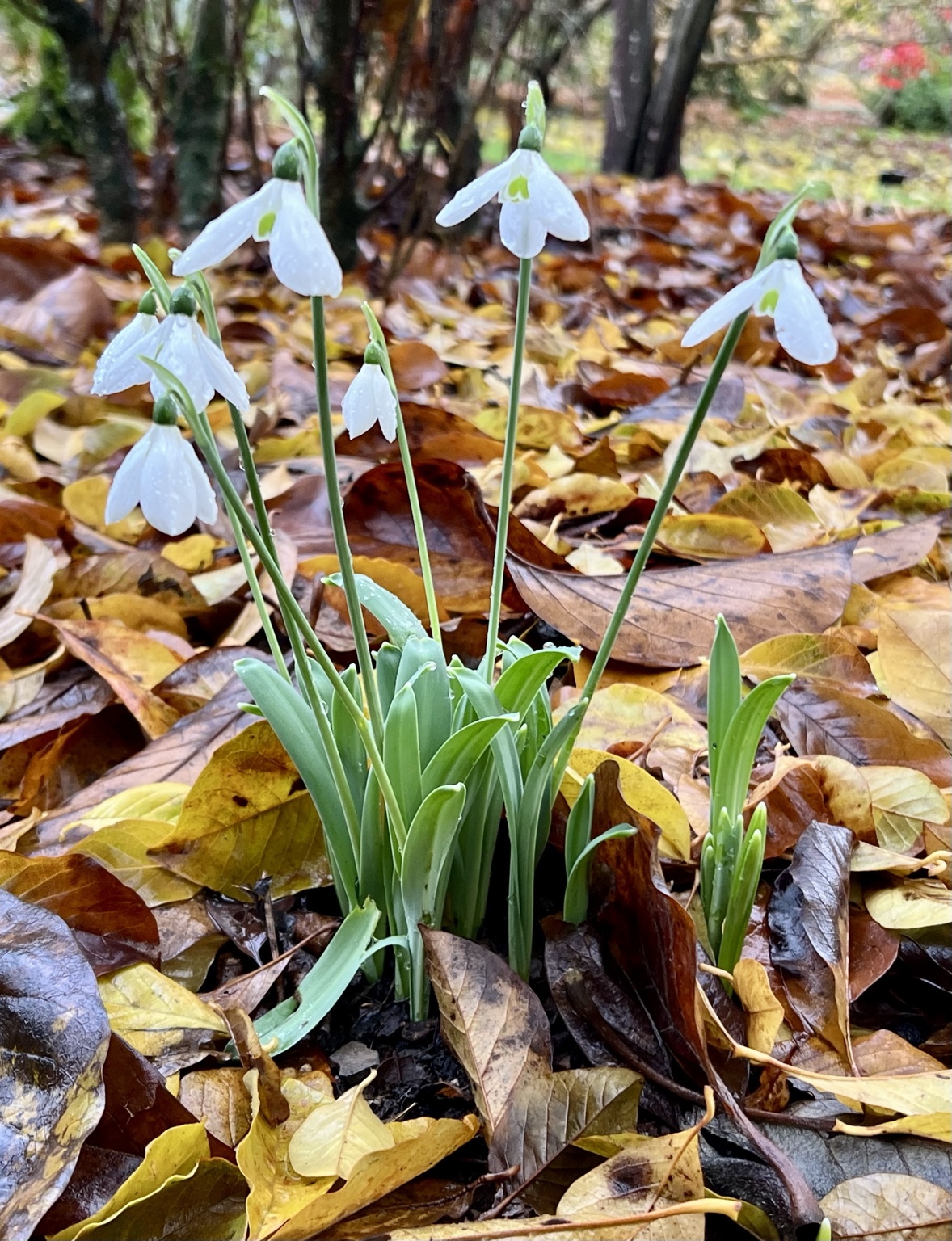
Yesterday, walking through Bodnant Garden, I came upon a little gathering of snowdrops flowering amongst the fallen leaves, their white heads suspended above a covering of copper, gold and darkening brown, and not far away I noticed a solitary Welsh poppy, its orange flower still open amongst the damp greenery and bare stems of plants that had long since finished flowering. The snowdrops seemed extraordinarily early, the poppy remarkably late, and I was struck by the curious sight of two flowers that belonged, in my imagination at least, to quite different parts of the year, yet here they were together in the same November garden, apparently unconcerned by the contradiction their presence presented to me.

I have always associated snowdrops with that uncertain passage between winter and spring, when the earth is still cold and the first small indications of another season begin to appear, while the Welsh poppy belongs to the longer days and abundance of green. Yet these associations, however familiar they have become, are not the flowers themselves, but part of the arrangement I have made of the natural world through years of looking, remembering and anticipating. Some snowdrops naturally flower in autumn, while other plants continue flowering whenever conditions allow, and the seasons themselves have never possessed the precise boundaries we give them in our calendars.
What stayed with me was the realisation that I had brought my own November into Bodnant Garden, assembled from memories of other Novembers, from familiar patterns of weather and flowering, and from everything I had learned to associate with this particular point in the year. My surprise arose not from anything the flowers had done, but from the difference between what was before me and what I believed ought to be there.
I wonder how often we encounter the world in this way, seeing not only what is present but what we have come to expect, and sometimes overlooking whatever does not belong to the picture we have already made. We may think we know a place because we have visited it many times, or understand another person because their habits and opinions have become familiar to us, yet familiarity can quietly become a form of certainty, leaving surprisingly little room for the possibility that something has changed, or that there was always more there than we understood.
Perhaps there is an important distinction between recognising something and continuing to see it, because recognition allows us to move through the world with confidence, while genuine attention sometimes asks us to question the very knowledge upon which that confidence rests. To look carefully may require something more than concentration; it may ask us to become willing to encounter what is actually present without immediately fitting it into the familiar arrangements of our minds.
The snowdrops and the Welsh poppy were simply flowering according to the conditions of their own existence, their lives unfolding within rhythms more intricate than the seasonal divisions I had brought with me, and I found myself wondering how much of the world remains unnoticed, not because it is hidden from us, but because it arrives in a form, or at a time, for which we have made no room.
Perhaps the most difficult part of learning to see is recognising how much of what we believe we know belongs not to the world itself, but to the way we have become accustomed to looking at it.
Photographed at Bodnant Garden, National Trust. Photographs © Jane Maye.
Support Nature Speaks
Choose an amount
Or enter a custom amount
Nature Speaks has been growing since 2011. Each essay may begin with something small — a leaf, a feather, a bird or a familiar path — but behind it are hours of observation, reading, research, reflection and revision. I keep this writing freely available because I believe that beauty, curiosity and a deeper relationship with the living world should be open to everyone. If something you have read has stayed with you, or changed what you notice, a small contribution helps me continue this independent work. Thank you for reading, whether or not you are able to give.