Small Observations | Old tramway path, November
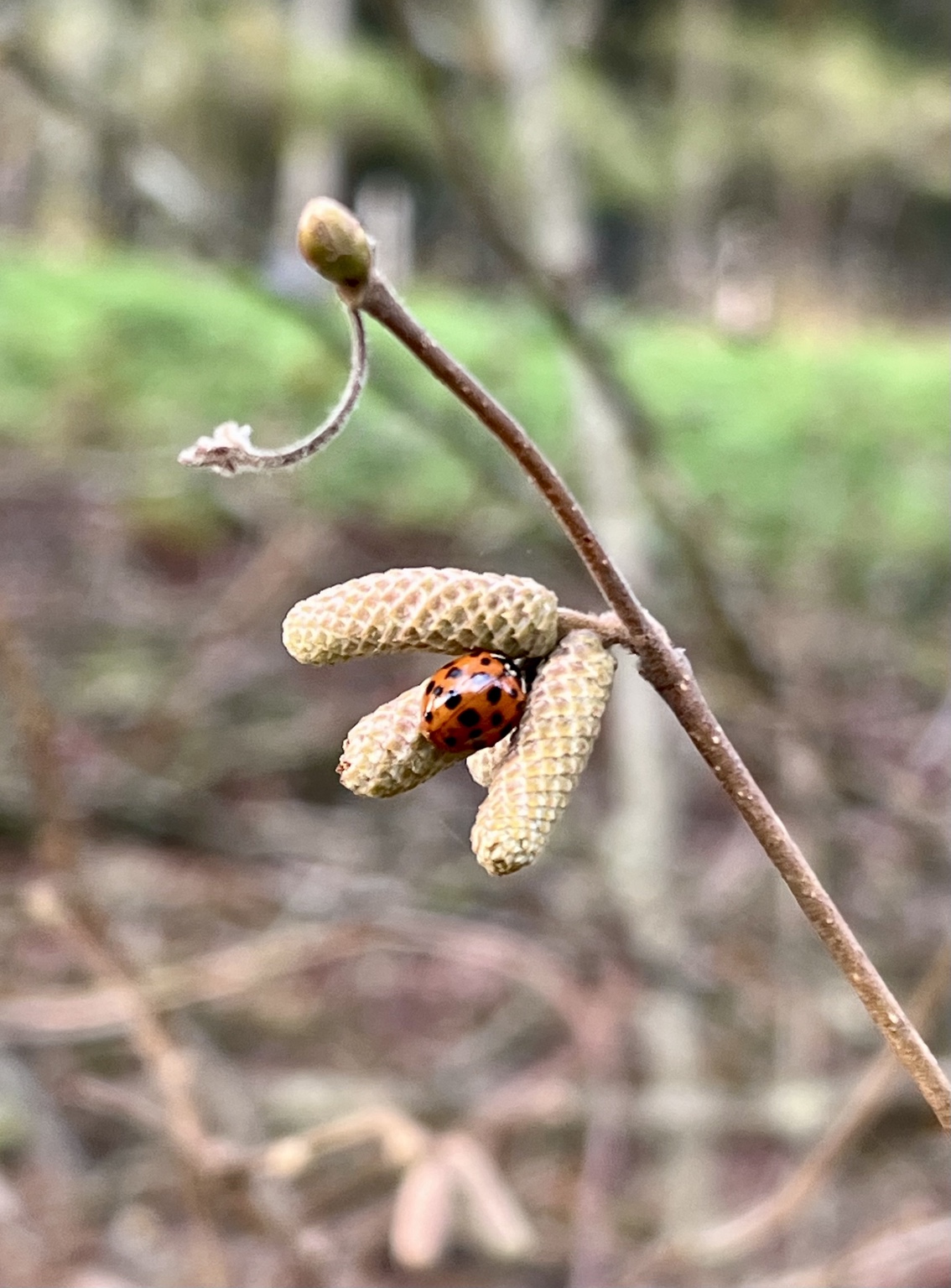
It was bitterly cold on the old tramway path today, and we were walking through a landscape that seemed to have settled into the stillness of late November, the trees almost bare, the undergrowth subdued, the little signs of life that had accompanied us through the warmer months increasingly difficult to find. I stopped beside a hazel to look at its catkins, curious about these small, tightly closed structures hanging from the branches when so much else appeared to have finished growing, and it was only as I leaned closer that I noticed a ladybird tucked amongst them, its bright orange shell almost hidden between their pale, patterned surfaces.
I had stopped to look at one thing and found another.
The catkins had begun forming months earlier, during the abundance of summer, and would remain through autumn and winter until the conditions were right for them to open and release their pollen. The ladybird, meanwhile, was perhaps seeking shelter from the cold, its small life continuing amongst the preparations for another season. Two very different forms of existence, occupying the same few centimetres of a branch, each responding to circumstances that neither could comprehend in the way we do, and neither requiring our attention in order to continue.
I wondered how long the ladybird had been there, and how many people might have passed along that path without seeing it. I might easily have been one of them, had something about the catkins not caught my attention, and there was a curious feeling in realising that the difference between a walk on which I had seen nothing particularly remarkable and one on which I had encountered this tiny life amounted to little more than a few seconds of looking.
Nothing had been added to the world in those seconds. The ladybird had not appeared because I noticed it, nor had the hazel become more interesting because I understood something of its life. What had changed was my experience of what was already there.
We live within a world of almost unimaginable complexity, yet the portion of it that enters our awareness at any given moment is extraordinarily small. Our attention selects, simplifies and excludes, allowing us to find our way through the day without being overwhelmed by everything that surrounds us, but in doing so it also creates a version of reality that we can easily mistake for reality itself. We see what we expect to see, recognise what we already know, and gradually become so accustomed to the familiar that we cease to experience much of it at all.
Perhaps this is why a small encounter can sometimes affect us more deeply than a magnificent view. A mountain announces its presence and invites our admiration, but a ladybird hidden amongst November catkins asks nothing of us, and might remain unnoticed for the entirety of its life. To become aware of it is to encounter, however briefly, the limits of our own perception, and to recognise that the world is not exhausted by what we happen to know about it.
There is something humbling in that recognition, but also something profoundly reassuring. We are so often troubled by the feeling that life has become smaller, that the days resemble one another too closely, that there is less to anticipate or discover than there once was. We may attribute this to the passing of time, to familiarity, or to the gradual loss of the curiosity we possessed as children, without considering how much of this apparent diminishment might arise from the way we have learned to direct our attention.
The path itself had not become less alive because November had arrived. Much of its life had simply become less visible, withdrawn into bark and soil, into sheltered spaces beneath fallen leaves, into buds and seeds and the countless small processes through which living things endure conditions that would otherwise overwhelm them. Even the catkins, which seemed at first to belong to the coming spring, were evidence that the future was already taking shape within the present, quietly and without any clear division between the season that was ending and the one that had yet to begin.
We are inclined to impose such divisions upon our own lives, too, speaking of beginnings and endings, periods of growth and periods of stagnation, times when we are moving forward and times when nothing seems to be happening. Yet perhaps some of the most important changes in us occur without announcing themselves, in those unremarkable stretches of time when we cannot see what is developing, and when the absence of visible progress tempts us to believe that nothing is taking place.
The temperature was already below freezing, and I found myself wondering how such a small creature could survive the cold. Ladybirds possess remarkable adaptations that allow many of them to endure winter in a state of reduced activity, often concealed in places where the worst of the weather cannot reach them, but the one before me seemed so exposed, its fragile existence held within a few centimetres of hazel branch. I could not know whether it had found a sufficiently sheltered place, whether it would remain there, or whether it would survive the winter at all. And perhaps there was something important in resisting the temptation to make its presence reassuring, to turn it into a little story about resilience simply because I wanted it to have a happy ending.
For the natural world is not arranged for our comfort, nor does every encounter offer the consolation we might wish to find in it. The ladybird was vulnerable, the cold was real, and the fact that I had noticed this tiny life gave me no knowledge of what would become of it. Yet its vulnerability did not make the encounter less wonderful; if anything, it brought me closer to an understanding of how much of life proceeds beyond our knowledge, and how little we need to possess or explain something in order to recognise its significance.
I walked on along the old tramway path, leaving the ladybird where I had found it, but the thought remained with me that there must have been countless other lives within reach of my eyes that afternoon, each as complete and consequential to itself as the one I had happened to notice, and each continuing beyond the narrow boundaries of my awareness.
The ladybird was there before I noticed it, and remained when I walked away. I wonder how much of the world we mistake for empty simply because we have not yet learned to see what fills it.
Support Nature Speaks
Choose an amount
Or enter a custom amount
Nature Speaks has been growing since 2011. Each essay may begin with something small — a leaf, a feather, a bird or a familiar path — but behind it are hours of observation, reading, research, reflection and revision. I keep this writing freely available because I believe that beauty, curiosity and a deeper relationship with the living world should be open to everyone. If something you have read has stayed with you, or changed what you notice, a small contribution helps me continue this independent work. Thank you for reading, whether or not you are able to give.