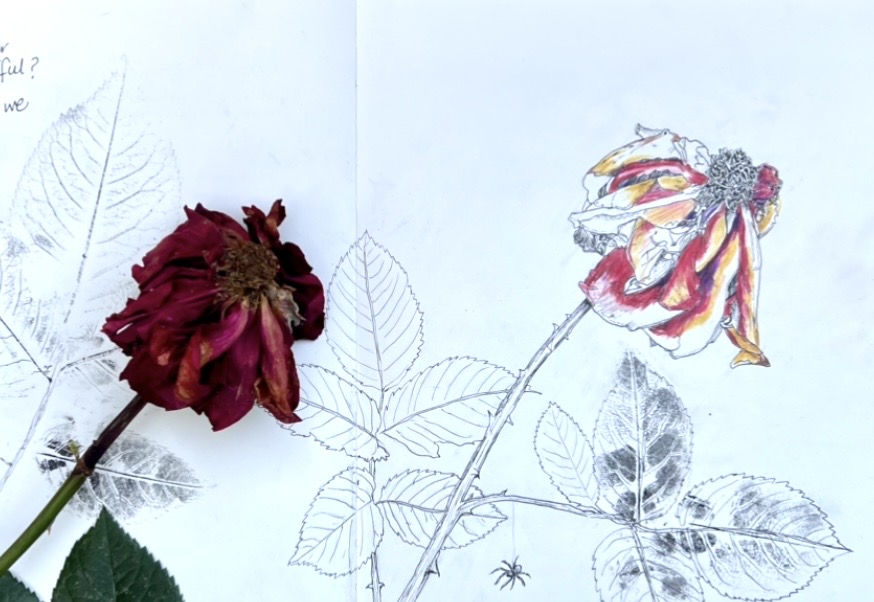
Looking again at my partially coloured rose, I find myself drawn to the places where the colour stops, where a petal returns to the simplicity of a line and the paper remains visible through what the eye understands as a flower. There is something about that meeting of colour and openness that holds my attention, although I am not sure I understood its appeal while I was making it. Only afterwards did I begin to wonder why adding more might have taken something away.
We become accustomed to thinking of completion as a matter of filling what remains, resolving uncertainty, bringing every part of a thing to the same degree of finish. Yet a drawing can reach a point at which another mark would close a space that needs to remain open, and the decision to stop becomes as much a part of the work as everything that preceded it. The drawing is complete, although the colour does not fill every part of it, and the uncoloured petal remains present, its outline giving us enough to recognise it while leaving something for the imagination to approach.
Perhaps part of its appeal lies in how closely this resembles the way we attend to the world. When I look at a rose, I never receive the whole of it with equal clarity. My attention gathers around the fold of one petal, the darkening edge of another, the small space where the light has entered between them, while the rest remains quietly present beyond whatever I am noticing. A moment later, something else comes forward, and the flower I thought I had already seen becomes unfamiliar again.
The partially coloured drawing seems to make that movement visible. Colour gathers in certain places as attention does, bringing one detail into vividness while allowing another to remain tentative. The eye can travel between them, following a line into the quieter parts of the image, perhaps lingering precisely because everything has not been explained.
There is a generosity in leaving that room for someone else. A person looking at the rose may bring a garden I have never visited, a flower once given to them, a memory of someone whose hands they can still picture arranging stems in a vase. None of these things can be placed deliberately inside the drawing, yet the drawing may offer somewhere for them to arrive. Its meaning continues beyond the moment when I put down my materials.
The rose itself makes the question of completion more complicated. In a garden, we may speak of a flower reaching its perfection, but the flower continues through the moment we have chosen to admire. Its petals loosen, their edges change, its colour deepens or withdraws, and what we call fading becomes another phase of its particular existence. Our wish to hold it at one stage belongs to us; the rose carries on.
Perhaps this is why the quieter passages feel at home within its image. They allow the flower to remain a little elusive, as living things are when we look closely enough to recognise that our understanding of them is always partial. I can draw what I notice, but there will still be more than I have seen.
Something similar happens to the person doing the drawing. We often describe creativity as self-expression, as though there were a complete and settled self waiting inside us, needing only the right materials through which to become visible. Yet making can reveal preferences, questions and feelings that we did not know were there until a particular choice asked us to recognise them.
A colour seems wrong before we can explain why. A line we intended to correct becomes the most interesting part of the image. We discover that the space we had planned to fill is the space the work needs, and have to loosen our attachment to what we thought we were making. In such small negotiations, our understanding changes alongside the thing taking shape beneath our hands.
The same can happen in writing, when a sentence leads us towards a thought we could not have reached before beginning it. We pause, read it again, and realise that the act of finding the words has altered what we wanted to say. The work holds a trace of that encounter, while we carry something from it into whatever we notice next.
This is one reason I think creativity deserves such care in the age of AI. When images and words can be generated in seconds, it becomes especially important to recognise what happens within us through the time we spend making. The finished piece is one part of that experience, alongside the patience we practise, the judgement we develop and the discoveries that become possible as we work.
With this rose, those discoveries came through looking, choosing colours, making marks and deciding where to leave the drawing open. Each choice asked something of my attention. I had to return to the flower, notice the particular turn of a petal and consider what I wanted to bring forward. The time spent doing this became part of my relationship with the rose, and with my own way of seeing.
Sometimes the hesitation is where I discover what matters. A passage that feels unresolved asks me to look again, to notice where my familiar idea of a rose has replaced the particular rose in front of me. Staying with that uncertainty gives me an opportunity to learn something I could not have anticipated at the beginning, including the possibility that the image needs to take a different direction from the one I had intended.
As AI becomes more present in our lives, I hope we continue to make room for experiences that ask us to develop our own perception, imagination and judgement. Creativity gives us somewhere to practise these capacities, to make decisions whose answers are not supplied in advance, and to discover that we are still capable of changing through what we do. There is value in making something ourselves even when the result is small, imperfect or never shared, because the experience can continue to shape us long after we have put it down.
That feels especially relevant to Attentive Wondering, where creating follows observing, wondering and reflecting, carrying something of those experiences into a mark, a sentence or an arrangement of found things. The result may be modest, even private, yet the attention involved has already had a place in the day. Someone has looked closely at a leaf, stayed with a question, or found words for something that would otherwise have passed unnoticed.
We need opportunities to continue discovering ourselves in this way, at any age and whatever our level of skill. A few lines in a notebook, a small drawing, a meal made with care or a patch of garden gradually taking shape can ask us to participate in our own lives with greater awareness. Through making choices and meeting what we could not predict, we remain capable of being surprised.
Looking at the rose now, I think some of what appeals to me is the permission it offers to stop without having said everything. The coloured passages have their place, and so do the lines that remain open against the paper. Together they give the eye somewhere to settle and somewhere still to go.
Perhaps there is a question worth carrying from the page into the rest of the day: what are we making that is also quietly making us? We may find an answer in something small enough to have escaped our notice, somewhere we are still learning how to look, or at the edge of a petal where, for now, the colour stops.
The Faded Rose is available as an A4 fine art print through Moss & Maye, for anyone who would like to live with this small reflection on colour, attention and the spaces we leave open.
