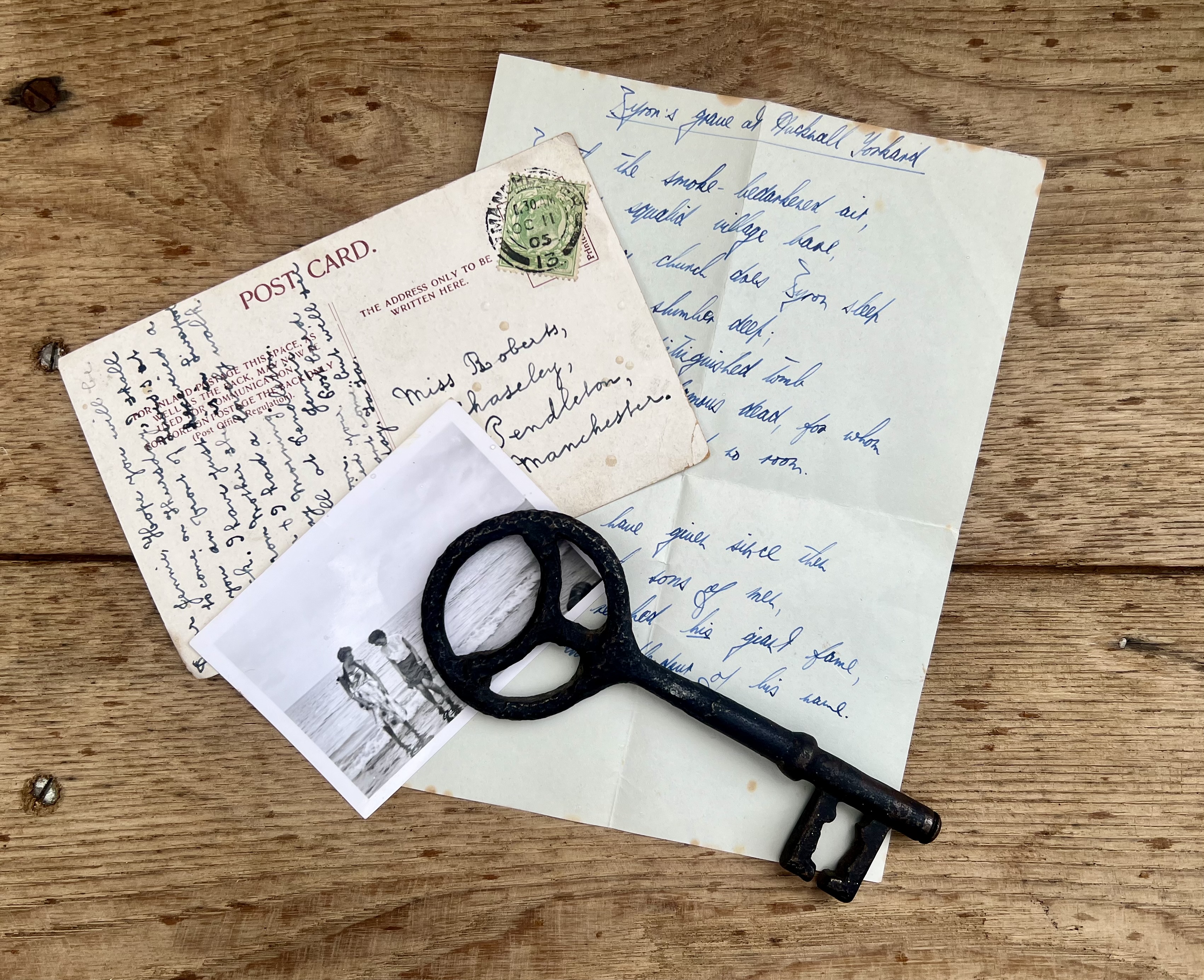
Donald Davies recently shared some of his work with me, and I found myself returning to several of the ideas within it, particularly one sentence that seemed to keep opening rather than closing as I thought about it: “Meaning does not remain where it is formed.” With his permission, I’m quoting it here because those words continued to travel through my thoughts long after I had finished reading, gathering other books, memories and questions around them, until I began to realise that the sentence was demonstrating its own truth simply by having crossed the small distance between Donald’s mind and mine. Whatever it meant at the moment he wrote it had already entered another life, encountered experiences he could not know, and become something neither entirely his nor entirely mine.
My thoughts went first to Viktor Frankl and Man’s Search for Meaning, perhaps inevitably, although it was the word search that began to trouble me. Searching suggests that meaning exists somewhere beyond us, hidden perhaps inside an experience, waiting for us to recognise it if we look carefully enough, endure long enough or achieve the right understanding, and I wonder whether I have sometimes imagined meaning in precisely this way, as something more solid than it really is, a small truth concealed inside what happened to us which, once discovered, might finally explain everything. Yet when I look back over my own life, meaning seems far less obedient than that. Things I once believed would always matter have quietly lost their hold, while moments I barely noticed when they occurred have grown in significance with the passing years; a place changes after someone we loved is no longer there, an ordinary object becomes difficult to discard because we suddenly remember the hand that held it, and a sentence heard decades earlier can return without warning carrying an emotional weight that it did not seem to possess when it was first spoken. Perhaps we did not misunderstand those things originally; perhaps meaning itself changed because we changed, because time altered the position from which we looked, and because no experience remains isolated once it has entered a life and begun touching everything around it.
There is something consoling in Frankl’s understanding that meaning is particular to the person and the moment rather than a single answer that can be handed from one human being to another, because it allows a life to change without requiring us to declare our earlier meanings false. A vocation may sustain us for years and then cease to do so, a house may once have represented security and later become somewhere we know we must leave, a relationship may continue to shape us long after it has ended, and what seemed absolutely clear when we were thirty may look quite different when we are sixty, not because one version was mistaken but because the person doing the seeing is no longer standing in the same place. We seem to want meaning to endure because permanence reassures us, yet perhaps part of being alive is learning that meaning has seasons too.
From Frankl my thoughts moved towards Jung and The Red Book, a book I have treasured for years, perhaps partly because the book itself seems to resist our desire for immediate explanation. Jung returned repeatedly to images, dreams and inner figures whose significance was not always clear when they first appeared, writing them, painting them, entering into dialogue with them and allowing them to remain alive long enough for new understanding to gather around them. Something first encountered within one human consciousness could therefore become an image, then a page, then part of a developing psychological idea, and eventually, many decades later, a book opened by somebody sitting in an entirely different room, carrying an entirely different life. When I turn those enormous pages now, something formed in Jung’s experience enters mine, and although I can study what he wrote and try to understand what he intended, I cannot meet those images without bringing with me everything he could never have known about me.

Perhaps this is one of the strange things about making anything visible. Once a thought becomes a sentence, an image becomes a painting or an experience becomes a story, it begins to live outside the conditions in which it was formed, and other minds arrive carrying their own histories. The maker still matters, intention still matters, context still matters, but none of them can completely determine what will happen next. A reader may find significance in a sentence the writer thought incidental, a painting may awaken a memory in someone the artist never imagined, and words written in one century may enter another carrying meanings shaped by lives and circumstances that did not yet exist.
Yet this human hunger for meaning can also make us impatient. We find a feather and almost immediately wonder whether it is a sign; a black cat crosses our path and centuries of superstition arrive with it; a raven becomes omen, an owl wisdom, a tree resilience, a river impermanence, autumn the necessity of letting go. These meanings are not trivial simply because we have created them — they carry myth, memory, culture, fear, consolation and centuries of human experience — but I sometimes wonder what happens to the actual thing beneath everything we ask it to carry. The black cat knows nothing of the fortunes we have attached to its colour, the raven does not know that its black feathers have entered mythology, and the feather lying beside a path cannot know that the person who picks it up may understand it as freedom, bereavement, protection or a message from someone no longer alive. The meaning may be profoundly real to the person who experiences it without being something that was residing inside the animal or object waiting to be found, and there is a difference between those two kinds of truth that seems increasingly important to me.
Our impulse to give meaning to what surrounds us is unimaginably old. Long before psychology had a name, before philosophy or science could offer explanations, human beings were watching animals, weather, darkness, fire, birth, death and the movement of stars, telling stories around what frightened them and what astonished them, burying their dead with objects, painting animals on cave walls and trying, somehow, to understand their place within a world that could sustain them one day and destroy them the next. Perhaps this was never simply a primitive failure to explain reality correctly; perhaps meaning-making was itself one of the ways consciousness learned to live with the unbearable fact of being aware — aware of beauty, danger, love, death, memory, time, and of the knowledge that everything we know will eventually change.
There are still experiences that seem to reach that older place in us before thought has had time to organise them, and I do not mean recognition in the ordinary sense of knowing what something is, but the stranger sensation that an image, a sound or a sentence has touched something already waiting within us. A dark forest can disturb us before we have decided what forests symbolise; a bird crossing alone through an evening sky can produce an ache we cannot account for; the smell of a coat kept at the back of a cupboard can suddenly restore a person so vividly that for a moment time seems to fold, while a particular quality of light can return us to a room we have not entered for forty years. We explain these things afterwards, because explanation is one of the ways we make experience bearable, but sometimes the body seems to recognise before the conscious mind understands, and I wonder whether meaning often begins there, in that quiet interval between being touched by something and knowing why.
This changes the question for me. Instead of asking only What does this mean?, I become more interested in asking What is happening between this thing and me that allows meaning to arise? A feather belonged first to a bird; before I ever held it or wondered about it, it grew from a living body, lay among other feathers, met rain and sunlight, perhaps held warmth close or shaped the air beneath a wing. Its existence did not begin when it entered my attention, and whatever meaning I give it cannot exhaust what it is. Indeed, there is a quiet danger in making the natural world continually speak about ourselves, because if every tree becomes a lesson, every bird a messenger and every landscape a metaphor, we can begin looking through the living world rather than at it, so that the raven disappears beneath mythology, the river beneath symbolism, and the tree beneath whatever human virtue we have asked it to represent.
Attentive wondering, for me, increasingly begins before this interpretation, in allowing something to remain itself for a while. If I stay with the feather rather than asking immediately what it means, the word feather begins to seem almost absurdly inadequate for what is in my hand: the pale shaft tapering towards an impossibly delicate end, hundreds of barbs arranged with an intricacy I cannot see when the bird is flying, minute signs of weather and wear, colours that change as the light changes, evidence of a life that was already complete in its own terms before I arrived. There is a different kind of intimacy in letting the object become more itself rather than more symbolic, and strangely, meaning often seems to deepen when I stop demanding it.
From here another question keeps returning to me, one I cannot answer and perhaps should not try to answer too quickly: do animals need meaning, or is this need to turn experience into a story about itself peculiarly human? Animals clearly remember, anticipate, attach, grieve, communicate, seek comfort and play, yet I cannot know whether a raven standing on a branch ever needs its existence to signify something beyond the living of it, or whether a dog lying in a patch of sunlight requires any account of why the sunlight matters, whether waiting at a door for someone it loves needs to become a story about love, whether grief needs to teach anything before it can simply be grief. Even as I write this I hesitate, because perhaps I am doing exactly what I have been questioning, making an animal carry another human idea, imagining simplicity where there may be an interior complexity inaccessible to me; still, the question remains because human beings seem peculiarly unable simply to undergo experience without eventually turning towards it and asking what it meant. We suffer and want to know what suffering changed, we lose someone and search for what remains, we survive and wonder why, we love and want the love to have mattered, and sometimes we seem to need the shape of a story in order to bear the disorder of what has happened.
Perhaps this is why words can travel so deeply between us. Someone writes a sentence and another person carries it away; a poem born from an experience the reader never shared becomes inseparable from something in the reader’s own life; an old painting opens a memory in someone born after the artist died; a photograph of a river in one country calls up another river, another childhood, another pair of bare feet standing in cold water many decades before. Meaning moves because people bring themselves to what they encounter, and in doing so they change it, while being changed in return.
This may be part of what poetry understands so well. It does not always close the space around an image by explaining what we should think, but gives us something and then withdraws slightly, leaving enough room for memory, association and feeling to enter. A few words can therefore remain dormant for years until life alters the person carrying them, so that a poem almost unnoticed at twenty can become unbearable at fifty although not one syllable has changed. Something apparently insignificant can wait in us in much the same way — a sentence heard as a child, an inherited object placed in a drawer, a place visited without much thought, an old book opened again after decades — until one day we meet it from somewhere new and discover that it has become capable of meaning something it could not have meant before.
Places behave like this too. A river does not possess one meaning any more than a feather does: to an otter it may be territory and food, to a trout the medium in which life itself is possible, to a child adventure, to someone who has lived beside it for years a repository of family, fear, weather and memory, to a scientist flow and chemistry and habitat, while to somebody passing for the first time it may simply be beautiful. The river continues through all these meanings without being contained by any of them, carrying human stories alongside silt, insects, leaves and rainwater, indifferent perhaps to our interpretations and yet continually offering itself to relationship.
And perhaps this is where I have arrived after carrying Donald’s sentence for these few days: meaning may be less like an object hidden inside things than something that happens between them, between a place and the person who has known it, between an object and the memory it awakens, between a writer and a reader, between what happened then and who we have become now. If that is so, meaning could never remain completely where it was formed because relationship itself is movement; we change, the world changes, the other person changes, and what passes between us changes too.
There are moments when I think we know this somewhere deeper than explanation, because certain words reach us before we have properly understood them, slipping beneath the part of the mind that wants to classify and conclude and touching somewhere older, where memory, image and feeling have not yet been separated into tidy categories. A sentence can arrive carrying a river we once knew, the smell of someone’s coat, the silence of a room after a death, the sensation of a hand we can no longer hold, the sound of a bird calling somewhere beyond the light, and something inside us moves before we have given that movement a name.
Perhaps this is why we sometimes carry a sentence for years, not because we completely understand it, but because some part of us has recognised something within it that the rest of us has not yet caught up with.
Donald wrote, “Meaning does not remain where it is formed.”
By the time those words reached me, they had already begun to prove themselves true, because whatever meaning they held for Donald entered another life, met memories, questions and associations that were not his, and became something altered simply by being received. I think I understand something of what they mean to me now, although even as I write that, the meaning is moving again, because Donald’s words have passed through my reading of Frankl and Jung, through feathers and ravens and black cats, through rivers, memory, loss and the unanswered question of what another creature knows of meaning, and they have now travelled beyond the privacy of my notebook into your life.
I do not know what they will meet there. Perhaps they will touch nothing and disappear, as most of the words we encounter eventually do; perhaps a fragment will return while you are walking somewhere, opening a drawer, watching an animal or thinking about someone you have lost, and for a moment you will remember this question without remembering exactly where it came from. If that happens, the meaning will have moved again, taking something from your life that neither Donald nor I could have placed there, becoming less like a possession passed intact from one person to another and more like a current that is recognisable even though the water is never quite the same.
And somewhere beneath all the explanations we give ourselves, I wonder whether there is an older part of us that has always understood this: that meaning is not fixed entirely in the world and not fixed entirely within us, but arises in the mysterious space of encounter, carrying traces of where it has already been while becoming something new wherever it arrives.
By the time you reach the end, these words will no longer belong entirely to Donald, to me, or even to the moment in which they were first formed.
With thanks to Donald Davies for allowing me to quote from his work, and for the conversation that set these thoughts in motion.
Support Nature Speaks
Choose an amount
Or enter a custom amount
Nature Speaks will always be free to read. If something here has made you pause, look a little longer, or notice the living world differently, you can help support the time and care that goes into the writing.
Some of what begins here — in noticing, wondering and allowing meaning to gather slowly — continues at Moss & Maye, through art, paper, objects and other things made, found and chosen with attention.