I have been selling things recently, clearing cupboards and shelves in preparation for a move, watching objects that have inhabited this house for years disappear one by one into boxes and envelopes and other people’s lives, and most of them leave quite simply, handed across a post-office counter to begin a journey I will know nothing about. But one item was too large to post, so I listed it for collection only, and when a woman who lived about twenty-five miles away contacted me to say that she really wanted it but had no means of collecting it, I said I would bring it to her.
She lived on the outskirts of a city, in a town I had driven through many times and therefore thought I knew, at least in that casual way in which we believe we know a place because its main road has become familiar to us, because we recognise the junctions and buildings and know where the traffic slows. Her address, though, took me away from that familiar road and into a small cul-de-sac I had never noticed before, and almost immediately I had the curious sensation of having crossed an invisible boundary and entered a little world within the larger one.
A man was working in his garden and looked up as I drove in, watching the unfamiliar car with the mild curiosity of someone who knows which cars usually belong there. I stopped and asked if he knew where number seven was.
“Oh yes, that’s Amy. You see that bungalow there with all the flowers? That’s Amy’s house.”
There was something about the answer that stayed with me, perhaps because it contained so much more than directions. Amy was not number seven; she was Amy, and hers was the bungalow with all the flowers.
I pulled up outside and opened the boot, and by then Amy was standing at her door. Before I had properly begun trying to manoeuvre the item from the car, another door opened across the road and a man appeared and asked if I would like a hand, then came over and carried it into the house for me. A couple of doors further along, another man seemed to be repairing a neighbour’s car, and for the few minutes I was there I became aware of an entire network of relationships that had been completely invisible from the road I had travelled so many times: people who knew who lived where, who recognised one another’s houses, who noticed the arrival of a stranger, who saw when someone needed help, who possessed skills that could be offered to somebody living a few doors away.
None of it was remarkable to them, I imagine. It was simply the texture of their ordinary lives, and perhaps it is often when we enter someone else’s ordinary life that we become aware of how extraordinary these invisible structures of belonging really are.
Driving home, I found myself thinking about names: Baker, Smith, Cooper, Fletcher, Carter, Thatcher, Taylor, names we now carry without thinking very much about the worlds from which they came, when what a person could grow or make or mend was more visibly woven into the life around them. A baker baked the bread, a smith worked the metal, a cooper made the barrels, and although it would be foolish to romanticise those communities, which must have contained suspicion, exclusion and conflict as surely as communities do now, there is something intriguing about a world in which the relationships behind the things necessary for everyday life were so much harder to overlook.
Some traces of that world remain in the rural place where I live.
At certain times of year signs appear at the ends of farm drives offering sacks of potatoes, while vegetables arrive at the local shop sometimes so recently pulled from the earth that it is still easy to imagine the field they came from. Outside houses, little sheds and makeshift stalls appear where people offer garden plants and vegetable plants, eggs and cakes, homemade jams and chutneys, the small surpluses of gardens and kitchens finding their way into other homes rather than travelling through some distant and largely invisible chain of production.
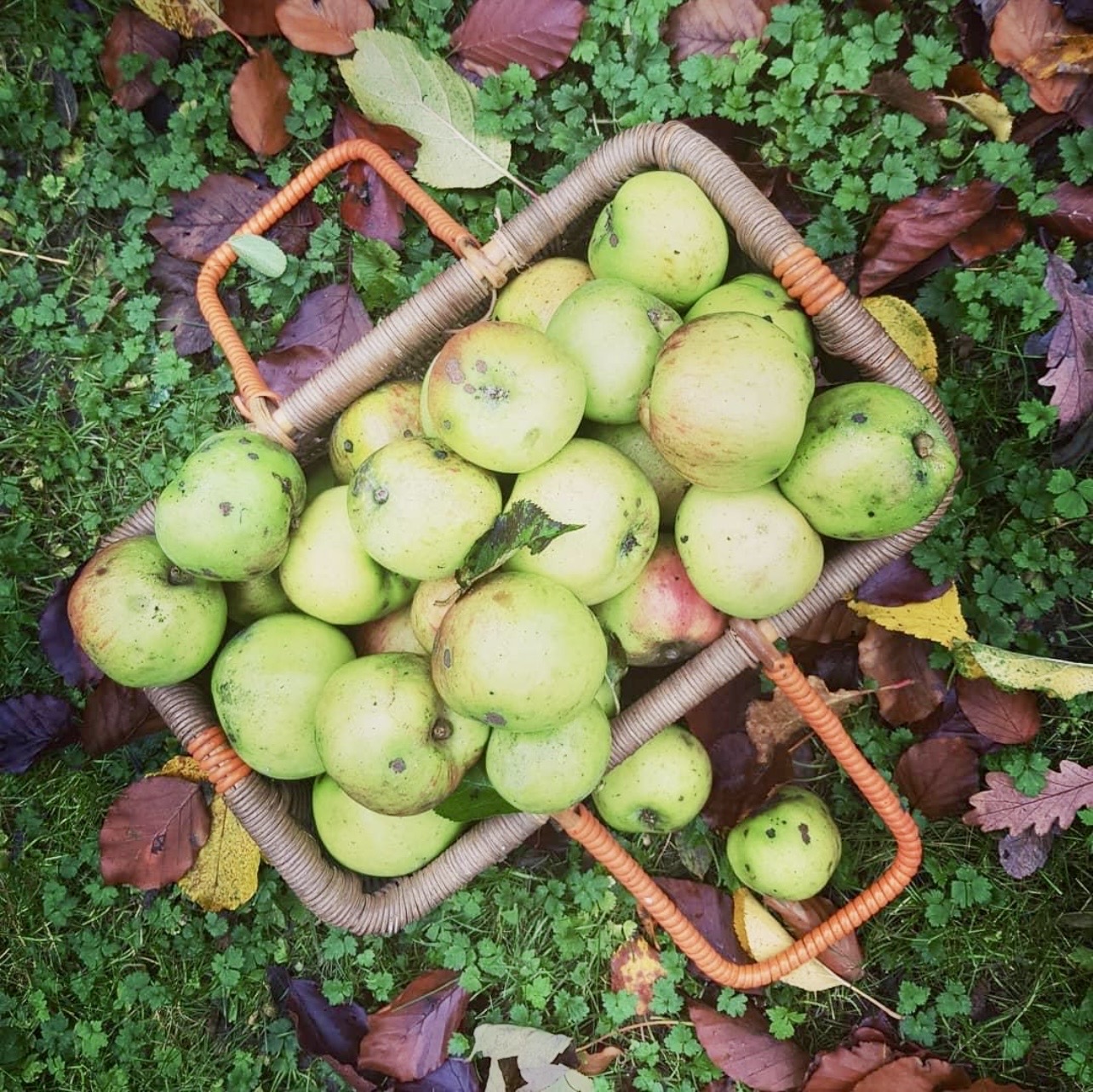
One of these little honesty stalls has, at different times, held eggs, homemade preserves, pickles and plants, and I often meet the woman who makes some of these things gathering fruit from the hedgerows. Neighbours offer surplus fruit from their gardens too, and some of my own apples make their way to her, so that fruit which might otherwise simply fall and disappear into the grass becomes part of another person’s making, perhaps eventually returning to another household transformed into a jar of something that will sit on somebody else’s kitchen table.
Other bags of my apples take a different route. I sometimes leave them at the local shop, where they are put outside in a box for anyone who would like them, with an invitation to make a donation to one of the local charity boxes inside. I like the quiet circularity of this: an apple tree produces more fruit than one household needs, the surplus travels a short distance down the road, someone else carries a few apples home, and a little money moves onwards towards something else within the community. No single part of the exchange is particularly significant, yet together these small movements form threads, connecting garden to shop, hedgerow to kitchen, neighbour to neighbour, one person’s abundance to another person’s need.
Perhaps surplus, in a place where people still know one another, has a way of becoming something other than surplus.
Years ago, one of the local farmers bottled unpasteurised milk from his own herd of cows and delivered it to local houses in his Land Rover, and I find myself thinking now about the beautiful simplicity of that journey: the cows were there, the farmer was someone we knew, the milk came from his herd, and the person bringing it to the door was the same person who had cared for the animals from which it came.
There is no need to pretend that this was necessarily a better world, or that modern systems have not brought enormous advantages, but perhaps something happens when the distance between ourselves and the origins of the things we consume becomes very great. In a supermarket we walk past row upon row of food whose histories are largely invisible to us; we know intellectually that someone planted and harvested the potatoes, that soil and rain and weather were involved, that somebody made the bread and picked the fruit and transported it across the country or perhaps across the world, but knowledge without proximity is easily forgotten. A sack of potatoes beside a handwritten sign at the end of a farm drive still seems to have a field attached to it, just as a jar of jam made by someone you have seen gathering fruit from the hedgerow seems somehow still to contain something of the hedge, the season and the person who gathered it.
Perhaps what I noticed in Amy’s cul-de-sac was something similar. The relationships were still visible.
And yet these little worlds are not created only by geography. Years ago, through my work with people with learning disabilities, I became aware of communities existing within and alongside the larger community, with their own friendships and loyalties, shared histories and ways of knowing one another. Deaf communities can have their own language, culture, humour and reference points, while workplaces, families, friendships and groups brought together through circumstances or shared experience form worlds whose boundaries may be almost imperceptible to those outside them.
We speak so easily of the world, as though there were one human reality spread continuously around us, when lived experience seems to be composed instead of worlds within worlds, overlapping and intersecting, sometimes occupying exactly the same physical space while remaining almost entirely invisible to one another.
All of this brought back the memory of a book I read many years ago, Joseph Chilton Pearce’s The Crack in the Cosmic Egg, and his exploration of the way culture, expectation and habits of mind help shape the reality we experience. We do not simply receive everything that is there; inevitably we notice some things and fail to notice others, interpret what we encounter through what we already know, and construct from the immeasurable abundance around us a world sufficiently stable and familiar for us to inhabit.
And from there it is difficult not to think of Plato’s cave, of people watching shadows upon a wall and taking them for reality because those shadows constitute the only reality they have known, and to wonder whether the enduring power of that ancient image lies partly in its uncomfortable suggestion that the boundaries of our own world are hardest to perceive precisely because we are standing inside them.
Perhaps there is no need to travel very far beyond those boundaries to discover something astonishing. Sometimes it may be enough simply to turn off the road.
I had driven through Amy’s town many times and could quite truthfully have said that I knew it, yet perhaps a hundred yards from the route I knew for a long time there had been a bungalow surrounded by flowers where a woman called Amy lived, and a neighbour who knew immediately which house was hers, and another who would open his door when he saw someone struggling with something heavy, and somebody nearby who could repair a car. That entire little constellation of lives had existed every time I passed, close enough that I might almost have waved to them from the main road, and yet until that morning it had formed no part of my world at all.
Perhaps this is one of the quiet gifts of attention: not simply that it allows us to examine more closely what we already know, but that it occasionally reveals how little of the familiar we have actually seen.
We tend to associate attention with small things — the lichen spreading across an old wall, the call of a bird that yesterday was merely part of the background, the first slight turning of a leaf towards autumn — but perhaps the same quality of attention can be turned towards human life, allowing us to wonder who knows whom here, who grew this, who made it, whose hands have touched it, what histories lie behind this apparently ordinary place, what networks of exchange and care are occurring quietly around us while we hurry towards somewhere else.
Perhaps our lives are composed of these nested worlds: household within street, street within village, village within landscape, while other communities formed through language, work, friendship, disability, interest and experience pass through all of them, each of us belonging to several at once and never quite knowing the full worlds inhabited by those around us. And perhaps the fact that these smaller worlds contain difficulties as well as kindness, watchfulness as well as care, does not diminish them; it simply reminds us that a community is not an idyll but a living arrangement between human beings, carrying all the generosity and complication that this entails.
Most of the time we pass their boundaries without even knowing they are there.
Every now and then, though, something creates a small crack in the shell of the familiar — a conversation, an unexpected kindness, a bag of apples passed from one pair of hands to another, a delivery we hadn’t intended to make, a turning we have passed a hundred times before — and for a moment the world seems larger, not because anything new has appeared within it, but because we have glimpsed something that was there all along.

Support Nature Speaks
Choose an amount
Or enter a custom amount
Nature Speaks has been growing since 2011. Each essay may begin with something small — a leaf, a feather, a bird or a familiar path — but behind it are hours of observation, reading, research, reflection and revision. I keep this writing freely available because I believe that beauty, curiosity and a deeper relationship with the living world should be open to everyone. If something you have read has stayed with you, or changed what you notice, a small contribution helps me continue this independent work. Thank you for reading, whether or not you are able to give.