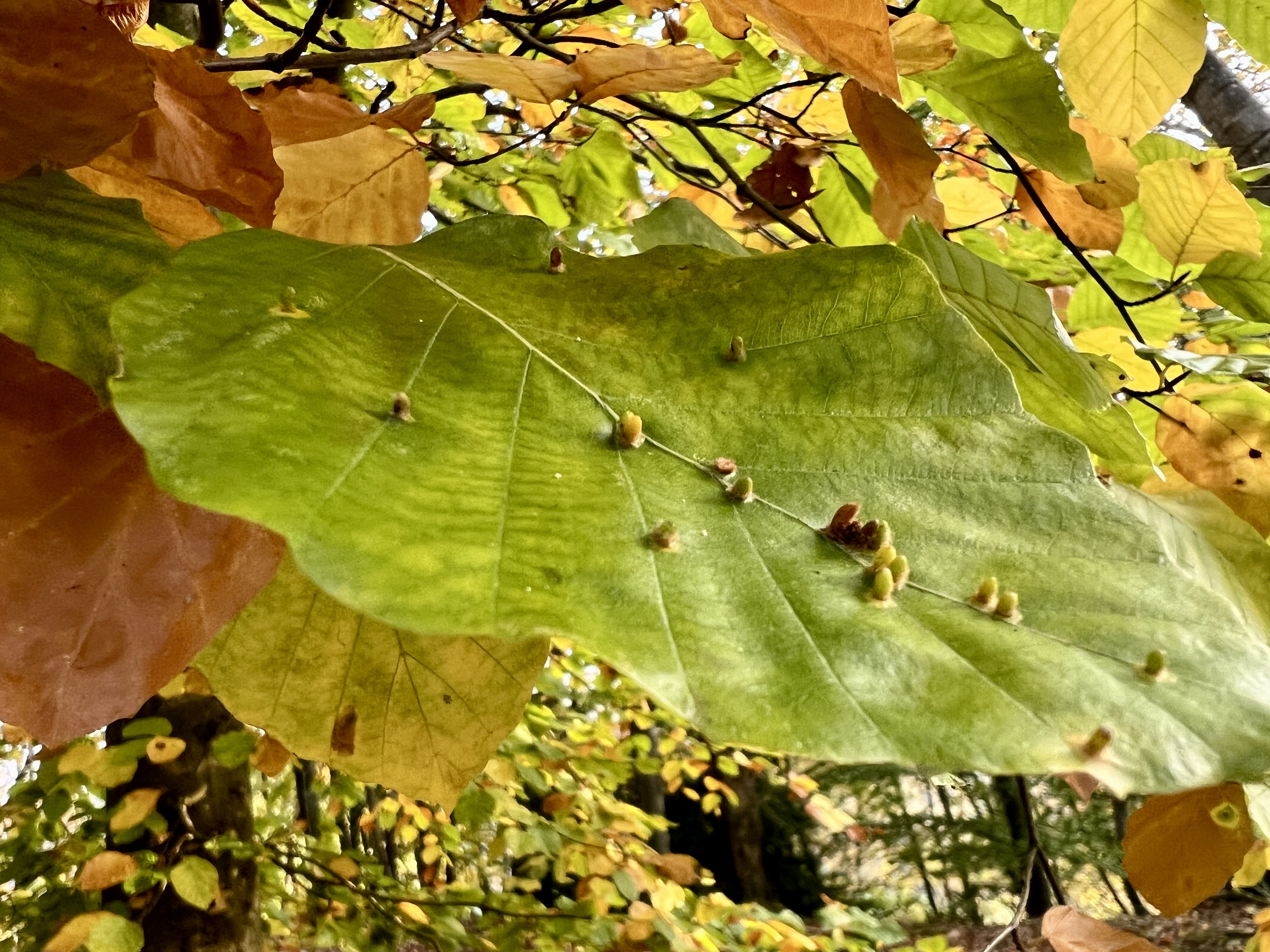
Walking through the grounds of Chirk Castle, I stopped to examine a leaf whose green surface was interrupted by several small swellings along its central vein, and found myself wondering what had caused them, for although they might easily have been dismissed as blemishes, there was something about their arrangement that suggested a story more interesting than the simple deterioration of a leaf.
They appeared to be galls, those curious growths that develop when certain insects, mites or other organisms influence the way a plant’s tissues grow, sometimes creating a small chamber within which another creature may feed or develop. What I find extraordinary is that the gall is not simply something attached to the leaf, like an egg laid upon its surface, but a structure formed from the leaf’s own living tissue, its growth directed in a way that would not otherwise have occurred.
I looked again at the small swellings and tried to imagine the beginnings of that relationship, the moment when one organism began to influence another, leaving a visible change in something I might otherwise have regarded as belonging entirely to the tree. Whatever had caused them was not immediately apparent, and I could not know whether it remained there, yet its influence had become part of the leaf’s form, so that the leaf I held was, in some small measure, the consequence of another life.

We are inclined to think of living things as separate, each possessing its own boundaries and following its own course, although the closer we look, the more difficult those distinctions sometimes become. A leaf may bear the tracks of a feeding larva, the marks of a fungus or the sheltering chambers of a gall-making organism, and what we first understand as the appearance of a single thing begins to reveal the history of relationships through which it has passed.
Perhaps this is why I am increasingly drawn to the small irregularities we so readily overlook, the holes, scars and peculiar growths that interrupt our expectations of how something ought to look, for they remind me that the visible form of a living thing is not always the expression of its life alone, but may also carry traces of others whose presence we would never otherwise have suspected.
I had stopped to look at a leaf, yet what held my attention was the possibility that some part of its shape had been determined by a creature I had never seen, and whose existence I might never have considered had the leaf remained perfectly smooth.
How much of the living world, I wonder, do we mistake for a collection of separate things, simply because we cannot see the relationships that have made them what they are?
.
Support Nature Speaks
Choose an amount
Or enter a custom amount
Nature Speaks will always be free to read. If something here has made you pause, look a little longer, or notice the living world differently, you can help support the time and care that goes into the writing.