What happens when we stop looking for something and simply look?
There are moments when we realise that we have been looking at the world without quite seeing it, walking the same path every morning, passing the same tree, hearing the same river moving somewhere below the road, noticing without noticing the small changes accumulating at the edges of the season, until one morning something interrupts the familiarity. Perhaps rain has fallen during the night and every leaf is holding the light differently, perhaps a bird lands unusually close and remains there, regarding us with an attention that feels strangely mutual, or perhaps we bend to pick up something almost insignificant—a feather, a snail shell, a fragment of bark—and, for reasons we cannot explain, we do not immediately put it down, but remain with it for a little longer than usefulness requires. At first we may do what we have been taught to do: we identify, name, search our memory, perhaps reach for a field guide or our phone. What tree is this, which bird dropped this feather, why does the snail’s shell grow in that particular curve? There is pleasure in knowing these things, and knowledge can deepen an encounter enormously; to learn that a tree has stood beside a road for two centuries, that a bird has flown hundreds of miles to arrive in the hedge outside our window, or that the spiral of a snail’s shell belongs to a family of mathematical forms that appears, through entirely different processes and at almost unimaginable differences of scale, in the sweeping arms of some galaxies, can make the familiar suddenly astonishing. There is nothing wrong with this kind of attention; we need it, because it allows us to distinguish one thing from another, to understand, compare, remember, make and act. Yet sometimes, if we remain with the thing a little longer, another kind of attention begins to emerge, and the question changes almost imperceptibly from What is it? to What is here?
I have become increasingly interested in the possibility that wonder begins somewhere around this threshold, not because knowledge has failed us, but because for a moment we stop requiring knowledge to be the end of the encounter. We allow the thing before us to remain partly unknown and, instead of experiencing that unknownness as a problem to be solved, become curious about it. The psychiatrist and philosopher Iain McGilchrist has spent much of his work examining something that seems particularly relevant here: the way in which attention changes the world we experience. His account of the divided brain is very different from the familiar popular idea that one side of the brain is logical while the other is creative; both hemispheres are involved in almost everything we do, but what differs, he argues, is something more subtle and perhaps more profound—the manner in which they attend. One mode of attention is narrow, precise and directed towards something already identified as important, allowing us to select an object from the complexity around it, isolate it, examine it and, where necessary, use it, while another is broader, more sustained, more receptive to context and relationship, and less certain in advance about what it is going to find. We need both. A bird searching the ground for a seed needs exquisite precision, yet it must simultaneously remain alive to the movement of the world around it—the shadow overhead, the approaching animal, the call of another bird—and human beings, too, need to focus and remain open, to grasp and receive. The difficulty may arise when one way of attending becomes so habitual that we forget there is another.
Our lives encourage us to grasp, to look at a clock and see how much time remains, at a field and see acreage, at woodland and see timber, at a river and see water quality, flood risk, fishing, recreation or energy; even our own attention has become something we speak about as though it were a commodity, something captured, lost, stolen, spent and monetised, while an enormous industry works continuously to seize it before something else does. Perhaps inevitably, we begin to approach the natural world in much the same way. We walk with an app that identifies the birds, photograph the sunset before we have really looked at it, count our steps through the wood, record the distance, check the route, name the flower, add the bird to a list, read the information board beside the ruins and move on. None of these things is wrong, and many enrich our understanding enormously, yet occasionally I wonder what would happen if, after all the naming and recording and knowing, we stayed for another five minutes, not in order to achieve anything but simply to discover what might happen when there is nothing left that we are trying to extract from the encounter.
This is where the work of philosopher Patrick Curry has become increasingly interesting to me, because Curry writes about wonder and enchantment in a way that resists our instinct to turn even these experiences into techniques. Wonder cannot simply be produced by an act of will; we cannot schedule an encounter with awe for half past three, perform the correct sequence of exercises and expect enchantment to arrive obediently at four, because the moment we make wonder serve a predetermined purpose, something essential about it begins to disappear. At a time when nature is increasingly prescribed to us as something useful, this matters. We are encouraged to walk in the woods because it may lower our stress, to listen to birdsong because it may improve our mood, to look at trees because it may soothe the nervous system, and there is much to welcome in the rediscovery of how profoundly human wellbeing depends upon contact with the living world; yet I wonder whether there is also a quiet danger in this, because the tree can so easily become another intervention, the river another treatment, birdsong another therapeutic tool employed in the continuing project of improving ourselves. Nature becomes useful to us once again, only now, instead of harvesting timber, food or fuel, we harvest wellbeing.
Perhaps the tree does not have to do anything for us, the river does not have to calm us, the raven does not have to become a symbol or the feather a lesson; perhaps the snail shell does not need to become an illustration of mathematics, nor the walk a route towards better mental health, because sometimes the encounter itself, without improvement or outcome, is enough. There is something both simple and strangely difficult about this, because the modern mind is accustomed to asking what things are for. Even leisure acquires objectives: we meditate to become calmer, walk to become fitter, read to become better informed, travel to acquire experiences, practise creativity to become more creative, until we become extraordinarily adept at turning almost anything into a project. Wonder is less cooperative. It tends to arrive sideways, often when we have stopped demanding anything of the moment: a shaft of late sunlight moves through trees we have passed a hundred times, a spider’s web becomes visible because mist has settled upon it, a raven tilts its head and for a second the comfortable distinction between the creature observing and the creature being observed becomes less certain, water gathers in the hollow of a stone, or a dead leaf turns over in the wind and reveals a network of veins so intricate that we find ourselves crouching on a wet path staring at something we would normally have stepped over. Nothing useful has happened, and yet the world has somehow recovered depth.
Perhaps this is what links Curry’s thinking about wonder with McGilchrist’s thinking about attention. McGilchrist suggests that different ways of attending disclose different aspects of reality, while Curry reminds us that wonder requires an openness to what cannot be entirely controlled or predetermined; put the two thoughts beside one another and a possibility emerges that I find difficult to dismiss: perhaps wonder is not merely an emotional reaction to an extraordinary thing, but something that becomes possible through a particular relationship with the ordinary. This might help explain why children can sometimes find extraordinary interest in objects adults barely register, when a stone is not yet merely a stone, a hole in a tree not simply a cavity, a feather not finished with once its species has been identified, because the world has not yet been completely sorted into categories of useful, irrelevant, familiar and understood. Adults cannot, and perhaps should not, attempt to return to some imagined state of childhood innocence; we know too much, and that knowledge is precious. The richer possibility may be to allow knowledge and mystery to coexist, to know the name of the bird and still be astonished by the bird, to understand something of the geology of a mountain and still experience its presence, to understand how the curve of a snail’s shell arises as the animal grows and still be stopped by the strange beauty of a form that seems to echo patterns we encounter at vastly different scales, or to know why a pine cone opens and closes according to humidity and still hold it in our hands and wonder at the patient intricacy of its structure.
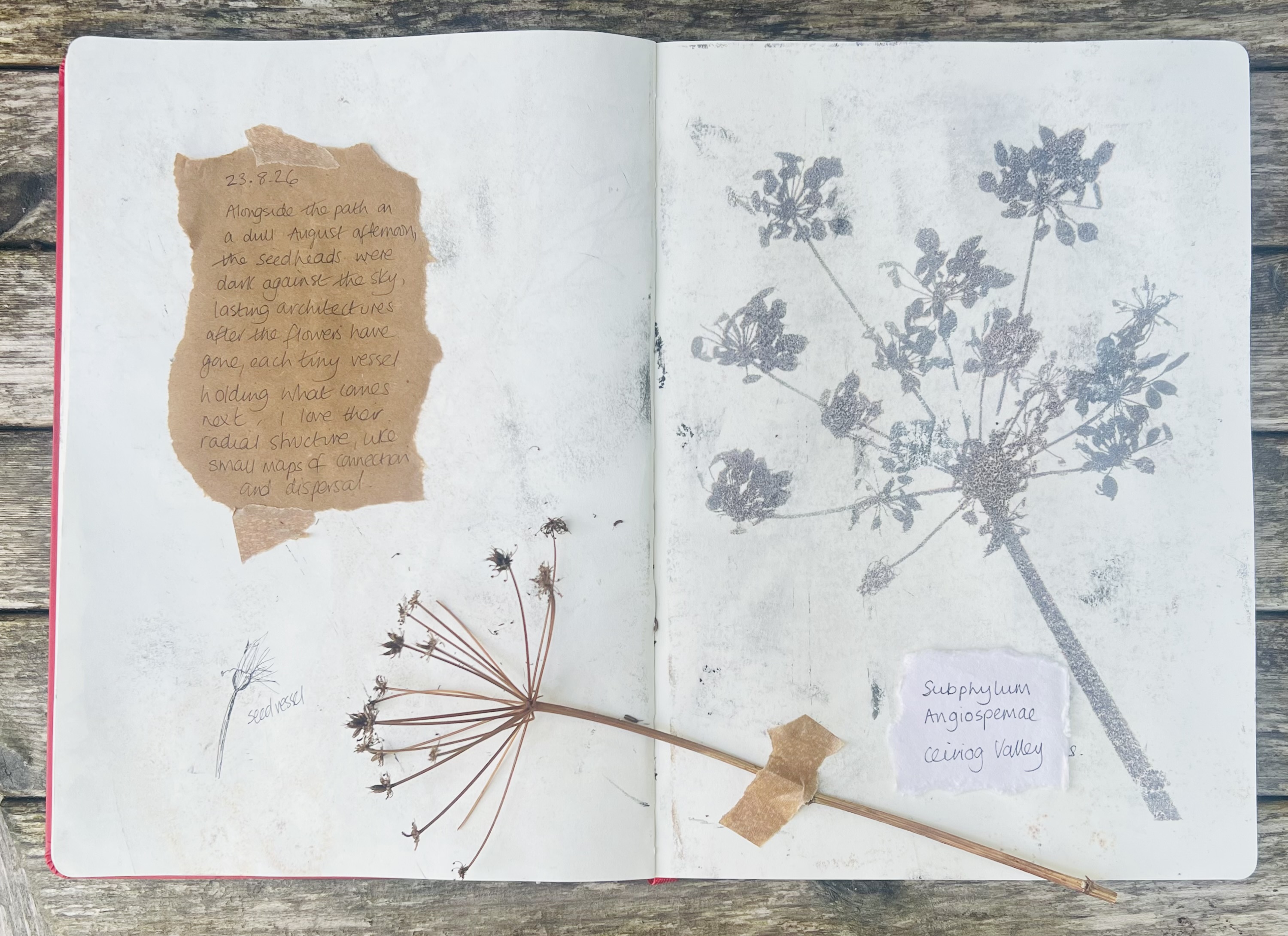
This is close to what I have come to think of as attentive wondering, which begins not with nature in the abstract but with something particular: this leaf, this stone, this bird, this patch of lichen spreading across the wall. We give it attention, initially perhaps the focused attention that notices colour, texture, weight, shape, movement and detail, and then allow that attention to loosen slightly so that, instead of rushing towards explanation, questions are permitted to remain open. What does this remind me of? What have I never noticed about it before? What might have happened here? What changes if I look from another angle? What is this connected to? What would I miss if I only knew its name? Somewhere in that movement, observation begins to become relationship, and perhaps this also explains why making something afterwards—drawing, writing, painting, printing, photographing, or simply putting a few sentences into a notebook—can feel so different from merely recording what we saw, because the making requires us to return to the encounter and, in returning, to discover what our first glance omitted. The curve of the feather is not quite what memory suggested, the edge of the leaf is irregular, the supposedly grey stone contains violet, rust, green and blue, the raven’s black feathers are not really black when the light moves across them, and gradually we discover that attention has layers.
Something more important may begin here, because the ecological implications of attention are difficult to ignore. It is much easier to destroy an abstraction than something with which we have entered into relationship. Woodland can become hectares on a planning document; a particular wood in which we know where the bluebells appear, where water collects after rain, where the old beech has split and continued growing, where ravens call from somewhere beyond the ridge, is harder to reduce to numbers. Attention gives particularity back to the world, and particularity makes indifference more difficult. Perhaps this is one reason wonder matters, not because wonder makes us virtuous, and certainly not because we should now turn wonder into another instrument for saving the planet—that would return us immediately to the very problem Curry identifies—but because sustained attention can alter the relationship from which our actions arise. The living world ceases, however briefly, to be scenery around the human story and becomes once again a multitude of lives and presences among which our own life is taking place.
There is another temptation here that seems worth resisting: the desire to explain exactly what is happening inside the brain during such moments, to measure electrical rhythms and speak of alpha or theta states, to locate wonder in a hemisphere or network and feel that, once mapped, the experience has been understood. Research into attention and contemplative states is fascinating, and the finding that different qualities of awareness can be accompanied by measurable changes in brain activity opens intriguing questions, but perhaps we should be wary of confusing a description of what the brain is doing with the entirety of what the person is experiencing. Knowing how light enters the eye does not exhaust what it means to see a sunset, just as knowing the neural activity accompanying wonder would not exhaust wonder; there are different kinds of knowing, and perhaps wisdom lies partly in allowing them to speak to one another without insisting that one must swallow all the others.
McGilchrist’s work repeatedly returns us to something close to this: the danger of mistaking our representations of reality for reality itself. Maps are extraordinarily useful, but we cannot walk through a map and hear the curlew calling; the word river contains no cold water, and a botanical name cannot reproduce the smell released when a leaf is crushed between finger and thumb. The map matters, but eventually we must return to the world, and perhaps that return is what attentive wondering is really about—not escaping thought, rejecting science, romanticising nature or attempting to remain permanently in some idealised state of open awareness, but recovering our ability to move between ways of attending, to focus and then widen, to know and then wonder, to examine and then encounter, to grasp when grasping is necessary and to recognise the moments when it is not.
There is something quietly hopeful in the fact that none of this requires us to travel anywhere extraordinary, because the object is already there: the tree outside the window, moss between paving stones, a feather caught beneath the hedge, the changing surface of a familiar river, the first leaf beginning to turn at the end of summer. We do not necessarily need a more spectacular world; we may need a different quality of attention, and perhaps the next time something small stops us—a bird, a stone, a sudden pattern of light—we might resist the urge to immediately photograph it, identify it, explain it or turn it into something useful, remaining beside it instead for a while without knowing quite what we are waiting for. Nothing may happen, and that uncertainty is part of the bargain, because wonder cannot be summoned; what we can do is make ourselves available to it, and occasionally, when our attention becomes quiet enough to stop telling the world what it already knows, the familiar thing before us seems to become inexhaustible again, not because it has changed, but because for a moment we have allowed it to be more than the name we gave it.