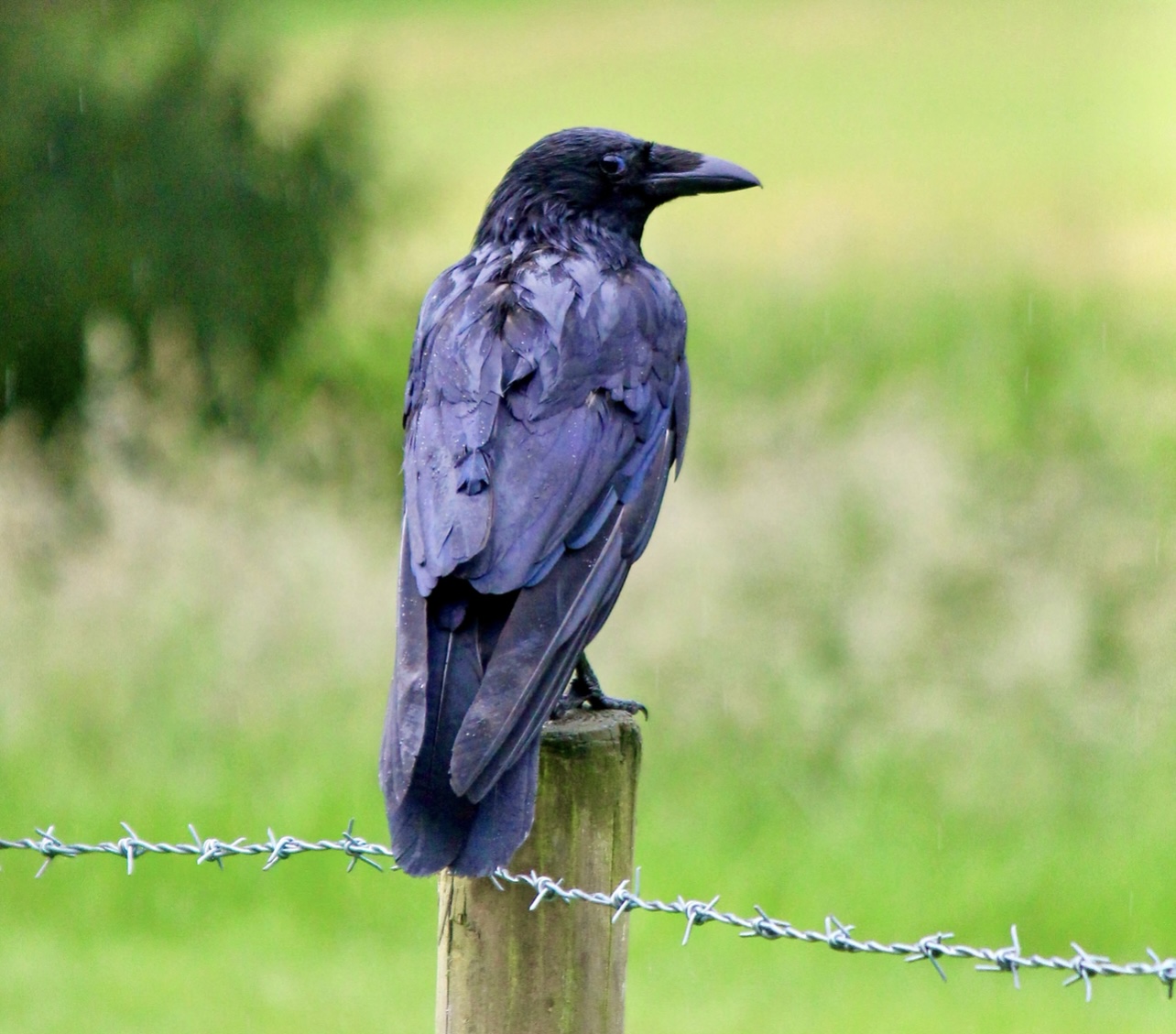
Each morning, they arrive: a pair of ravens and, this summer, their young. They come without hurry, settling first on the fence, then the summerhouse roof, then midway up the copper beech, waiting until their presence has quietly folded itself into the shape of the day, becoming as ordinary as the kettle beginning to boil or the changing light on the wall.
It would be easy to call them intelligent and leave it there, but intelligence feels too small a word for what is happening on that fence. There is something in the way they attend to the world that suggests a different kind of knowing altogether. Watch a young raven meet something it has never encountered before and it will often turn its head slightly, offering the left eye first, the eye connected to the right hemisphere of the brain and to a broader, more relational way of seeing. It is not identifying the thing before it so much as entering into a kind of conversation with it, approaching before naming, meeting before deciding.
There is something quietly reassuring in that small act.
So much of modern life trains us towards a different habit. We move quickly from observation to conclusion, from encounter to explanation. The object is named, filed and understood, and then our attention moves on. Efficient and useful though this may be, somewhere in all our naming we have perhaps lost the willingness simply to remain with a thing for a little longer than certainty requires.
This is close to what Iain McGilchrist has spent many years describing. The two hemispheres of the brain, he suggests, do not merely process different kinds of information but inhabit different relationships with the world itself. One tends towards certainty, precision and utility; the other remains open to context, relationship, metaphor and the living whole. Both are necessary, and neither can flourish without the other, but lately, McGilchrist argues, the narrower way of seeing has begun to crowd out the wider one, until the map starts to feel more real than the land from which it was drawn.
Perhaps this explains a curious hunger many of us carry without quite knowing its name, a sense of gathering more information while somehow feeling less at home in the world.
Carl Jung spoke of something similar, a quiet exile from the symbolic life, from dream and imagination and from the sense that the natural world might be something other than scenery. To Jung, the outer world was never simply outer; it answered something within us, and the things we encountered in nature often became mirrors in which another part of ourselves could be seen.
William Blake, in his own way, warned against the same forgetting. He called the habits that narrow our seeing “mind-forg’d manacles”, those subtle ways of reducing a living thing into a fact, a measurement or a category. Imagination, for Blake, was not escape from reality but a fuller participation in it.
And John Ruskin asked for something simpler still. He called it the innocence of the eye: the ability to see before naming, to receive colour before category and shape before concept, to allow the world to arrive first as experience and only afterwards as explanation.
I think the ravens still possess something of this innocence.
Their young hop across the lawn and along the roof on uncertain legs, curious about everything they meet, approaching, startling, retreating and returning again, not merely looking for food but living inside a kind of endless apprenticeship to the world around them. They seem content to inhabit uncertainty, to remain in relationship with things that have not yet been understood.
Perhaps attentive wondering is nothing more than a quiet return to this way of being. Not a rejection of thought, but a rebalancing of it. To sit beside a river and follow the light as it moves. To hold an acorn in the palm and consider, briefly, the forest folded inside it. To notice a feather, a shell or a stone and let the first question be something gentler than What is it? Perhaps instead we ask: What is it like to be with this? What does it stir? What becomes visible if I remain a little longer?
The narrow, focused mind still has its place. Lists remain useful, bridges still need building and appointments still need to be kept. But the wider attention, the one willing simply to meet a thing before possessing it, perhaps needs once again to lead.
As I write, one of the young ravens has returned to the copper beech and is sitting quite still, its head turning slightly as though listening to something I cannot hear. The morning is otherwise ordinary: a mug cooling beside me, the river moving below the garden, a light breeze in the leaves.
And yet the raven seems to know something we often forget.
That the world was never merely a collection of objects to be sorted and understood, but a living company waiting patiently to be met.
Each morning the ravens return and quietly make the same offer. They do not seem to seek mastery over anything, only to remain in conversation with it. Perhaps this is their wisdom, and perhaps our own restlessness comes from forgetting how to do the same.
Perhaps the young ravens, meeting each morning as though it were entirely new, have never lost the innocence of the eye.
Further Reading
Support Nature Speaks
Choose an amount
Or enter a custom amount
Nature Speaks has been growing since 2011. Each essay may begin with something small — a leaf, a feather, a bird or a familiar path — but behind it are hours of observation, reading, research, reflection and revision. I keep this writing freely available because I believe that beauty, curiosity and a deeper relationship with the living world should be open to everyone. If something you have read has stayed with you, or changed what you notice, a small contribution helps me continue this independent work. Thank you for reading, whether or not you are able to give.