On why the wood warbler doesn’t ruminate, and what it might teach us
There is a moment, in any woodland worth its silence, when you stop walking and simply stand.
Not because you have decided to stand. Because something has caught your attention. A flicker at the edge of sight. A change in the quality of air. Some small, specific thing that the rational mind hasn’t yet named but the body has already responded to, turning you into a still point in a moving world.
This is the beginning of attention. Not the searching kind – binoculars raised, guidebook ready – but the other kind. The kind that arrives before thought.
I have been thinking about mental prisons, and finding the idea unexpectedly full of the natural world. Not in the way self-help language often is, with its borrowed metaphors of rivers and mountains. More precisely than that. How suffering tends to become a dark sun around which everything else turns – a gravitational centre that pulls awareness inward, shrinking the space around it until there is room for nothing else.
I recognised that concept immediately. Not as an abstract idea, but as a feeling I know well. The mind folded in on itself on a difficult morning, when even the light through the window feels like an intrusion rather than an invitation. When you are looking without seeing – eyes turned outward, gaze turned in.
What strikes me most, though, is that the prison is self-constructed. Built from rumination – the same thought walked in circles, worn into a groove, growing more solid with each pass. We ruminate on our ills and turn them into monsters. The monsters were small to begin with. We made them large by attending to them so persistently, so exclusively.
Go outside on any morning and this becomes obvious, in the most consoling way.
The wren that moves through the hedge doesn’t ruminate. This isn’t a sentimental observation – it’s almost an anatomical one. The wren operates in a perpetual present tense. Each moment arrives and is fully inhabited: this twig, this insect, this shaft of cold light. There is no groove worn by yesterday’s failures or tomorrow’s uncertainties. No mental prison. Just: Twig. Insect. Light.
I am not suggesting we should all aspire to be wrens. We are not wrens. But there is something worth looking at in the way a non-human creature moves through the world, carrying nothing forward, setting nothing aside. The heron standing at the water’s edge isn’t indifferent to its surroundings – it is wholly present to them, in a way that makes most human attention look impoverished by comparison.
The animal world doesn’t get stuck. It attends, acts, releases, attends again.
The question I keep returning to is this: how can we free ourselves from self-generated torment? The answer, it seems to me, is precise, and somewhat paradoxical.
It is not by expelling the difficult thoughts. Not by force of will. But by expanding the container.
You cannot drive rumination out by fighting it. You give it more substance by fighting it, more solidity. Instead, you widen the scope of awareness – you let in sound, breath, the body, the texture of the present moment – until the dark thought is still there, but is diluted in something larger than itself. Held in a bigger field. Its relative weight reduced.
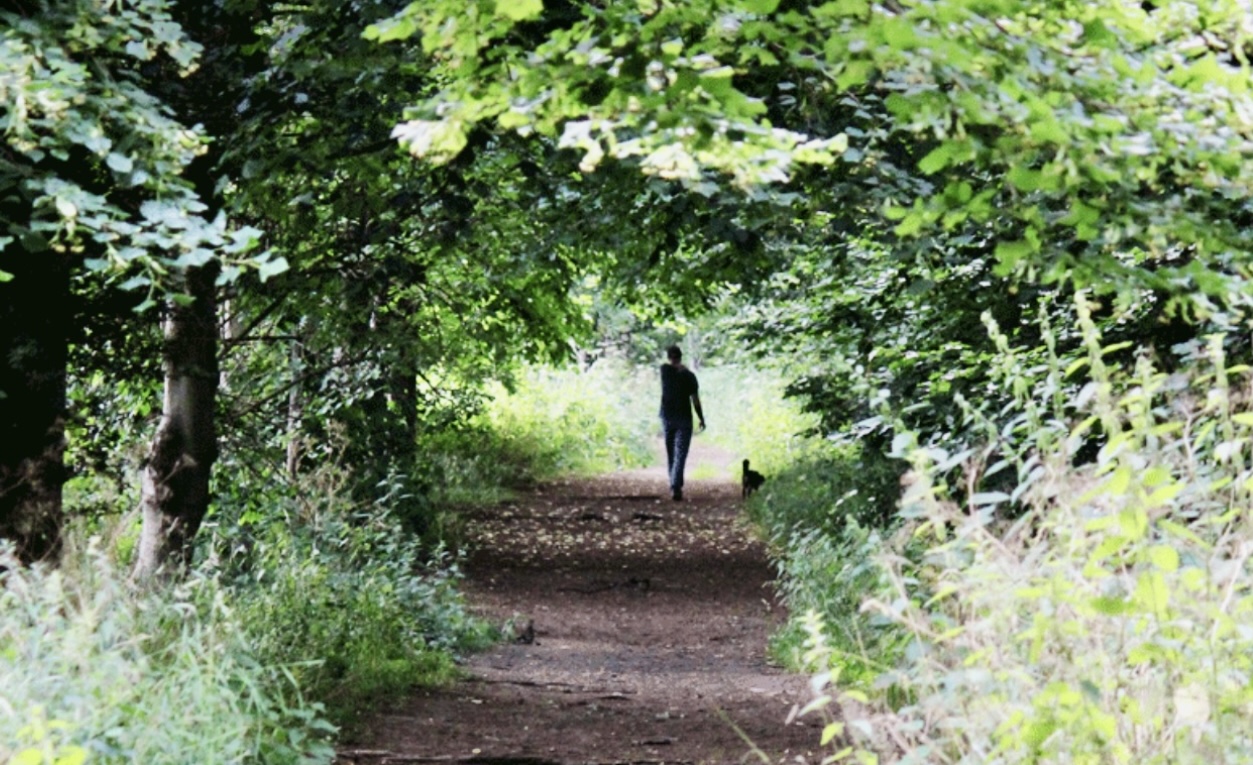
This, it seems to me, is exactly what walking in nature does, when it works.
Not distraction. Not escape. Expansion.
There is a particular quality of attention I notice in myself on the days when the woodland does its work on me. It isn’t focused, exactly – it is wide. Alert without being tense. The mind doesn’t land on one thing and grip it; instead it rests, lightly, on everything at once: the colour of the moss underfoot, the sound of water somewhere to the left, the specific smell of leaf litter after rain – the kind you could only ever smell in October, never in March, though you couldn’t say precisely why.
This is attention as the opposite of rumination. It moves. It flows. It doesn’t circle.
I think of it as the natural world’s constant invitation – the jay landing unexpectedly, the first bluebell a full week before you expected it, the way light falls differently today than it did yesterday on the same slope of hillside. Nature keeps interrupting. And every interruption is a small release from the prison of the self.
I think this is why nature writing – real nature writing, the kind grounded in actual looking – does something to the reader that other writing doesn’t quite do. Not because it’s peaceful, or pretty, or reassuring. But because sustained attention to the external world is structurally incompatible with sustained rumination. You cannot fully watch a hunting kestrel and simultaneously rehearse an old grievance. You have to choose. The kestrel always wins, if you let it.
The residue of attention is what I call what stays after you’ve come back inside, pulled off muddy boots, made a cup of tea. Something has shifted. The dark sun has moved from the centre. Other things – the cold on your face, the particular silence of a winter field, the unexpected cheerfulness of a robin in November – have been let in. The container is bigger than it was.
What the practice of impermanence offers is not detachment, not the pretence that nothing matters, but fluidity. The recognition that nothing – not pleasure, not pain, not the thing you’re clinging to, not the thought that has imprisoned you – lasts. To be in a wood through a whole season is to watch impermanence made visible. The bluebells don’t last. Neither does the mud. Neither does the low, hard light of February that makes everything look both bleak and strangely beautiful. Everything passes through.
The wood warbler doesn’t know this philosophically. It simply lives it.
We know it philosophically, but must practise it. Must choose, again and again, to step outside and let the world interrupt us. To stop walking and stand still. To let the flicker at the edge of sight catch us.
To look at things, rather than through them, back at ourselves.
There is a small flask on a windowsill in a painting I keep returning to – a trompe-l’oeil, the kind that folds the world inside itself. The man beside the window appears to have his head stuck in the frame, looking without seeing, imprisoned by the solidity of stone and glass and wood. But on the ledge beside him, half in shadow: a tiny bottle. A magic potion, perhaps. Or simply what’s always been available – the world, on the other side of the glass, if we can only lift our eyes to it.
