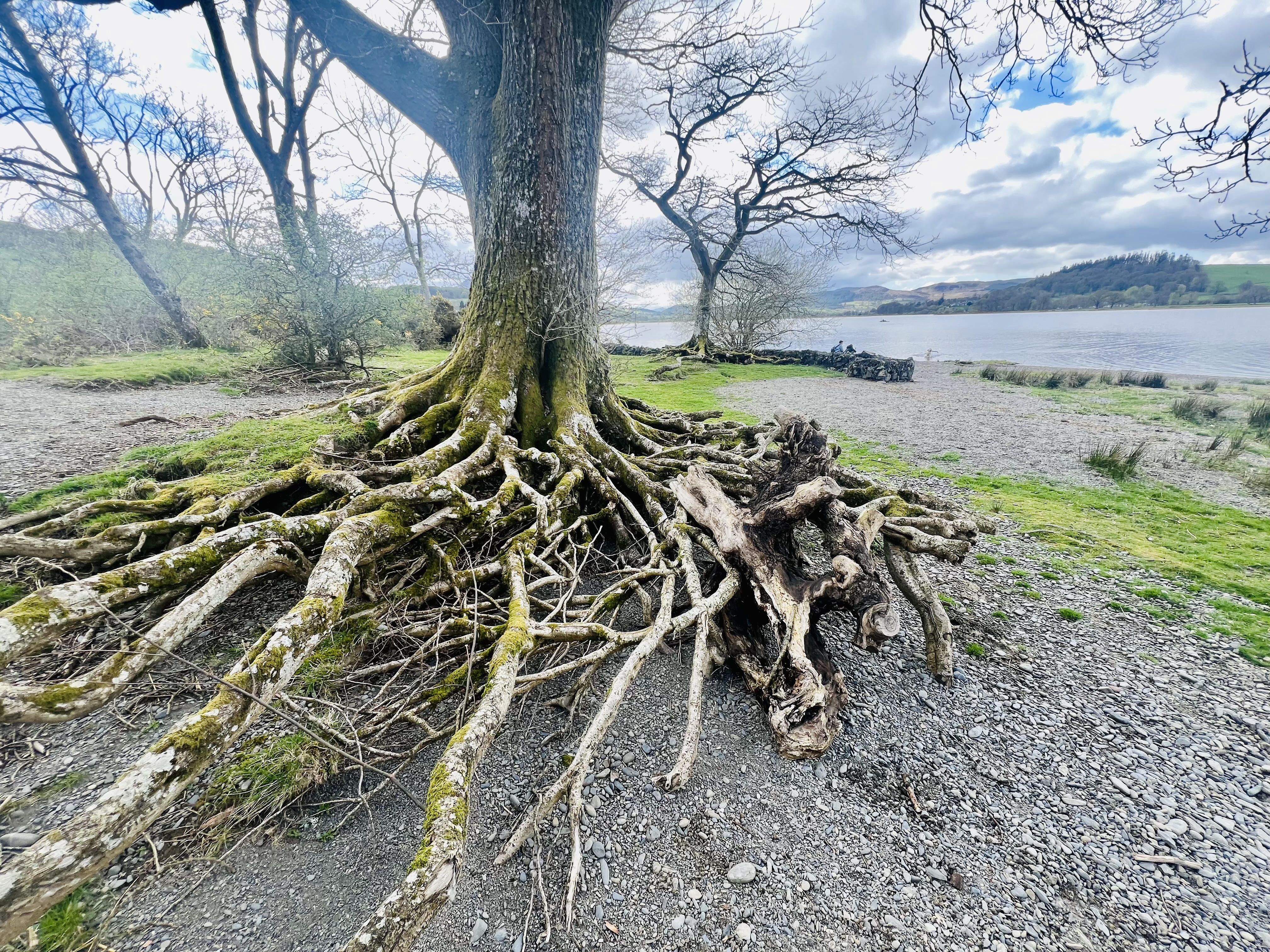
When Llyn Tegid drops low enough, the roots appear. What seemed, from any distance, to be a trunk simply standing is revealed as something that has been working all along: gripping, curving, finding the particular shape of this particular ground beside this particular water. The roots are not usually submerged. Only in winters of heavy rain does the lake rise far enough to claim them.
You are walking and it stops you, without your realising it has.
The body notices before the mind does. Something in the pace changes. You find yourself staying longer than intended beside what is, after all, only a tree.
Perhaps what is being recognised is not the tree at all.
Llyn Tegid is Wales’ largest natural lake, fed by the Dee, which passes through it and, according to those who have long known this place, never quite mixes with the older water already there. Beneath it, legend says, lies a drowned court, a kingdom lost in a single night because of what its ruler refused to become. The lake has been covering things for a very long time. It knows, in whatever way a body of water knows anything, how to hold what is hidden and when to let it show.
The trees at its edge have stood through many such risings and recedings. Their roots, exposed on the gravel shore, record the whole of it. Not as statement. As fact.
We tend to give our attention to what is finished. To the outcome, the composure, the life as it presents itself on a clear day. There is less interest, culturally, in the work that happened underneath: the long accumulations, the private corrections, the things practised for years before anyone could see them being practised.
A tree beside Llyn Tegid does not operate by this logic. It cannot. To survive at a waterline that moves, it must be genuinely anchored, not apparently so. Every root is a response to flood and drought alike, to gravel and silt, to the particular looseness of this shore in this season. What the photographs show, that wide lattice spread across the grey stones, is not exposure. It is the conversation the tree has been having with the ground for decades, briefly made visible.
There is something in this that steadies.
We imagine, often, that the significant changes in a life ought to be legible. That growth should feel like growth. That recovery should arrive with some clarity. But what the root system suggests is something quieter: that the most consequential developments often occur below the surface of our noticing, across a duration that resists being charted, in conditions we would not have chosen.
By the time something can be seen, it has usually been forming for a long while.
This is true also of what breaks down. When circumstances flood, when the familiar ground is gone and the water higher than expected, what becomes apparent is not what we believed we had, but what is actually there. Not invincible roots. Not perfect ones. Only real ones. Habits that return when called upon. Relationships that hold a name steady beneath the noise. The small and practised ways of coming back.
Llyn Tegid will rise again. The shore will change. What is visible now will be covered, and what was covered will, in time, be shown.
It helps, sometimes, to remain with one thing a little longer than feels necessary. One tree. One stretch of shoreline. One patch of root with its particular arrangement of moss and decades.
Not in order to extract meaning from it. Simply to let the looking continue until something in the looking shifts.
The roots were always there. The water dropping only made them visible.
That, perhaps, is enough to come back for.
