The ravens arrived in the way that things which matter often do – without warning, and then suddenly everywhere.
There are two of them. They come when they want to, which is often, and they make their wanting known from a distance. The call carries. It crosses the garden and the river and finds its way through walls, and by the time you have registered it consciously, some older part of you has already begun moving vtoward the door.
Raven intelligence is like that too. It doesn’t announce itself. It simply acts, and you catch up later.
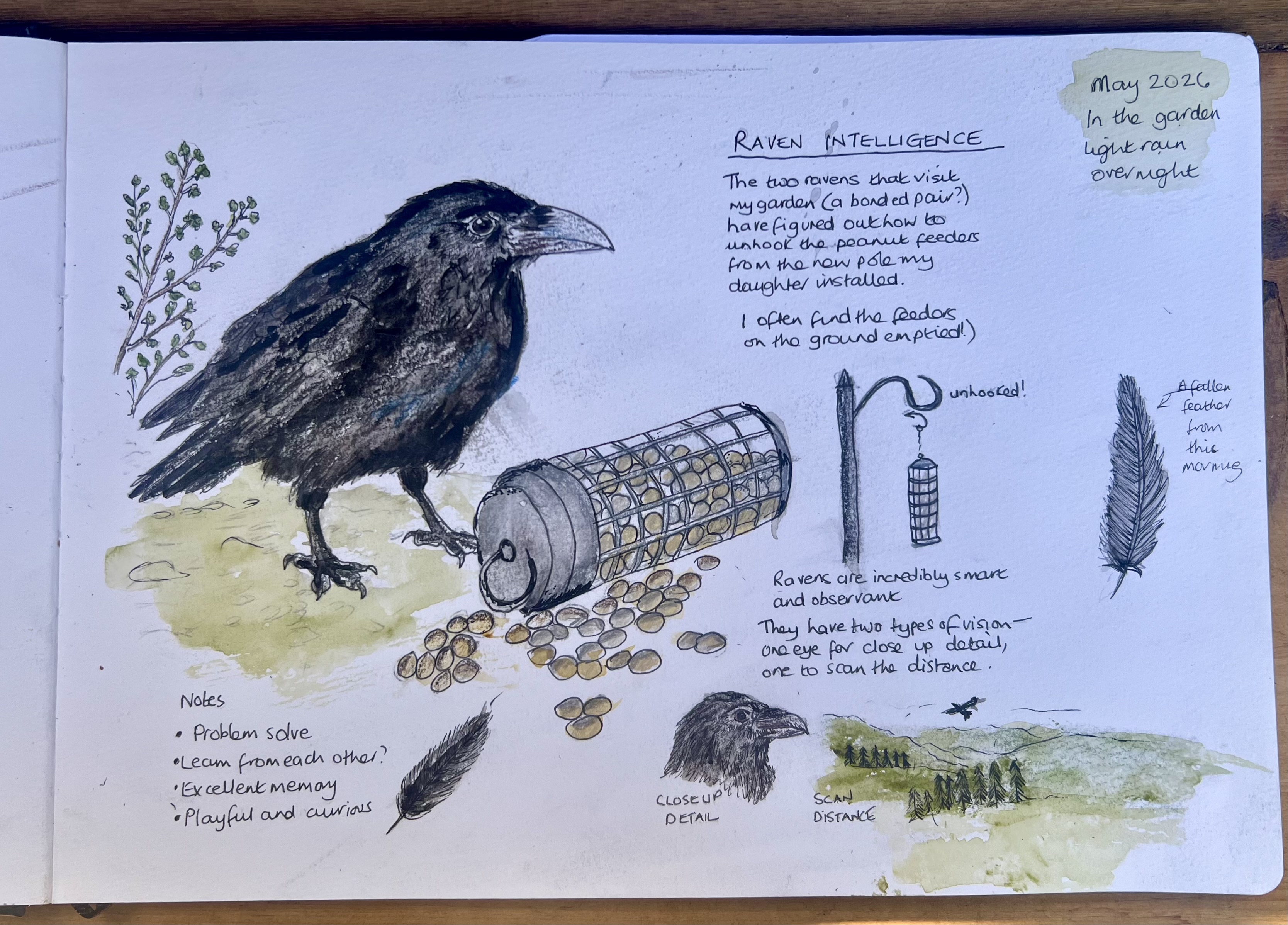
A raven, at close range, is not the bird of gothic imagination. There is something alert and almost architectural about the head, the way it angles and re-angles, working the world into information. The beak is heavy, made for taking things apart. The eye is not dark so much as very present, the kind of gaze that is doing something rather than simply looking.
It was the eye that made me think of Iain McGilchrist.
In his work on attention and the two hemispheres of the brain, McGilchrist draws on a remarkable observation from the study of birds: that a bird uses its two eyes for fundamentally different kinds of seeing. The right eye – connected to the left hemisphere – is for the close and the particular. The grain. The seed distinguished from the grit beside it. The left eye – connected to the right – is for the wider field, the periphery, the hawk that has not yet announced itself. Both are necessary. Neither sees the whole. And crucially, neither can be switched off in favour of the other: the bird is always doing both at once, holding the specific and the expansive in simultaneous attention.
McGilchrist’s larger argument is that something of this division runs through human experience too – that we have a mode of attending that reaches for the particular and instrumental, and another that holds the broader context in which any particular thing is embedded. The trouble, he suggests, is that we have become far better at the first than the second. The grain-finding eye has been rewarded and cultivated. The horizon-eye has been, if not lost, then gradually unemployed.
The raven does not have this problem.
I know this because last week he worked out that the peanut feeder could be unhooked from the arm of the bird feeder stand. Not lifted, not tilted – unhooked. He must have turned the problem in his mind for some time before attempting it, or perhaps he simply tried everything that presented itself as a possibility and arrived at the answer without what we would call deliberation. Either way, he had it off the pole and was carrying it across the grass before I reached the window. Raven intelligence, in practice, looks exactly like this.
He could not quite manage the full weight of it. He dropped it then stood over it. He considered what to do next.
The feeders are now tied on.
There is something in this that strikes me as pure attention – not the narrow kind that fixes on a single variable and optimises, but something that holds the whole situation at once: the hook, the angle, the weight, the watcher at the window. The raven is not solving a puzzle. He is reading the world.
We lose this, I think, more than we notice. The environments most of us move through now are designed to be finished, interpreted, completed. A screen presents its information in a frame. A room is a bounded thing. There is less and less that asks the peripheral eye to do its work, less and less that rewards a slow turning of attention around a problem that has no edges.
Outside is different. A hedge is not finished. A field does not resolve. The rook that just dropped into the far corner of the grass – you caught it because something in you was still watching the whole field, not only the thing you were supposed to be looking at.
Nature journalling, if it is anything useful, is practice in that second kind of seeing. Not the extraction of facts – not the correct identification, the accurate sketch – but the longer staying, the willingness to let the attention move in something other than a straight line. You are not trying to solve the leaf. You are trying to hold it long enough that it begins to exceed your first impression.
The raven is very good at this. He exceeds every first impression.
This morning they came earlier than usual. I heard them before the light had fully settled, two voices calling back and forth across the garden, and when I looked out they were in the old copper beech tree, each facing a different direction.
One watching the garden. One watching the sky.
Between them, seeing everything.