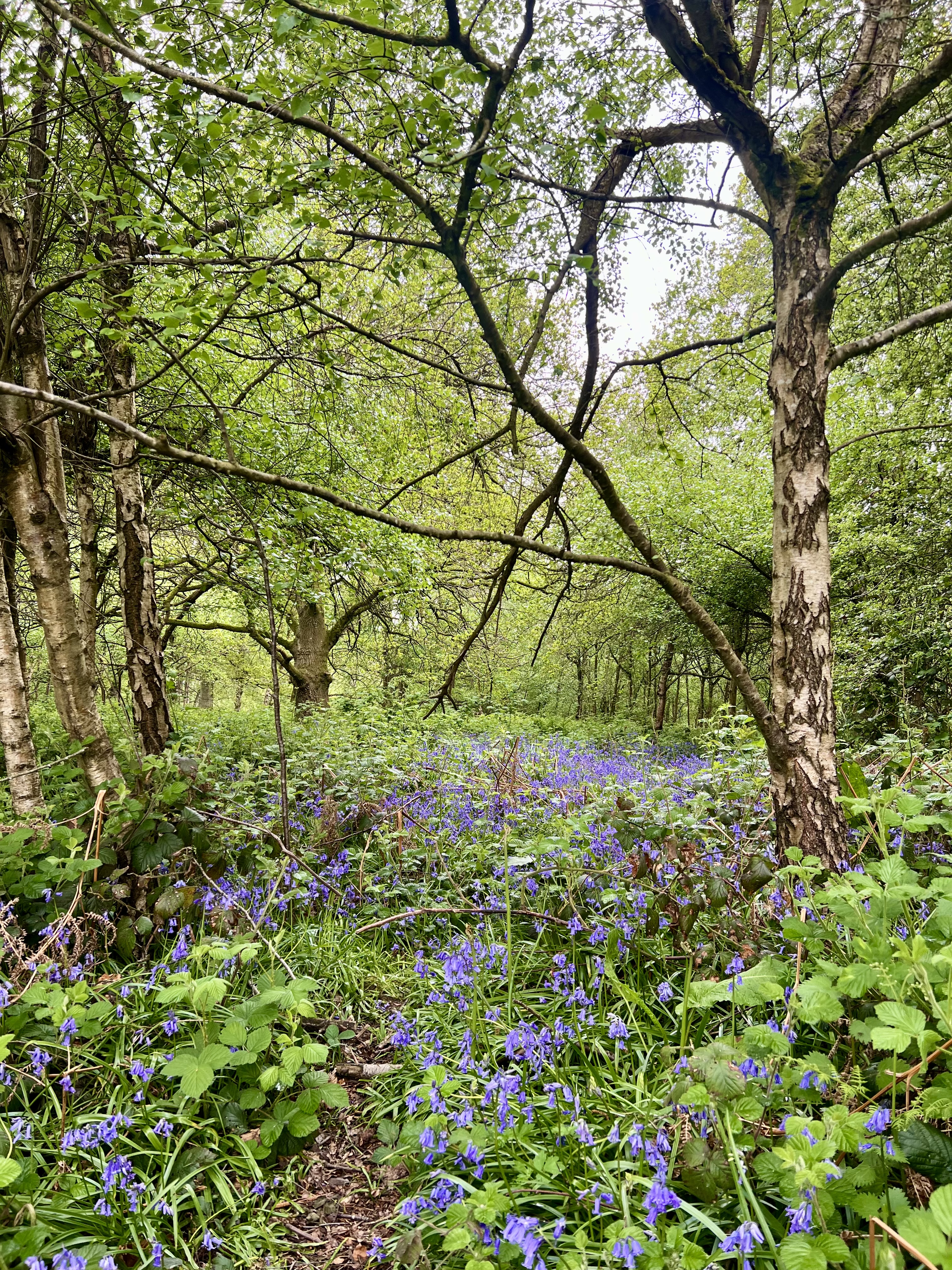
Get down low enough and you begin to see what is really happening, not only the postcard version of the bluebell wood, though that has its own beauty, the dreamy wash of blue beneath the trees, the path bending gently into light, spring arranging itself into something almost too lovely to believe, but the more complicated, more truthful world at ground level, where nettles are already pushing up, last year’s dead stems are still standing, rust-brown bracken lies collapsed into itself, and yellow lesser celandine is scattered through the rough grass like dropped coins.
Here the old season has not quite gone and the new one has not yet fully arrived, and through this untidy threshold the bluebells rise, each stem threading its way through the remains of what came before, lifting its small cluster of bells into the air with a quietness that makes the whole thing look effortless. It is not effortless, of course. It requires timing, stored energy, hidden labour, and an exact understanding of light, but plants do not announce their effort. They do not say, look how hard I have worked to become visible. They simply arrive, when the moment is right, and the woodland floor changes colour.
There is only a small window for this, smaller than we think, because the bluebell lives by timing. It comes after enough light has returned to the woodland floor, but before the canopy closes and turns the understorey green and dim again. For two weeks, sometimes three, a tide of blue rises and holds beneath the trees, then slips quietly back into leaf and shadow. Miss it, and you wait another year. This is not a metaphor, though of course it is also a metaphor.
Here, the bracken tells the fuller story. By midsummer these slopes will be almost buried beneath it, under that high, dense, shoulder-deep green that takes possession of whole hillsides, closing over paths, hiding hollows, swallowing the smaller plants beneath its insistence. In August you might walk here and think there was nothing else to see, but come now, in late April or early May, and the bracken has not yet risen. Last year’s fronds lie folded and brittle across the ground, their strength spent, their architecture collapsed into brown ribs and broken lace, and through them, through the wreckage of last summer, the bluebells are coming. They have been here all along, waiting in the dark, holding themselves underground until the light returned, and they know exactly how long they have.
This is the thing you only notice if you come back. If you return to the same places in different seasons, with some part of your attention still available, not looking for spectacle, not needing the rare or impressive thing, but willing to kneel among the ordinary, the place begins to reveal itself slowly. Not all at once, and not to a hurried eye, but gradually, through repetition, weather, absence, return.
This is where a nature journal becomes useful, not as a record of impressive sightings, not only the rare bird, the unusual moth, the extraordinary thing glimpsed once and carried home like treasure, but as a way of noticing change in ordinary places. Perhaps especially ordinary places. A journal is a way of keeping faith with change, of saying: I was here, on this day, and this is what the ground was doing.
A journal entry does not need to be long, and it does not need to be literary. It needs only to be honest about what was actually there, and where you were standing when you saw it, or kneeling, as it happens here, at ground level, one hand resting in the dead bracken, the soil cool beneath the fingers, the bluebells close enough to count their individual bells, which nobody really needs to do, but which is worth doing once.
Write down the date, the weather, what else was growing nearby, the celandine, the nettles, the young bramble leaves, the state of the bracken, whether the trees were fully open or still holding some light back, whether the ground was wet, whether the flowers were newly out or already beginning to loosen and fade. These details can feel like clutter when you write them, small and plain and almost unnecessary, but a year later they become a kind of doorway.
You return, and everything is slightly different. The season has come earlier, or later. The bracken is already pushing up at the edges. The bluebells are further along, or not yet fully open. What you once thought of simply as “spring” becomes many springs, each with its own pace, its own weather, its own secret order.
The naturalist Richard Mabey has written about how knowledge of a place is cumulative, built through repeated attention, until a landscape begins to speak in a language you have slowly learned to read. The journal is how you keep that learning from dissolving back into the blur of time passing. It holds what the mind lets go of: the first curl of bracken, the smell of damp leaf mould, the day the celandine closed early, the morning the blue was deeper in the shade than anywhere else.

What did the ground smell of? Write that down. You will think you will remember. You probably will not.
A field notebook does not need to be precious, and in fact it is often better if it is not too precious, because the best notebook is the one you actually bring with you. A cheap notebook, a pencil, perhaps a pocket small enough to stop the whole thing becoming an occasion. The pencil matters, because pens fail in cold and wet, and this country is often cold and wet.
Write as soon as you can, while the place is still close to you, while your knees still remember the damp ground, while your fingers still hold the faint green smell of crushed stems, while the blue is still somewhere behind the eyes. Memory is less reliable than it feels, and the longer you leave an observation, the more it begins to smooth itself into something general.
Notice what surprises you, even if you cannot yet explain why, because surprise is often the signal. Especially the small surprises: the thing that was not there last time, the thing that was there but has changed, the first curl of bracken lifting like a question mark from the soil, the celandine already closing, a single bluebell stem bent low under the weight of rain. The mind has touched the edge of something it has not yet understood.
Sketch, if you can, though it does not matter whether you can draw well. Drawing is not always about making a beautiful picture. Sometimes it is a way of slowing the eye until it begins to tell the truth. How many bells hang from the stem? Which way does it lean? Are the petals curled back? Is the leaf narrow or broad? You may not know until you try to draw it.
And write the things that do not yet have names: the quality of the light, the particular sound the wind made in this stand of trees, the feeling of the place on this particular morning in May. These are not unscientific observations. They are part of the data of being alive in a place.
In six weeks, come back here.
The bluebells will be gone, not dead exactly, but withdrawn, their brief above-ground season spent, their work done, their energy returned to the hidden bulb. The bracken will be rising, green and vigorous, almost triumphant, and this hillside will look like an entirely different country. If you had not crouched here today, if you had not put your hand among the dead fronds and brought your eye close enough to see the flowers properly, you might have no reason to suspect what lies beneath the green.
You might never know about this blue, not quite violet, not quite lavender, not quite anything else, a colour that seems to belong partly to the eye and partly to memory.
This is what a journal holds. Not just what you saw, but the fact that you stopped long enough to see it. Proof that you were here, that you looked, that the ground gave something up to a careful eye on an ordinary morning in May.
Soon the bracken will cover it all again, the paths will narrow, and the hillside will close over.
But the bluebells will know where they are.