The Questions Paintings Leave Behind | Samuel Palmer’s The Magic Apple Tree
There are paintings we admire and move on from, and others that seem to ask something more of us, holding our attention in ways we cannot immediately explain, until we find ourselves returning to them, discovering details that were present from the beginning but which, for reasons that may have as much to do with ourselves as with the artist, we were not yet ready to see.
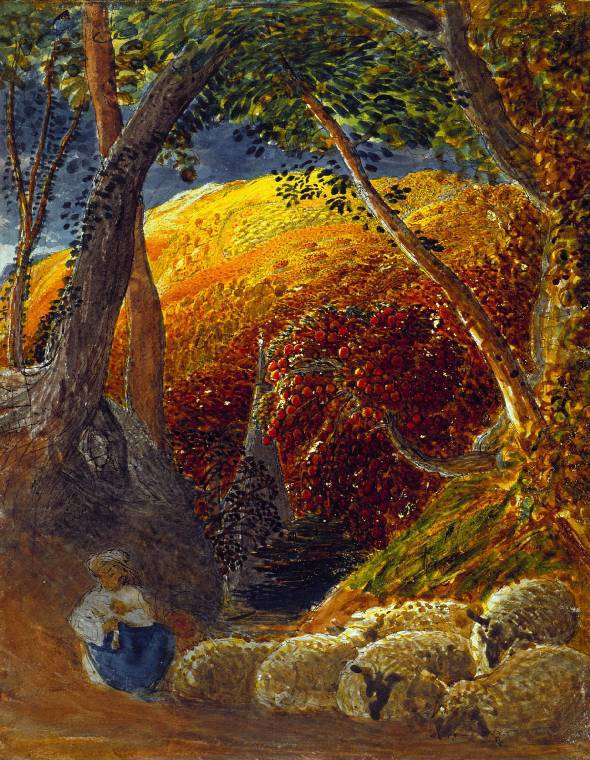
Samuel Palmer’s The Magic Apple Tree, painted around 1830, is one of these, a small landscape of such extraordinary abundance that the familiar English countryside seems almost to have awakened from a long sleep, its trees heavy with foliage and fruit, its fields glowing with ripened corn, its sheep gathered in a little company of wool and warmth beneath the sheltering branches, while a solitary figure plays a pipe and, beyond the valley, a church spire rises towards a sky that is darkening with the promise of rain. Nothing here is particularly extraordinary when considered separately, for these are the common constituents of a rural landscape, trees, fields, animals, a distant village and the changing weather, yet Palmer has arranged them with such intensity of feeling that the whole seems to possess a richness greater than the sum of its parts, as though something usually concealed within the ordinary world had briefly become visible.
Before looking further, it is worth remaining for a moment with the painting itself, allowing the eye to move without immediately seeking an explanation, for the first thing we may notice is how completely the landscape seems to embrace what lies within it. The trees rise on either side and bend towards one another, their branches forming an arch through which we look into the valley, while the apple tree extends its fruit-laden bough over the slope as though offering its abundance to anyone who might pass beneath it, and the sheep, gathered close together in their thick fleeces, appear almost to belong to the rounded forms of the earth upon which they rest. Even the distant fields seem less like separate parcels of land than parts of a continuous living presence, and there is something in this gathering of forms that makes the scene feel sheltered, enclosed and yet mysteriously expansive, as though we had entered a place that was both intimately familiar and somehow larger than the world we ordinarily inhabit.
And then, perhaps, we notice the sky.
For all the warmth and apparent contentment of the scene, the weather above it is not entirely benign, and the dark clouds gathering over the valley introduce a quiet uncertainty into what might otherwise have appeared an image of untroubled perfection. The corn is ripe, but the rain is coming; the fruit hangs heavily upon the branches, but it cannot remain there indefinitely; the sheep rest, but their repose belongs to a passing hour within the ceaseless movement of the seasons. There is no reason to suppose that Palmer intended these details to carry all the meanings we might find within them, yet perhaps they prevent the painting from becoming merely a comforting fantasy, reminding us that abundance and impermanence are not opposites, and that the beauty of a moment does not depend upon its ability to endure.
I find myself thinking about how rarely we allow these things to coexist within our own experience, how readily we postpone contentment until the circumstances of our lives have become more secure, our worries resolved, our work completed and the future sufficiently predictable that we feel entitled to enjoy what is already present. We wait for the unsettled weather to pass before allowing ourselves to appreciate the garden, for the difficult period to end before acknowledging the happiness that may still be found within it, for the next achievement, the next improvement, the next change in circumstances, while the life we are actually living continues to unfold, often containing moments of tenderness and beauty that we scarcely permit ourselves to recognise because they have arrived before everything else has been put right.
Perhaps this is one of the questions Palmer’s painting quietly raises, whether we have come to believe that beauty belongs only to circumstances from which difficulty has been removed, when in fact so much of what moves us most deeply exists alongside uncertainty, beneath skies that may never become entirely clear.
Palmer painted this landscape during the remarkable years he spent in Shoreham, Kent, where, under the influence of William Blake and in the company of other young artists who shared his belief in the imaginative and spiritual possibilities of art, he developed a way of seeing the countryside that was at once intensely observant and profoundly visionary. The fields, orchards and hills surrounding him were not remarkable because they were remote or unfamiliar, and the work of those who cultivated them was certainly not free from hardship, yet through Palmer’s eyes the ordinary landscape became luminous, revealing something of the sense of wonder, spiritual abundance and imaginative freedom that he and his companions sought within the natural world.
There is a temptation to understand such work as an escape from reality, as though imagination were a means of replacing the imperfect world with a more beautiful one, but I wonder whether it may also be understood as a way of recovering something that our customary habits of perception have gradually concealed. We become so familiar with the places through which we move that we cease to encounter them with any real curiosity, seeing the road primarily as the means of reaching our destination, the garden as a succession of tasks awaiting attention, the field as land belonging to somebody, the tree as a recognisable shape against the sky, until the ability to identify and navigate our surroundings begins almost imperceptibly to replace the experience of being present within them.
This happens so gradually that we may not notice what has been lost, for the world continues to appear before us, and we continue to look, but looking is not always the same as seeing, and there are ways of passing through a place that leave almost everything about it untouched by our attention. We know the tree is there, have known it for years, perhaps have even watched it grow, yet no longer notice the particular arrangement of its branches, the changes in its bark, the creatures that shelter among its leaves or the way the light falls differently upon it from one hour to another, and in this manner a living presence, inexhaustible in its detail and relationships, becomes reduced to something we believe ourselves already to know.
Perhaps the most extraordinary thing about Palmer’s painting is that it resists this reduction, refusing to allow the apple tree to become merely an apple tree or the sheep merely sheep, and inviting us instead to encounter them with something of the astonishment that familiarity so often diminishes. Even the fruit seems almost impossibly generous, the branches bending beneath its weight, while the surrounding vegetation grows with an intensity that feels closer to a remembered dream than to an ordinary afternoon in the English countryside, and perhaps what we are witnessing is not simply an artist exaggerating the natural world, but an attempt to convey the depth of feeling that may accompany looking at something familiar as though we had never really seen it before.
I wonder how different our own lives might feel if we could recover, even occasionally, that quality of attention, not through pretending that everything around us is beautiful, nor by denying the difficulties and disappointments that are part of being alive, but by resisting the assumption that familiarity has exhausted the meaning of what we encounter. There are people whose voices we hear every day without attending to their particular warmth or inflection, rooms in which we have spent years without noticing the changing passage of light across the walls, paths so familiar that we scarcely remember walking them, and small gestures of care that have become so woven into the fabric of our lives that we recognise their significance only when, for some reason, they cease.
Perhaps this is where the painting begins to move beyond the landscape and towards something more intimate, because the habit of overlooking the familiar is not confined to trees and fields, and we may be equally susceptible to overlooking what is precious in the ordinary human circumstances of our lives. A meal shared with someone we love, the sound of a familiar person moving about in another room, a dog resting beside us while we read, the simple reassurance of returning to a place in which we feel at home, all may seem too commonplace to deserve particular attention, yet these are often the very experiences towards which memory returns with greatest tenderness when life has changed and we can no longer inhabit them.
There is something almost painful in recognising this, because we cannot remain continuously conscious of the significance of everything around us, nor could we live well if every ordinary moment demanded the full intensity of our appreciation, yet perhaps we might learn to become a little less certain that what is familiar has nothing more to reveal, allowing ourselves occasionally to look again before the circumstances that give something its meaning have altered beyond our reach.
When I return to The Magic Apple Tree, I find my attention settling once more upon the little company beneath the branches, the resting animals and the figure playing her pipe, and I am struck by how little appears to be happening, despite the extraordinary richness surrounding them. No great event is taking place, nobody seems to be striving towards an achievement, and the landscape does not appear to exist in order to provide a lesson or an experience for somebody passing through it. There is simply a moment of living, held within the larger movement of weather, growth and time, and perhaps this is what gives the scene its strange tenderness, that Palmer has invested an apparently uneventful interval with all the seriousness and wonder we ordinarily reserve for the exceptional.
Our own lives are made largely of such intervals, the mornings that resemble other mornings, the familiar journeys, the meals, conversations, small responsibilities and moments of rest that seem scarcely worth remembering while they are taking place, and perhaps we spend so much time anticipating the occasions that will give our lives meaning that we fail to recognise how much of that meaning is already present within the hours we regard as merely passing.
Palmer’s apple tree will eventually lose its fruit, the harvest will be gathered, the sheep will rise and move elsewhere, and the light that gives the valley its extraordinary warmth will fade beneath the approaching weather, yet none of this makes the moment less complete, and perhaps its beauty lies partly in the fact that it belongs to a world in which everything is changing, even while, for a little while, everything seems to have found its place.
I think this is what I would like to remember the next time I walk along a familiar path and find myself scarcely aware of what surrounds me, or sit beside someone whose presence has become so reassuring that I have almost forgotten to notice it, because the world does not necessarily become less remarkable as we grow accustomed to it, although we may become less willing to be surprised.
And perhaps this is the question I would leave with Palmer’s painting, not whether we can learn to see the extraordinary in everything, for such a demand would soon become another impossible task, but whether we might occasionally remember that the things we are most accustomed to living with may also be the things we would most wish to see again, if one day they were no longer there.
Tomorrow, when we look from a familiar window, walk beside a tree we have passed hundreds of times or hear a voice that has become part of the ordinary music of our lives, perhaps we might allow ourselves to remain with it for just a moment longer, not because we have been instructed to practise gratitude or mindfulness, but because something that has become almost invisible through its constancy may still possess the power to astonish us.
And perhaps we will discover that the ordinary was never quite as ordinary as we believed.
Artwork
Samuel Palmer, The Magic Apple Tree (c. 1830). Pen, ink and watercolour with gum arabic on paper. The Fitzwilliam Museum, Cambridge.