On attention, the hidden depths of other lives, and the limits of our understanding
There is a moment, almost too brief to notice, when a bird leaves the branch on which we have been watching it and disappears among the trees, its wings briefly visible against the pale sky before the branches conceal its passage, and although we may follow its movement for a little while, our attention soon returns to whatever occupied us before, leaving the small creature to continue a life of which we have witnessed scarcely anything. Yet the bird has not disappeared from the world, only from our particular place within it, and somewhere beyond the reach of our eyes it is moving through a landscape of familiar places, possible dangers and remembered sources of food, carrying on with an existence that began long before we noticed it and whose significance has never depended upon our presence.
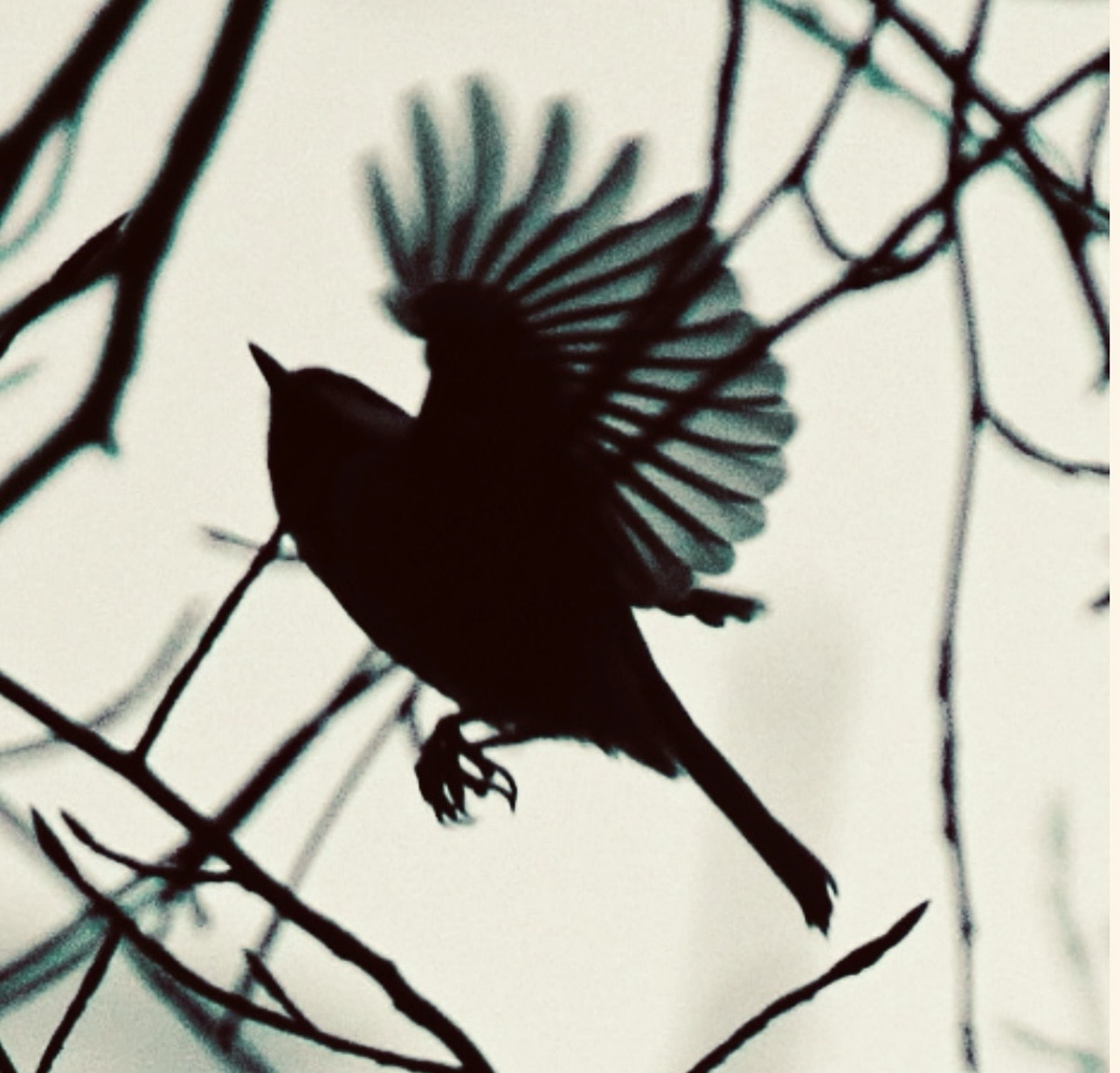
I have been thinking about this while looking through some photographs I took of birds in the garden, particularly one that catches a bird in flight, its wings extended at the instant of leaving the shelter of a tree, and what interests me increasingly is not simply the beauty of that fleeting movement, but everything the photograph cannot contain. We encounter the natural world in fragments, through the brief appearances of creatures that cross our paths or emerge from the undergrowth while we happen to be passing, and because these encounters are necessarily organised around our own presence, we may begin, almost without realising it, to mistake the small part of another existence we have witnessed for the life itself.
Something similar happens in our encounters with people, although perhaps it is more difficult to recognise because we are so accustomed to believing that familiarity brings understanding. We pass someone walking along a country path, exchange a greeting and continue on our way, knowing nothing of the circumstances that brought them there, whether they are returning to a house filled with companionship or one that has become unbearably quiet, whether they are recovering from some private disappointment or carrying a happiness they have not yet found words to express. For a moment our lives have occupied the same place, perhaps close enough for us to notice the colour of a coat, the expression on a face or the dog walking beside them, yet almost everything that makes this person who they are remains inaccessible to us, and within a few minutes we may have forgotten the encounter entirely.
I find myself remembering Edward Hopper’s painting Nighthawks, in which four figures occupy a brightly illuminated diner surrounded by the darkness of a deserted city street, their presence made visible through an immense expanse of glass that nevertheless separates them from the world outside. A man sits with his back towards us, another customer is turned towards the counter, and a woman in red occupies a place beside him, while the attendant stands within the pool of artificial light, yet for all the apparent clarity with which Hopper allows us to see these people, we are given almost nothing of their private lives, their relationships or the circumstances that have brought them together at such an hour. There is no visible entrance through which we might join them, and perhaps this is part of the painting’s particular power, that we are permitted to look without being permitted to know, left standing outside a moment of human existence whose meaning cannot be recovered simply by observing it more closely.
The painting brings to mind Hemingway’s A Clean, Well-Lighted Place, in which an elderly man sits alone late at night in a café, his continued presence an inconvenience to a younger waiter who wishes to close and return home, while an older waiter recognises something of the need that may lie beneath the man’s reluctance to leave. What makes the story so affecting is not that we are given a complete account of the elderly man’s suffering, but that one person is willing to recognise its possibility without demanding that it be explained, while another, measuring the encounter against the circumstances of his own life, cannot understand why someone would wish to remain in a café when there is a perfectly good reason to go home.
I wonder how often we find ourselves occupying one or other of those positions, impatient with behaviour that inconveniences us because we cannot imagine the circumstances from which it arises, or unexpectedly moved by a small gesture whose significance becomes apparent only when we recognise that another person’s experience of the world may be profoundly different from our own. The stranger walking alone may have spent the morning gathering the courage to leave the house, the person sitting quietly in a café may be delaying a return to an empty room, and someone whose conversation seems distracted or whose manner appears withdrawn may be carrying responsibilities, losses or uncertainties that remain entirely concealed beneath the ordinary gestures of everyday life. We cannot know these things merely by looking, and it would be equally mistaken to invent suffering wherever we encounter silence, yet perhaps we can learn to leave room for possibilities that our first impressions have not allowed us to consider.
There is something unsettling about recognising how confidently we sometimes interpret other people from the smallest fragments of their behaviour, as though a moment of impatience revealed an unkind character, an awkward conversation disclosed a lack of interest, or a life that appears unremarkable from the outside must necessarily be lacking in richness within. Even among those we have known for years, familiarity can persuade us that we understand someone so thoroughly that we gradually cease to wonder about them, forgetting that every person carries memories formed before we knew them, thoughts they may never have spoken aloud and private meanings that cannot be entirely shared, however close our relationship may become. To acknowledge these limits is not to diminish intimacy, but perhaps to make it more generous, allowing another person to remain more complicated, more changeable and more mysterious than the version of them we have grown accustomed to carrying in our minds.
And there is another recognition here, one that may be even more affecting, because we too are among these partially known lives, passing through the experience of others as a face glimpsed through a window, a figure walking along a path or a stranger sitting quietly in a room, while carrying within ourselves everything those brief encounters cannot reveal. There may have been times when simply getting through an ordinary day required more of us than anybody understood, when we were mistaken for someone indifferent because we had grown quiet, or judged by a decision whose history remained invisible to those observing it, and perhaps remembering our own experience of being incompletely understood might make us slower to believe that we possess the whole truth of another person.
I return to the photograph of the bird leaving its branch, and find myself thinking about the curious relationship between seeing and understanding, because attention can reveal extraordinary detail while leaving the essential mystery of another life intact, and perhaps this is something we ought to welcome rather than attempt to overcome. The bird does not become more fully itself because I have photographed it, just as the strangers in Hopper’s diner do not become more completely known because we have spent a long time looking at them, and Hemingway’s elderly man does not need to explain the whole of his suffering before another person can recognise that a little light, dignity and shelter may matter to him.
Perhaps the deeper gift of attention is not that it allows us to know everything, but that it teaches us to recognise where our knowledge ends, and to approach what lies beyond it with curiosity rather than certainty, understanding that the lives around us are not incomplete accounts waiting for our interpretation, but existences whose richness far exceeds the moments in which they happen to intersect with our own.
The bird in my photograph has long since disappeared among the trees, and I do not know where its flight carried it, what dangers it encountered or where it eventually found shelter, yet somewhere in the brief moment I happened to preserve is a reminder that the world does not end at the boundaries of our attention, and that what we have been permitted to witness is never necessarily all there is to understand.
And perhaps later today, when we pass somebody on a familiar path, exchange a few words with a stranger or find ourselves irritated by a person whose behaviour seems difficult to comprehend, we might remember the bird disappearing into the trees, the figures behind Hopper’s illuminated window, or Hemingway’s elderly man reluctant to leave the café, and recognise that the life before us has begun long before our arrival and will continue into places we cannot follow.
We may never know the whole of another life, but perhaps we can learn to be more careful with the little that we see.
Photograph: A bird in flight, photographed by Jane Maye.
Art and literature referenced
Edward Hopper, Nighthawks (1942) — View the painting at the Art Institute of Chicago.
Ernest Hemingway, A Clean, Well-Lighted Place (1933) — Short story.
Support Nature Speaks
Choose an amount
Or enter a custom amount
Nature Speaks will always be free to read. If something here has made you pause, look a little longer, or notice the living world differently, you can help support the time and care that goes into the writing.