The Questions Paintings Leave Behind — No. 1
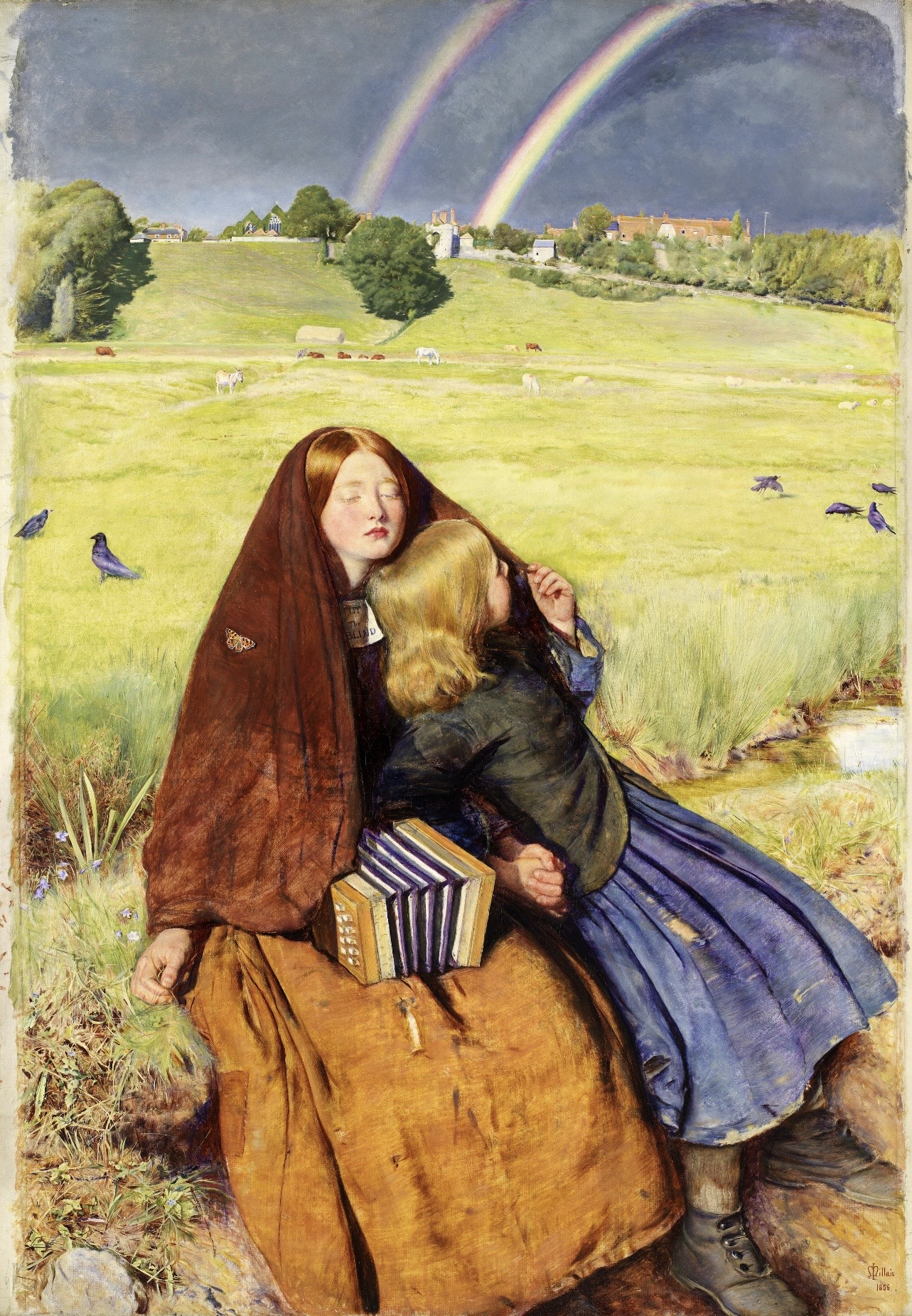
There is something about John Everett Millais’s painting The Blind Girl that encourages us to linger, as though the moment it depicts possesses a significance we recognise without quite knowing why. A shower has passed over the countryside, leaving the grasses damp and the distant fields illuminated by the returning sunlight, while above them a double rainbow stretches across the sky, its colours suspended briefly in that curious interval when the rain has passed but the air still seems to hold something of its presence. Beneath it sit two children, resting beside a country road. The younger girl looks towards the rainbow, while her older companion, who is blind, has turned her face towards the warmth of the sun, a concertina resting in her lap and a small butterfly settled upon her shawl. Around her neck hangs a sign bearing the words Pity the Blind, a reminder of the hardship that could accompany disability in Victorian England, and of a society in which compassion was often sought through an appeal to pity.
At first, our attention is drawn towards the apparent contrast between the two girls, one able to witness the extraordinary spectacle above them, the other unable to see it, and perhaps we find ourselves imagining the beauty from which the older child has been excluded. Yet the longer I remain with the painting, the less certain I become about the assumptions contained in that response, because although we know that the older girl cannot see the rainbow, we know remarkably little about what either child is actually experiencing. We cannot enter the private world of the girl whose face is lifted towards the sunlight, cannot know what meaning the warmth, the sounds of the countryside or the companionship of the younger child may hold for her, just as we cannot know what passes through the younger girl’s mind as she looks towards the sky. We bring our own sense of wonder to the rainbow and, almost without noticing, allow it to become hers, filling the silence of the painting with thoughts and feelings that belong, perhaps, more to ourselves than to either of the figures before us.
I find myself returning to this small, almost imperceptible movement of the mind, the ease with which we supply what we cannot know from what we already believe, because it seems to reveal something about the way we encounter the world beyond the painting. Our days are shaped by accumulated experiences, memories and expectations that allow us to recognise what we meet without having to discover everything anew, and there is a necessary kindness in this familiarity, which makes the world navigable and gives continuity to our lives. Yet it may also conceal something from us, for once a thing has become familiar, once we have given it a name and found a place for it within our understanding, we can begin to mistake that recognition for a more complete knowledge than we actually possess.
Consider a tree beside a road we have travelled for years, its branches forming part of the scenery so familiar that we scarcely register its presence, until one morning the light falls differently across its leaves, or we notice the delicate beginnings of new growth upon a branch we had thought lifeless, and suddenly the tree seems to have emerged from the background of our awareness. Nothing remarkable may have happened to the tree beyond the ordinary changes of weather and season, yet something has altered in our encounter with it, and what we had long since ceased to question becomes once again particular, mysterious and alive. We may know its name, recognise its form and understand something of the processes through which it grows, while still discovering that the longer we attend to it, the less it resembles the simple, settled idea of a tree that we have carried in our minds.
Perhaps this is one of the quieter gifts of attention to the natural world, that it can restore a sense of unfamiliarity to what we thought we knew, revealing not some hidden world concealed behind appearances, but the inexhaustible richness of the one before us. A fallen leaf, held for a few moments in the hand, becomes an intricate record of growth and weather, its veins branching towards an irregular edge, its surface bearing the small evidence of lives and events we will never entirely reconstruct. The tree from which it fell belongs in turn to a community of other lives, extending beneath the soil and beyond the reach of our sight, and what appeared to be a separate, easily understood object gradually reveals its participation in relationships whose complexity exceeds anything we might have imagined at first glance.
Knowledge can deepen this encounter immeasurably, yet there is a difference between learning about something and allowing what we learn to exhaust our sense of what it is. A woodland can be described through its species, a river through its course and volume, a meadow through the habitats it supports, and each description may enlarge our understanding, but none can contain the whole of the place or what it means to the lives unfolding within it. When we come to regard these descriptions as complete, the living world risks becoming little more than a collection of objects, resources and functions, its value determined by what we have learned to recognise or measure. What escapes our attention may then escape our concern, and the boundaries of our understanding become, almost without our noticing, boundaries upon what we are willing to protect.
I wonder whether familiarity can diminish our curiosity about people in much the same way. We come to know another person’s habits, expressions and responses, gradually acquiring the comforting sense that we understand who they are, while forgetting that behind even the most familiar face there remains an interior world shaped by memories, hopes, fears and associations that we can never fully share. We may love someone deeply and still misunderstand them, not necessarily through indifference, but because the person we believe we know has become so firmly established within our imagination that we no longer leave sufficient room for their continuing existence beyond it. Perhaps there is a form of generosity in recognising this, in allowing another person’s experience to remain larger than our interpretation, and in approaching even those closest to us with something of the curiosity we ordinarily reserve for strangers.
Returning to Millais’s painting, I become increasingly conscious of the way the girls’ circumstances have shaped my initial response. The sign around the older child’s neck invites pity, and we may find ourselves considering her blindness before almost anything else about her, allowing one aspect of her existence to stand in for the life we cannot know. The rainbow, meanwhile, draws our attention towards what she is unable to see, although we have no means of measuring the fullness of either child’s experience against the other. What is visible to us becomes the foundation of a story we tell ourselves about what their lives must be like, and perhaps the most unsettling thing about the painting is not the difference between their perceptions, but the confidence with which we begin to interpret them.
There is something humbling in recognising how little of another life, or indeed of the living world around us, can be contained within the meanings we give it, but I find the thought unexpectedly hopeful, because it suggests that understanding need not be something we finally achieve and possess. It may be something we remain in relationship with, allowing each new encounter to alter what we thought we knew, so that knowledge becomes not the end of curiosity but one of the ways through which curiosity deepens. The familiar tree, the person whose thoughts we believe we can anticipate, the landscape we have crossed a hundred times may all continue to hold possibilities that become available only when we loosen our certainty long enough to encounter them again.
And so I return once more to the two children resting beneath the rainbow, to the sunlight upon the older girl’s face and the younger child’s gaze turned towards the sky, and I find that the painting has changed for me, although nothing within it has moved. The rainbow remains as beautiful as it was when I first looked, the girls as still and unknowable, yet I am less inclined now to imagine that their experiences can be measured by what is visible to me, and more conscious of how much of the world I may have diminished simply by believing I had already understood it.
Perhaps the real loss is not that there are things we cannot see, but that there are so many things we no longer think to wonder about.
How much of what we call understanding is simply the point at which we stopped being curious?
John Everett Millais (1829–1896), The Blind Girl, 1854–56. Oil on canvas. Birmingham Museums Trust.
Explore the painting
View or download a reproduction: The Blind Girl — Wikimedia Commons

Explore a museum reproduction: The Blind Girl — Birmingham Museums Trust Shop
.
Support Nature Speaks
Choose an amount
Or enter a custom amount
Nature Speaks will always be free to read. If something here has made you pause, look a little longer, or notice the living world differently, you can help support the time and care that goes into the writing.