What the fallen apples taught me about belonging
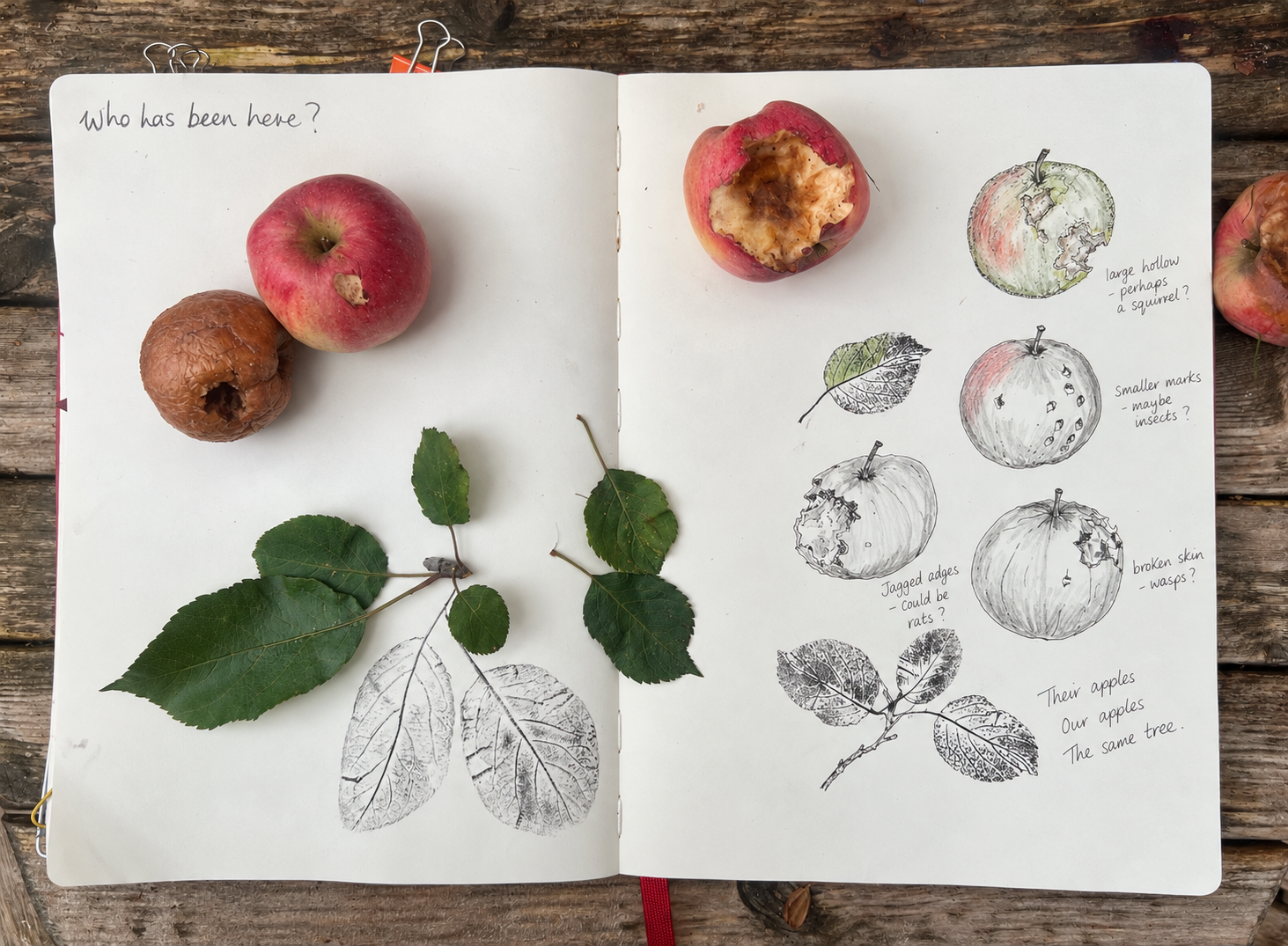
For several weeks I have been watching the fallen apples disappear beneath the trees, their bright skins gradually giving way to great irregular hollows, their flesh exposed and darkening, until some are little more than empty shells, while others carry smaller marks whose makers I can only guess at. I had seen the blackbirds gathering around them, sometimes several at once, and the wasps moving over the softening fruit, but it was only when I happened upon a grey squirrel eating one that I began to wonder how much was taking place in this familiar corner of the garden without my knowledge, and how easily we mistake the things we happen to witness for the whole of what is happening.
I am not particularly fond of grey squirrels, and I cannot pretend to welcome the rats that also visit the fallen fruit, although I find myself increasingly interested in the lives of both. Perhaps there is something revealing in that distinction, in being willing to watch a blackbird with affection while regarding another creature engaged in precisely the same business of finding food with considerably less enthusiasm. The wasps have been curious too, some appearing so unsteady around the softening apples that I have wondered whether the fruit might have begun to ferment, while the different hollows, punctures and ragged edges suggest encounters I have never witnessed and cannot confidently identify. I find myself imagining the succession of visitors that might come to a single apple, one breaking through its skin and another discovering the exposed flesh, each leaving it altered for whoever arrives next, although perhaps the most interesting thing is not what I can imagine but how much remains beyond my knowing.
Something else has puzzled me. All the apples being eaten have come from the tree bearing the sweeter eating apples, while those that have fallen from the neighbouring cooking apple tree remain untouched, although they lie only a short distance away. I had thought of the difference between the two largely in terms of what I might do with them in the kitchen, but the creatures beneath the trees appear to be making distinctions of their own, perhaps responding to sweetness, acidity, ripeness or texture, or to qualities I have never considered. It is strange to realise that the garden I move through every day is not experienced in anything like the same way by its other inhabitants, that what is simply an apple to me may be a particular combination of scent, taste, softness and possibility to another creature, and that the familiar world is full of perceptions to which I have no access.
I have been thinking about this while drawing the damaged apples in my nature journal, following the broken outlines of their skins, the irregular edges of the hollows and the little marks that might have been made by insects, and finding that the longer I look, the less inclined I am to regard them simply as spoiled fruit. There is a temptation to think of an apple as complete when it hangs from the tree, smooth-skinned and unblemished, and of everything that follows as a gradual loss of what made it valuable, yet the fruit lying in the grass seems to be entering a different kind of usefulness, its changing form allowing other lives to reach what was previously enclosed. What I might have called decay is also a succession of openings, and what appears, from one point of view, to be an ending may be part of a much longer exchange whose beginning and conclusion I cannot see.
Until recently, I would have gathered away much of the fallen fruit as part of tidying the garden, keeping what I could use and removing what remained, but I find myself less inclined to do so now, aware that the apples I leave beneath the trees may feed creatures I never encounter and will eventually return something of themselves to the soil. It is a small change, scarcely worth mentioning perhaps, and yet I wonder how many of the things we do without thinking are shaped by what we have failed to notice, how often our idea of caring for a place is inseparable from our desire to make it conform to our own expectations, and whether attention sometimes asks something more difficult of us than admiration: the willingness to allow other lives to matter even when they are inconvenient, unattractive or entirely indifferent to our presence.
And then, in the midst of wondering about all these visitors, I realised that I had overlooked two of the most familiar, because I gather apples for cooking and my dog, Digby, enjoys them in his morning porridge, although it had never occurred to me to think of our breakfast as belonging to the same story as the feeding beneath the trees. Perhaps the distance between the kitchen and the garden had seemed greater than it was, separated by all the small arrangements of human life, the gathering and preparing, the bowls and spoons, the familiar rituals that make our dependence upon the living world appear so different from that of the creatures outside. Yet the apples came from the same branches, and the nourishment passing through our lives was no less a part of the garden’s quiet exchanges because it had crossed a threshold and arrived at a table.
I wonder how often we do this, placing ourselves at the centre of a world we believe we are observing, as though our ability to name its creatures, distinguish its species and describe its processes somehow establishes a distance between their lives and ours. We speak of nature as somewhere we go, something we encounter, a source of beauty, restoration or wonder, and perhaps all these things are true, but the language can also conceal a curious forgetfulness, for we do not visit the living world in quite the way we visit a place to which we do not belong. Our lives are already entangled with it, through the food we eat, the air we breathe, the water that passes through us and the innumerable forms of life upon which our own existence depends, although these relationships are so continuous and ordinary that we can spend years understanding them in principle without ever quite feeling what they mean.
Perhaps that is why the apples have stayed in my thoughts. There was no remarkable encounter, no rare creature or extraordinary landscape, only a few fallen fruits, some blackbirds, a squirrel I would rather not have in the garden, and the evidence of other lives arriving and departing while I was occupied elsewhere. Yet something about looking more carefully has disturbed the familiar arrangement in which I had placed myself, and I find that I can no longer think of the apples beneath the trees as belonging to one world and those in my kitchen to another, nor of the creatures feeding upon them as simply the inhabitants of a nature from which I stand apart.
Tomorrow the blackbirds will probably return, the cooking apples may remain untouched, and Digby will wait for his porridge, while the garden continues with all the small exchanges I will never witness or understand. Nothing has changed for the creatures beneath the trees because I have begun to notice them, and perhaps that is what I find most humbling, that their lives have never depended upon my attention, while my understanding of my own life has been altered by theirs.

I had begun by wondering about the creatures sharing the apples beneath the trees, without realising how much I had come to think of myself as standing apart from them.
.
From Nature Speaks to Moss & Maye
The nature journal accompanying this essay is part of my creative practice at Moss & Maye, where close observation of the natural world inspires original artwork, prints, cards and downloadable nature-journaling guides. Both Nature Speaks and Moss & Maye grow from the same belief that looking more closely can change the way we experience the ordinary world.
.
Support Nature Speaks
Choose an amount
Or enter a custom amount
Nature Speaks will always be free to read. If something here has made you pause, look a little longer, or notice the living world differently, you can help support the time and care that goes into the writing.