Lately I have been thinking about balance, perhaps because I have returned to some of the ballet exercises I learned many years ago and have discovered, with that peculiar mixture of familiarity and surprise that comes when the body remembers something the conscious mind has almost forgotten, that the old positions are still there somewhere, held quietly in muscle and bone. When I stand carefully, lengthening through the spine, settling my weight through my feet and trying to find the place we call balance, I become aware that I am not really still at all, because even when the body appears motionless the ankle is making its tiny corrections, muscles are tightening and releasing, weight is travelling almost imperceptibly across the foot, the eyes are gathering information from the room and the inner ear is listening to gravity. Beneath what looks like stillness there is a continuous conversation taking place, so subtle that most of the time I do not know it is happening, and I have begun to wonder whether this is what balance has always been: not stillness, not a perfect position finally found and held, but a succession of almost invisible responses to the fact that something, however slightly, is always changing.
What interests me even more is that those small disturbances are not failures of balance; they are part of balance itself. The body moves fractionally away from equilibrium and something answers, a muscle engages, the ankle yields, weight is redistributed, and what appears from the outside to be stillness is really an unbroken sequence of disturbance and response. Without the movement there would be nothing to correct. Perhaps this is why the idea of balance becomes more interesting the longer I remain at the barre, because it begins to seem less like resistance to change and more like the capacity to remain responsive within it, to feel the movement early enough and answer it gently enough that the body can continue. There must also be a point at which the disturbance becomes too great, or arrives too quickly, for those small corrections to be enough, when the body can no longer absorb what is happening and movement becomes a fall, and it is this thought that has begun to follow me away from the barre and into the landscape around me.
I have often thought that nature aims for balance, although the more closely I look at the living world, the less certain I become about what I mean by that word. Rivers rise and fall, populations increase and diminish, trees grow towards openings in the canopy, roots find their way around stones, banks erode and gravel settles elsewhere; a tree falls and what looks, from one point of view, like destruction becomes light for seedlings, food for beetles, a place for fungi, and eventually soil from which other things will grow. We arrive somewhere in the middle of all this movement and give names to what we see — growth, decline, damage, recovery, beginning, ending — although perhaps these are sometimes only names for the particular moment at which we happened to look. What seems settled may simply be changing too slowly for us to perceive it, while what seems catastrophic may be one moment in a process whose continuation lies beyond the length of a human life.
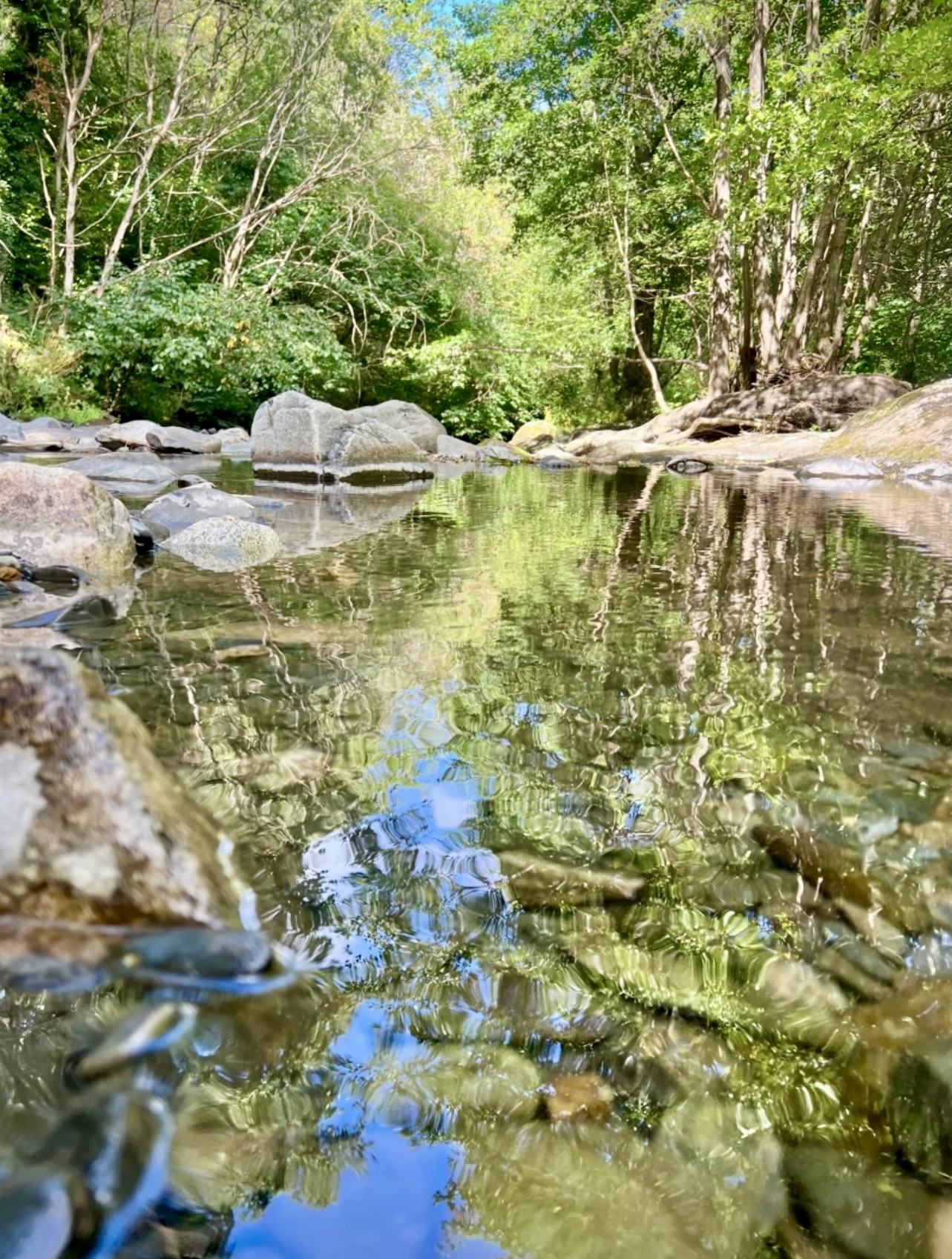
The River Ceiriog has been quietly complicating this thought for me for most of my life. There was a large rock in the river that I used to sit upon as a child, one of those places that acquires importance without anyone ever deciding that it should, becoming part of the private geography of childhood simply because we return to it again and again. I do not remember wondering then how long the rock had been there, what forces had brought it to that particular place or whether it would remain; childhood accepts certain things as permanent simply because they were there when we arrived, and perhaps adulthood does much the same thing with greater confidence and more elaborate explanations.
The rock remained as I grew older, but the place did not remain unchanged. Over many years a tree grew upon it, its roots gradually travelling across the stone, thickening and folding themselves around it before reaching towards the water, until eventually the rock I remembered sitting upon was almost enclosed. By then I was an adult, and sometimes when I looked at that strange union of tree and stone I found myself wondering what it might be like to be the rock beneath those roots, whether their hold would feel protective or constricting, whether the rock might somehow feel suffocated beneath this life that had slowly claimed its surface. I could not know what it was to be a rock, but perhaps that was never really the point of the wondering; what mattered was that small movement of imagination away from myself, the possibility of looking at something familiar and allowing, however briefly, the certainty of my own perspective to loosen.
Then last winter, after storms and prolonged rain, the Ceiriog rose with extraordinary force, and when I returned to that familiar place afterwards the tree had gone and so had the rock. I remember looking at the space where they had been and struggling to comprehend the absence, not because rocks cannot move — rivers have been moving them for longer than we have been here to watch — but because this particular rock had accompanied so much of my own life that I had unconsciously placed it among the permanent things. I had been a child sitting upon it; years had passed, the tree had arrived and grown, its roots had enclosed the stone, and I had become the adult standing on the bank contemplating it, while beneath all those changes the rock appeared simply to remain. Its constancy had become a background against which I noticed my own alteration, and perhaps that is one of the quiet ways in which landscape enters us: we borrow permanence from places without ever asking whether they have promised it.
And yet everything had been moving. The river moved quickly enough for me to call it movement, the tree slowly enough for me to call it growth, while the rock changed on a scale that allowed me to call it stillness, and through all of this I too was changing, the child on the stone becoming the adult who wondered about the roots and then the woman who would one day return to find them both gone. Perhaps permanence is sometimes only change occurring beyond the scale of our attention, and perhaps what we call stillness tells us as much about the limits of our perception as it does about the thing we are observing.
I still do not know what happened to the rock. Perhaps the river finally became powerful enough to move tree and stone together; perhaps somebody removed them with machinery. But almost as soon as I realised it was gone, I began wondering where it was, and then, with the same curious impulse that had made me wonder whether it felt suffocated beneath the roots, I wondered how it might feel to find itself somewhere else. There is something about that instinct to follow a thing in imagination after it has disappeared from sight that stays with me, because disappearance is so often a limitation of the observer rather than an ending in the thing observed. The rock had gone from my stretch of river, from my field of vision, from the arrangement of the world that I remembered, but it had not therefore become nothing. Somewhere, in some form, the story continued.
There is another memory that returns whenever I think about balance, although it is a less comfortable one. Years ago I heard a sound outside that I can still remember, something sharp and desperate, closer to shouting than birdsong, and because there are sounds that reach the body before thought has time to intervene, I went immediately to see what was happening and found a sparrowhawk pinning a starling to the ground. The starling was on its back, its wings flailing, feathers splayed and beak opening again and again as it cried out, while above it the sparrowhawk seemed almost unnervingly composed, concentrated entirely upon what it was doing. There was no cruelty in the hawk, only hunger, but there was certainly no peaceful acceptance in the starling, which was fighting with everything it possessed to remain alive, and for a few seconds I stood between those two truths, knowing perfectly well that what I was witnessing was natural, that sparrowhawks must eat and that predation is part of the ancient movement of life through life, while also hearing the desperation of a creature that did not want to die.
I stepped forward, the sparrowhawk flew and the starling struggled upright before flying too, raggedly but unmistakably alive, and for a little while I felt the uncomplicated relief that comes from believing that something terrible has been prevented. It was only afterwards that the other questions began to arrive. The starling may already have been badly injured and I do not know whether it survived; the sparrowhawk was still hungry and perhaps later that morning it caught another bird, one that would otherwise have lived. I have never known, and so the memory has remained unfinished in me, because perhaps I saved a life that morning, perhaps I postponed a death, or perhaps I merely shifted the cost somewhere beyond my sight.
The longer I have carried that memory, the less comfortable the word balance has become. We like it when it suggests harmony, reciprocity and everything finding its proper place, but the starling and the sparrowhawk both had a place in that garden and there was no conclusion available in which neither paid a price. Nature contains cooperation of astonishing intricacy, but it also contains hunger, competition, parasitism, disease, injury and death, and perhaps attending properly to the living world requires us to resist making it either more cruel or more benign than it is. What appears balanced from a distance may feel nothing like balance from within the life being lost, and there is something humbling in recognising how readily we confuse the pattern visible to the observer with the experience of those living inside it.
My intervention that morning was tiny, impulsive and compassionate, and I suspect I would make exactly the same choice again, but the moment I stepped towards those birds I entered their relationship and altered what would otherwise have happened without ever being able to follow the consequences far enough to know what my action ultimately meant. Human beings intervene in living systems on a vastly different scale while often possessing the same inability to see where all the consequences will travel. We remove one species because we call it a pest, introduce another because it is useful, drain wetlands because we want the land beneath them, straighten rivers because we want water to travel somewhere more convenient, remove hedges, clear forests, spray insects, alter soils and move organisms between continents, and because cause and consequence may be separated by years, generations or thousands of miles, it becomes surprisingly easy to believe that the story ends where our intention ends. Our field of vision is so often smaller than the consequence.
This was one of the great warnings contained in Rachel Carson’s Silent Spring. The chemicals used to solve a particular human problem did not remain obediently within the boundaries of that problem; their effects travelled through soil, water, organisms and food chains, appearing in lives and places for which they had never been intended. Perhaps the extraordinary power of Carson’s title lies in the simplicity of the image she gave us, because instead of asking us only to understand evidence she asked us to imagine a spring morning from which the birdsong had disappeared, and there is something deeply unsettling in the possibility that consequence may first announce itself not through the arrival of something dramatic but through an absence, through the moment when something that had always accompanied our lives simply fails to return.
For me, DDT has never belonged entirely to environmental history. My brother suffered DDT poisoning, and so the substance Carson wrote about belongs somewhere within the history of my own family as well, crossing the artificial boundary we draw between what happens to the environment and what happens to us. I find myself returning to the thought that there is no true away in a living system. We spray something onto a field, wash something down a drain, release something into water or bury something in soil, and our language allows us to imagine that the act is complete because the substance has left our hands and our sight, while the living world continues the sentence: into water, into soil, into tissue, into another organism, another place, another time. The action may take seconds while its consequences travel for years, and perhaps this difference in timescale is one reason we find it so difficult to recognise ourselves within the whole.
Perhaps this is why absence deserves our attention as much as presence: the bird no longer heard where it once was common, the insects that no longer gather in such numbers, the flower that used to grow in a particular place, the old tree missing from a familiar horizon, the empty space in a river where a rock once stood. Dramatic loss forces us to notice, while quieter diminishment can become almost invisible because we adjust to it, accepting a little less and then a little less again until the altered world begins to feel normal. There is something troubling in this too, because adaptability is one of life’s great strengths and yet our own capacity to adapt may allow us to inhabit increasing loss without fully recognising it; we can become accustomed to conditions that should perhaps have made us feel the ground shifting beneath us.
There are times when I look at what we have done to the living world and find the language of environmental damage strangely inadequate, because damage can sound accidental and temporary, something that might simply be repaired, while some acts seem to belong to an older and more troubling word: desecration. To desecrate something is to treat what was once understood as having value beyond its usefulness as though it were merely material, and I sometimes wonder whether the physical destruction of the living world was preceded by an imaginative one, when a forest became primarily timber, a river became water, a meadow became land, an insect became a pest, and the immeasurable relationships contained within each disappeared beneath the single purpose we assigned to it. Perhaps separation begins in imagination long before it appears in the landscape.
Even now we speak of “going into nature”, and the phrase has begun to sound increasingly strange to me, because where, exactly, have we been? The walls around us were made from the Earth; the food on the table contains sunlight transformed by plants; the water from the tap has travelled through cloud and rain, soil and rock, river and reservoir; every breath crosses a boundary we like to imagine exists between the body and the world. We can surround ourselves with glass and concrete, spend our days looking into screens and travel for miles without placing a bare hand upon soil, but none of this moves us outside nature. Perhaps civilisation has not separated us from the living world nearly as completely as it has separated us from the feeling of being within it.
I have sometimes caught myself thinking that nature will eventually fight back, particularly when confronted by the scale of what we have altered, and during the pandemic there were moments when that thought returned as streets emptied, aircraft remained on the ground and something microscopic interrupted the immense machinery of human civilisation. I do not mean that nature consciously sent disease to punish us, nor that human suffering can be made meaningful by imagining the Earth administering some moral correction; what stayed with me was something less comforting, the recognition that perhaps nature had not regained control at all because we had never possessed the control we imagined. For all our extraordinary intelligence, our medicine and machines, our satellites and cities and ability to cross oceans in hours, we remained what we had always been: vulnerable biological creatures living among other biological creatures, breathing air we did not make, drinking water we did not create and depending upon soils, organisms and relationships whose full complexity remains beyond us. We had not stepped outside the system in order to alter it; we were breathing inside the experiment.
This is why I am no longer certain that I believe nature “aims for balance”, at least not in the way I once understood the phrase, because it suggests some final harmonious arrangement towards which everything is quietly returning, when what I see instead is something more restless and more mysterious: relationship, response, adaptation, disturbance, loss and renewal, innumerable lives and forces continually changing the conditions encountered by one another. Disturbance itself is not necessarily the opposite of balance; the body at the barre has shown me that much. A system can bend, absorb, respond and rearrange itself, and perhaps much of what we call resilience lies precisely there, but there must also be limits to what can be absorbed, thresholds beyond which the old relationships can no longer reorganise quickly enough, and when we reassure ourselves that nature will adapt we might also ask what we are asking it to become, what will disappear in the adaptation, and whether our own lives are among those that depend upon the conditions being left behind.
A river does not punish us when it floods and a hillside does not seek revenge when it slips; the Earth does not need to share our ideas of justice for consequences to follow from altered conditions. Perhaps what we sometimes experience as nature fighting back is simply the moment at which we encounter the continuation of a story we thought had ended elsewhere, the consequence returning within the boundaries of our attention. There is no balcony from which humanity watches this unfold, no position outside the living world from which we can alter one part and remain untouched by what follows, and perhaps the deepest illusion was never that we could control nature but that there was a separate we doing the controlling.
And so my thoughts return to the ballet barre and to the apparently motionless body, because the longer I stand there the less balance seems to have to do with holding myself rigidly in one correct position and the more it seems to depend upon remaining sensitive enough to feel change as it happens. The ankle yields a fraction, weight moves, muscles respond, and what looks from the outside like stillness is actually an unbroken act of listening. I wonder sometimes whether the living world has been offering us small shifts for a very long time — fewer insects against the window, a bird no longer heard where it once was common, a river behaving differently, flowering times moving, familiar seasons no longer feeling quite as memory tells us they should — and whether our greatest danger lies not only in causing change, but in losing the sensitivity required to recognise how far the weight has already moved.
Somewhere, perhaps, the rock I sat upon as a child lies beneath different water now, although I have no way of knowing whether the river carried it ten yards or ten miles, or whether human hands removed it altogether. For much of my life I had mistaken its slowness for stillness, just as I had mistaken balance for the absence of movement, when all the while the river was carrying, the roots were thickening, the stone was weathering and I was changing too, a child becoming the woman who would one day return and find an empty place where something apparently permanent had been.
I think again of the body at the barre, of that almost imperceptible yielding through the ankle before conscious thought has even registered that the weight has shifted, and wonder whether this is the kind of attention we have lost: not the ability to prevent movement, because nothing living has ever offered us that, but the sensitivity to feel ourselves within it. We see such a small part of the movement in which we participate, a little way upstream and a little way down, a bird escaping into the air, a substance leaving the hand, a stone remaining long enough for us to believe that it will remain forever, while beyond the limits of our attention consequences continue travelling through water and soil, through bodies and generations, through lives we will never see.
And somewhere the river is moving around a rock.
Perhaps it always was.
Support Nature Speaks
Choose an amount
Or enter a custom amount
Nature Speaks will always be free to read. If something here has made you pause, look a little longer, or notice the living world differently, you can help support the time and care that goes into the writing.