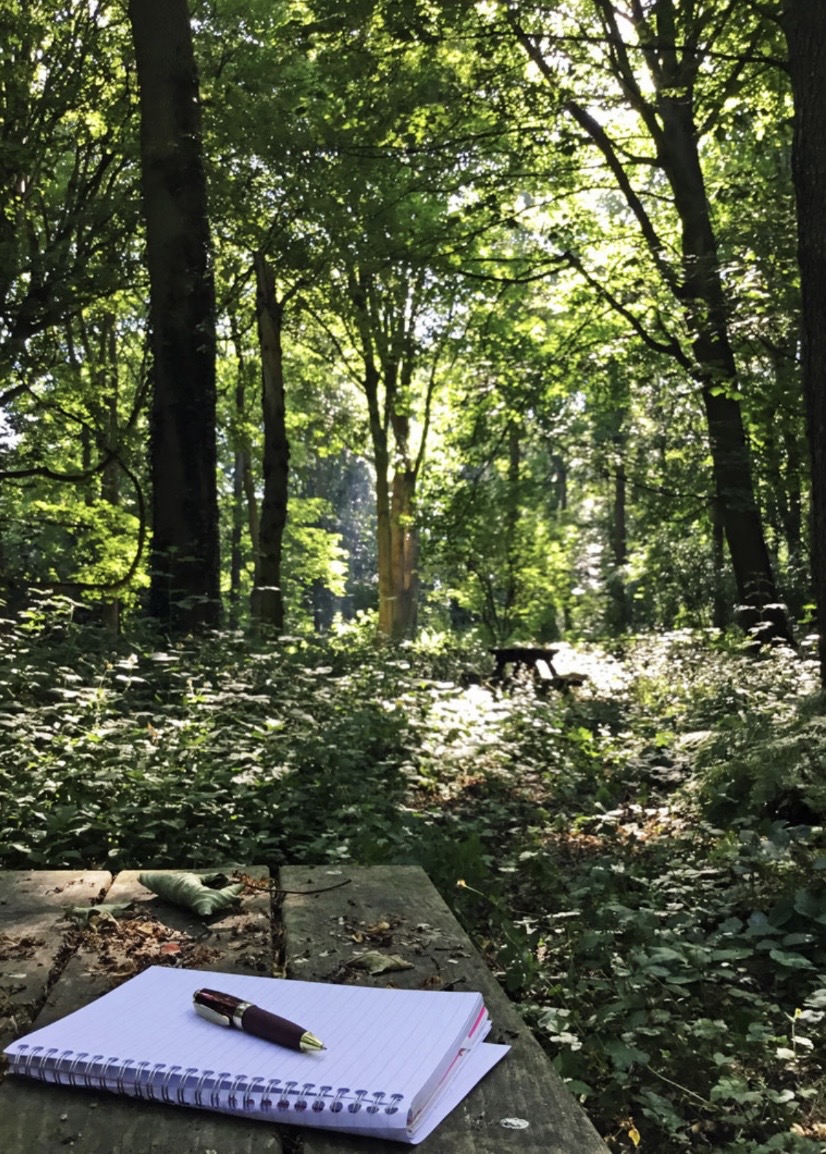
At two in the morning, I sometimes put on the bedside light and reach for a notebook, because a thought has arrived that seems worth keeping, and experience has taught me that however certain I am I will remember it, by morning it may have gone. I go to bed early and usually fall asleep straight away, but a few hours later I can find myself awake with ideas, as though something has been quietly gathering while I slept and is now ready to be written down.
I cannot say exactly what happens in those hours, only that this is how it feels. Ideas from long ago collide with something new, a sentence in a book or something glimpsed on a walk, and in that meeting a thought begins to take shape, drawing together things I hadn’t realised were connected.
During the day, I carry a smaller notebook. I make time to read and write, and when I’m driving I often listen to an audiobook. Some of my most interesting thoughts arrive while I’m out walking with Digby, with time to notice what is around me and let my mind wander. There is something about walking, about allowing my eyes to follow what is around me while my feet know what to do, that gives a thought room to travel. I may set out with one thing on my mind and return with another, having noticed something that drew me away from the question I thought I was trying to answer.
Sometimes I finish a book, or reach the end of an audiobook, and feel that I have remembered surprisingly little. I could not give a proper account of its argument or repeat the passage that held my attention, yet days later an idea surfaces and I recognise something of what I have read within it. More has stayed with me than I knew, although it has not necessarily remained in a form I can summon when asked.
Poetry seems to leave its own particular traces. An image, a rhythm, a way of bringing two apparently distant things together can linger somewhere beyond my immediate recollection, then return when the light falls a certain way or something moves in the river. I read a poem and go on with the day, unaware of what it may have seeded, until an ordinary encounter feels a little deeper because those words have passed through my life.
Writing by hand helps me hold on to things too. There is something in the pace of a pen moving across paper, in having to remain with a thought while I find the words for it, that seems to help me remember. Sometimes the sentence changes as I write, or leads somewhere I had not anticipated, and what began as an attempt to record an idea becomes a way of discovering what I think.
For much of the past month, however, I was very busy, and these familiar activities were squeezed into smaller and smaller spaces. There was less time to read, less time to write without a particular purpose, and less opportunity to wander in the unhurried way that allows me to follow whatever catches my attention. Gradually, I noticed that the ideas were arriving less often.
My days were certainly full. I was taking in information, making decisions and learning things, yet I began to miss the kind of thinking that usually happens around the edges of an ordinary day. I found myself wondering how much I depend on those apparently spare moments, and how easily I give them away because their value is difficult to explain before anything has come of them.
It made me think about screens, and about how readily an unoccupied moment can become another opportunity to take something in. I rarely watch television unless my daughter puts something on and we watch together, and I value that shared time, just as I value the writing, art and conversations I encounter online. But I recognise the impulse to reach for a screen before a pause has had time to become anything, to fill the little interval in which I might otherwise look out of the window or allow my thoughts to drift.
I wonder what happens to a thought when another arrives so quickly behind it, and another behind that. How often do I give something time to meet what I already know, to stir a memory or become a question of my own?
Art helps me stay a little longer. When I draw a leaf, I begin to notice how its edge turns, where a vein branches, how one part has dried differently from another. What I thought I had seen becomes more complicated as I try to put it on paper, and I have to look again, adjusting the mark because the leaf is showing me something I missed.
The finished drawing holds only part of that experience. There is also the time I have spent in the company of this particular thing, learning its irregularities, discovering how readily I had substituted an idea of a leaf for the leaf itself. Even if the drawing goes no further than a page in my journal, that time has mattered.
As AI becomes more present in our lives, I find myself thinking about what happens to us when we no longer take part in the slow, physical and sometimes uncertain processes through which creativity becomes part of our lives. There are valuable uses for these tools: they may help with routine accounts, organise information, support IT, assist with app building, or take on repetitive tasks that consume time. Used thoughtfully, they may give us more room for activities that might otherwise be squeezed out of the day.
But what if, in our eagerness to make everything quicker, we begin to hand over the pauses in which we think, dream, notice and make? What might we miss when we stop drawing because an image can be generated in seconds, or abandon an unfinished thought because an answer is immediately available? The result may look convincing, even beautiful, while we have passed over the time spent looking, the small resistance of the material, the mistakes that alter our direction, the unexpected thought that emerges because we have stayed with the difficulty.
This leaves me wondering whether the origin of an image matters to our experience of it, and whether it matters in ways we can immediately recognise. When I look at a photograph of a woodland, I understand that somewhere those trees stood in that relationship to one another, that light entered through those branches, and someone was there to notice it. When I look at a drawing, I can follow the marks left by another person’s attention, their attempt to meet something with their eyes and hands. I wonder how much that knowledge contributes to what I feel, and what changes when I discover that an image which moved me was generated rather than witnessed.
I cannot assume that my brain knows the difference before I do, or that the comfort I might find in a generated image is somehow unreal. Whether it offers the same restorative possibilities as a photograph or a work made by hand is a question I would want to explore, rather than answer from intuition alone. Yet I remain interested in what happens when we know that another person has looked, felt and tried to give form to an experience, leaving something through which we might encounter it too.
Perhaps part of what I value in a painting, a photograph or a poem is this sense of meeting another person’s attention, of being invited to linger where they once lingered, and to discover what becomes visible through that shared act of looking. Even an imagined landscape can carry something of the life of the person who imagined it, their memories, preoccupations and ways of seeing, which may touch something in my own.
For the person making the work, there is also the encounter itself. When I try to follow the curling edge of a leaf with a pencil, I allow what is in front of me to alter what I thought I knew. The drawing may be modest, but it has required my patience, my uncertainty and my willingness to look again, and I carry something of that attention away with me when I close the journal.
The same is true of writing. When I struggle towards a sentence, I am often still discovering what the thought is, and the sentence becomes a place where thinking happens. It may falter, become awkward or lead me somewhere unexpected, and in that movement I may discover a connection that would never have appeared if the words had arrived already formed. Sometimes the difficulty asks me to stay long enough for something less obvious to emerge.
This is why I want to be careful about what I ask technology to do for me. There are moments when I need a practical outcome quickly, and others when the time spent finding my way is part of what I need. I want to recognise those differences, especially when convenience makes it tempting to treat every hesitation as a problem to be removed.
What happens to our inner lives if every empty space is filled, every question answered before it has had time to deepen, every image supplied before we have looked closely enough to make one of our own? Might we become so accustomed to receiving that we give ourselves fewer opportunities to discover? And if we stop practising attention, what will we pass without noticing?
These are questions I want to keep beside me as I decide how to use the tools available. I want to protect the activities whose value lies partly in their slowness: writing in a notebook, drawing what is in front of me, walking without filling the silence, allowing a thought to remain unfinished, looking at a tree long enough for its particular character to begin to emerge.
And I wonder what all of this means for our relationship with the living world, which offers so much to anyone willing to linger, but can so easily become the background to a life conducted elsewhere. How do we continue to meet it with curiosity if we rarely give ourselves time to be drawn beyond a first impression?
Knowledge can deepen an encounter. Something we learn about a tree may send us back to look at its bark, its roots, the life gathered in the crevices, while time spent beside it may raise a question we would never have thought to ask. Reading and wondering can sustain one another in this way, each making the next encounter a little richer.
We do not have to know the name of everything before it can matter to us, but familiarity gives us something to remember and return to. I think of the places I walk through often, and how my sense of them has accumulated through small encounters, until a tree or a bend in the river has become part of the way I know where I am.
What might I fail to notice if I stopped giving those places my attention? What changes would pass me by, and what questions would remain unasked? Attention cannot, by itself, protect a river or preserve a woodland, but it can bring a change into view and give us a reason to find out more, to speak, or to act.
Perhaps this is part of why creativity matters to me, and why I felt the absence of those quieter practices during a busy month. They keep me curious about things beyond the immediate demands of the day, giving an unfamiliar thought somewhere to begin and a familiar place another chance to surprise me.
Now that the busiest weeks are behind me, I have more time again for reading, writing, drawing and wandering, and I return to them with a clearer sense of how much they bring to my life. There is pleasure in reading a poem and lingering over its words, in opening my notebook without needing to turn what I write into a finished piece, and in walking with enough time to stop beside something that interests me, allowing whatever thoughts arise to take their own shape.
And when I next pick up a leaf to draw, I would like to give it enough time to show me something I haven’t yet seen.
Support Nature Speaks
Choose an amount
Or enter a custom amount
Nature Speaks will always be free to read. If something here has made you pause, look a little longer, or notice the living world differently, you can help support the time and care that goes into the writing.
You can also visit Moss & Maye, where I bring together my artwork and thoughtfully chosen objects for those drawn to nature, beauty and the stories things carry.