Not long ago, when I mentioned on LinkedIn that I owned a little stretch of the River Ceiriog, Keith, whose conversations there have often made me stop and reconsider something I thought I understood, replied with four words: we don’t own anything. I have thought about those words many times since, and the more I have thought about them, usually when I am close to the river itself, the less straightforward the word own has begun to feel. My name may be on the deeds, alongside the careful language of boundaries, riparian rights, fishing rights and ownership of part of the riverbed, but perhaps those documents describe only one particular human arrangement with this place, necessary in the world we have constructed, while saying almost nothing about the deeper relationship between a river and all the lives gathered around it. The water itself passes through those invisible boundaries without hesitation, carrying what was somewhere else yesterday towards somewhere else tomorrow, while the otter slips beneath a bank without knowing whose bank it is, the kingfisher crosses from one ownership to another in a flash of blue, and the heron stands in the shallows with the magnificent indifference of a creature that has never encountered a title deed.
The longer I have lived beside this river, the more peculiar the idea of possession has become, because to say my river is to speak from the smallest possible perspective in a place inhabited by lives whose claims upon it are older, more immediate and, in many cases, more absolute than mine. I can leave the river and return to my house; the brown trout cannot, the grayling cannot, and neither can the tiny creatures clinging to the undersides of stones, living almost entirely beyond human sight in the cold, moving world between rock and water. For them this is not a view, an amenity, a place for recreation or a desirable addition to the value of a property; it is simply the world, the entirety of what sustains them, surrounds them and makes their particular form of existence possible.
And yet the longer I live here, the more I wonder whether even our love of rivers can contain a subtle kind of possession, because we speak so readily of what nature gives us — peace, restoration, beauty, somewhere to walk when the human world becomes too loud — that it is easy to forget that the river is not here to restore me, the kingfisher is not blue for me, the trout does not enter a patch of sunlight so that I may experience wonder, and the dragonflies patrolling the water on warm afternoons, or the damselflies so slight that sometimes they seem less like creatures than fragments of colour temporarily held together by light, are not decorations placed along the bank for my pleasure. They are living their own brief, urgent lives in a world that happens to intersect with mine, and would go on doing so if I had never come down the path to see them.
Even the horseflies, those dreaded and astonishingly persistent creatures whose arrival can empty a peaceful summer afternoon of almost all philosophical generosity, belong here no less than the kingfisher does, and perhaps they are useful reminders of how quickly our ideas about the value of nature become entangled with our own preferences. It is easy to construct an idea of the natural world from the creatures we have decided to love — otters moving secretly through the river, kingfishers stitching that impossible blue between the trees, badgers travelling their ancient paths nearby, foxes appearing at the edge of a field, owls calling somewhere beyond the house — but harder to extend the same recognition to the rat beneath the bank, the horsefly circling our bare leg, the insect larva beneath a stone, or the innumerable creatures whose names we will never know and whose beauty we have never learned to recognise. The river makes no such distinction; it accommodates the beautiful and the inconvenient, the noticed and the unnoticed, the creature we photograph and the creature we recoil from, without asking any of them to justify their presence to us.

A local zoologist once told me about some of the small creatures that live beneath the rocks here, and since then I have found it difficult to look at those apparently ordinary stones in quite the same way, because their unseen surfaces are inhabited too. Beneath water that from the bank may appear almost empty, lives are feeding and hiding, hunting and mating, emerging and dying, entire dramas of existence occurring at a scale to which most of us have simply failed to pay attention, and there is something profoundly humbling in the thought that what we see of a river may be only its thinnest visible layer, while below the threshold of human noticing an immeasurably complicated community continues whether or not anybody is there to witness it.
In spring I sometimes notice nests built on branches overhanging the water and wonder at their precariousness, at those tiny lives beginning inside structures assembled from twigs and grass above a current that will not soften itself because a young bird is learning to fly. We notice the successful fledgling perhaps, hear its insistent calls from the trees and watch the parents returning with food, but I sometimes wonder about the others, about how many first flights end in the water, how many small lives disappear without witness, and how much birth and hunger and fear and death is occurring around us while we make tea, answer emails, worry about money, arrange our possessions and move through our days with the largely unexamined assumption that the human world is the principal world, rather than one life among millions unfolding simultaneously around us.

There are places along this stretch of the Ceiriog where the current loosens and deeper pools form, where the water becomes darker and still enough that, when sunlight reaches it at the right angle, I can sometimes see brown trout suspended below the surface, apparently motionless until one moves and reveals that what I had taken for stillness was simply a different kind of attention. There are grayling here too, and sea trout and salmon belong to the wider life of the river, although what I know most intimately is not the catalogue of species but the experience of looking into the same water over many years and feeling that I see fewer fish now than I once did. I cannot prove this from standing on the bank; I have no survey or sequence of measurements to place beside the memory, only the imperfect evidence of repeated looking, and perhaps that distinction matters, because loving a place does not automatically make us experts on it, but it can make us witnesses.
Perhaps these are among the saddest observations we make about places we have known for a long time: that there used to be more fish, more insects, more birds, not because change itself is unnatural, but because so often we do not recognise the moment when abundance begins becoming memory, and by the time we find ourselves reaching for the words there used to be, something that once seemed so ordinary that we scarcely thought to count it has already become remarkable. There is a particular sadness in remembering abundance because memory cannot tell us precisely when the change occurred; it only preserves the uncomfortable knowledge that once we expected to see something that now surprises us when it appears.
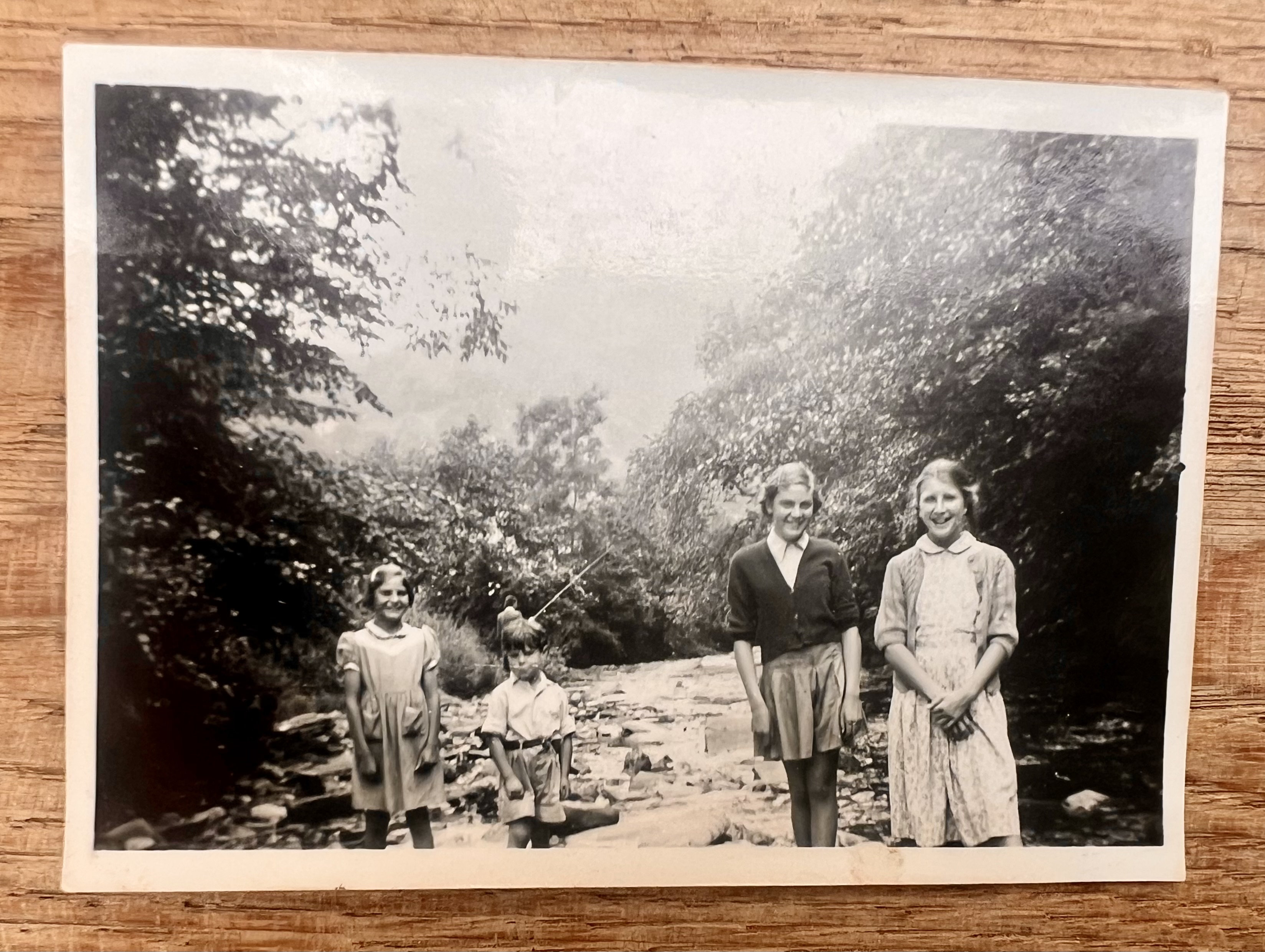
My own memories of the Ceiriog seem to reach beyond my lifetime because I have photographs of my family standing in this river going back generations, people whose feet touched these stones beneath water that has long since travelled onwards, people who perhaps also looked into these pools for trout, who heard this river after rain and crossed it in summer and knew the particular coldness of its water around their ankles. I find those photographs increasingly moving, not simply because the people in them belong to me, but because in another sense they no longer belong to anyone: the people changed, aged and disappeared, children became adults and stood in the river with children of their own, houses changed hands, names were written onto deeds and later replaced by other names, boundaries were surveyed and gardens bought and sold, while the Ceiriog continued to come down from the hills, passing through all these human arrangements as water always has.
There is something strange about looking at an old photograph and realising that every person within it once experienced that moment as now. They could not feel themselves becoming history any more than I can as I stand beside the river today; the sunlight on their faces was present sunlight, the water around their ankles was present water, whatever they were talking or worrying or laughing about belonged to a future still unfolding before them, and yet from where I stand they have already become the past. Perhaps rivers reveal something about time that we spend much of our lives trying not to understand: that permanence may be largely an illusion produced by the brevity of our perspective, and that while we imagine the river passing through our landscape, it is also passing through generations of us.
For a little while my family stood here, and for a little while I stand here, and one day somebody I will never know may stand in this same place and look into one of these pools. Perhaps they will know nothing about me beyond a name encountered on an old deed, if even that, just as there are names in the history of places that we read without being able to imagine the living person who once answered to them; or perhaps, somewhere, a photograph of me standing in the Ceiriog will survive, and I will have become what the people in my old family photographs have become for me — a figure standing in another time, caught for a fraction of a second in water that seemed entirely present to her. The thought is strangely moving, because I know that if such a photograph is taken I will not feel historical as I stand there; I will be thinking whatever I happen to be thinking that morning, perhaps looking for trout in the deeper water or listening for the kingfisher, while the person who looks at the photograph many years later will know something I cannot feel from inside my own life: that my time beside the river has already passed.
And perhaps that future stranger will wonder about the river too, not whether the garden was once beautiful or whether the water added value to the property, but what lived here when I did, what moved beneath the surface and along the banks, and what has survived into their own brief period beside it. Will there still be trout holding themselves in the light, will the kingfisher still announce itself not by arrival but by disappearance, that flash of impossible blue already gone by the time the mind has understood what the eye has seen, will dragonflies still patrol the summer water and damselflies settle among the vegetation, will an otter pass through in darkness, and beneath apparently ordinary stones will there still be those small creatures living lives that the person standing above them may never know are there? Or will some of these have joined that growing catalogue of things remembered principally through the words there used to be?
Perhaps this is where the language of ownership finally fails me, because ownership asks what belongs to us, whereas a river seems continually to ask the opposite question: what do we belong to? The water passing my garden has fallen somewhere upstream, moved through soil and roots and tributaries, passed fields, roads, houses and other people’s pieces of river before reaching mine, and what enters it there eventually reaches me, just as what enters it here will travel onwards towards somebody I cannot see. A river exposes the fiction of separateness rather beautifully, because my stretch cannot truly be healthy if the water arriving from elsewhere is not, and whatever happens within my boundary does not remain obediently there simply because a map says that it should; the river gathers our separate actions into one moving consequence and carries them downstream.
Perhaps, then, I do not own this river so much as I have been allowed a period of closeness to it, a few decades, if I am fortunate, in which I can learn the sound it makes after rain and where the deeper pools form, notice the first damselflies and curse the first horseflies, look for trout beneath the surface and kingfishers above it, wonder about the nests suspended over the water and occasionally remember that beneath the stones are lives I will probably never understand. And perhaps this is what sustained attention eventually does to us: we begin by looking because the world is beautiful, and if we keep looking long enough beauty becomes something more difficult and more demanding, because the kingfisher leads us to the fish, the fish leads us beneath the surface, the stone leads us to the almost invisible creature clinging underneath it, and the otter leads us upstream and downstream beyond the boundary we thought was ours, until gradually the river ceases to be scenery and becomes what it has always been, a community of lives, most of which have nothing whatsoever to do with us.
There is both liberation and responsibility in recognising this, because a river does not need to delight us in order to matter; it does not need to improve our mental health, raise the value of our houses, provide somewhere beautiful to walk, offer fish to catch or photographs to take, and the rat does not have to become lovable, the horsefly does not have to stop biting, nor do the creatures beneath the stones even have to become known to us before their lives acquire value. Perhaps one of the most difficult forms of attention is learning to recognise that something matters despite being of no use to us at all, and that the living world does not require a human purpose in order to justify its continuation.
My name may be written on the deeds for this small piece of the Ceiriog, but the river has no knowledge of such arrangements, and sometimes I imagine all those generations of my family standing in its water, each of them inhabiting what must once have felt like the permanent present while the river moved around their legs and onwards, until they too became part of the past through which it had flowed. Somewhere among those photographs there may one day be another, perhaps of me standing where they once stood, and somebody who never knew my voice, or the things I worried about, or what it felt like to wake here and hear the river after rain, may know me only from a name preserved on an old document, or from a faded photograph in which I have become what those people in my family photographs have become to me: someone who once stood in this water and believed, quite naturally, that this moment was now. By then another name may be on the deeds, another family may look into the pools for trout, another person may stop in mid-sentence because a streak of impossible blue has crossed the river, while beneath the stones lives will continue that neither of us ever knew were there, and the Ceiriog, indifferent to the brief succession of names by which we divide the world between ourselves, will go on carrying lives we know and lives we have never noticed towards a future none of us will see.
Perhaps this is what Keith’s four words have been asking me to consider all along, because the deeper I look at this place, the harder it becomes to understand ownership as anything more than a temporary human arrangement laid over something immeasurably older and more complicated than ourselves. We arrive, draw our boundaries, put our names on paper, love certain creatures, overlook thousands of others, grow older and eventually disappear, while the water continues around the stones and beneath the branches where new lives are beginning.
Perhaps the river has been showing us the limits of ownership all along: the river is not passing through our lives; we are passing through the life of the river.
