When I worked in the hospital, patients were sometimes referred to by their condition and the place in which they happened to be lying—“the hernia in bed three,” “the fractured hip in bed six,” “the chest infection by the window”—and although such phrases could sound jarring when heard outside the ward, they were rarely intended unkindly, because hospitals are busy places in which language becomes compressed under pressure, and a diagnosis may be the most immediately relevant information when people are making decisions about treatment, allowing a few words to communicate what an entire team urgently needs to know.
I understood the usefulness of this shorthand, yet there were moments when I wondered what happened to the person when the condition became their name, and whether seeing beyond labels became more difficult once the label had gathered everyone’s attention around the part of a life that was injured, diseased or in need of treatment. The hernia in bed three had arrived with a whole existence, although almost none of it appeared in the phrase by which they were now identified: relationships, memories, loyalties and private jokes; knowledge acquired over decades that no one on the ward knew they possessed; fears they might not have spoken aloud and ordinary pleasures to which they hoped to return; perhaps somebody at home who depended upon them, somebody they were quietly mourning, or an animal waiting behind a closed door and listening for the familiar sound of their key.
The hernia was real and required attention, but it was not the whole person, and perhaps every form of expertise carries this risk, because in order to understand anything we must identify what appears most relevant, give it a name and place it within a category, allowing us to recognise patterns, share knowledge and decide what action may be needed, yet the very clarity that helps us act can also narrow what we see, until the name that was intended as a beginning becomes a stopping place and we feel, without quite realising it, that we already know what matters.
Once a person has become “the hernia,” the rest of their life can recede behind the condition; once a plant has become “a weed,” an insect “a pest,” an animal “vermin” or a tree “dangerous,” the category can begin to replace the living presence before us, even though the label may describe something real, because the plant may be growing where it is not wanted, the insect may threaten a crop, the tree may genuinely be unstable and an introduced species may cause serious ecological harm. The problem is not that such categories are necessarily wrong, but that they are necessarily incomplete, drawing one feature into the foreground while allowing everything else to soften and disappear behind it.
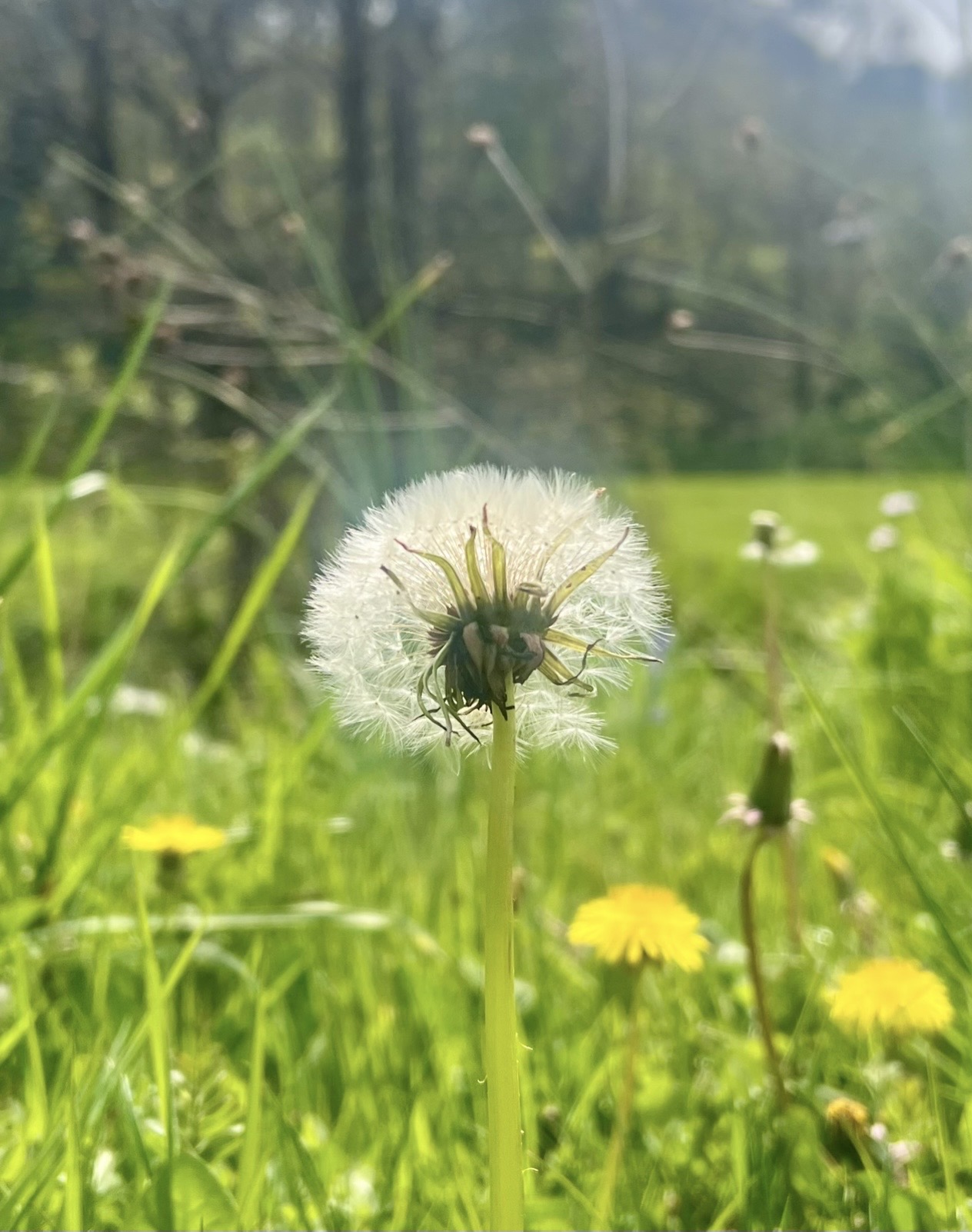
Consider the word weed, which tells us almost nothing about the plant itself and much more about the relationship between that plant and a particular human intention, because the same dandelion may be pulled from a vegetable bed, visited by insects at the edge of a field, gathered for food or medicine, studied by a botanist, painted in a journal or held for the first time by a child preparing to blow its seeds into the air; although the plant has not changed, the frame around it has, and within each frame a different part of its existence is permitted to become visible.
Even apparently neutral names can bring attention to a premature end, because we identify an oak, a raven, a fox or a badger and experience the small satisfaction of recognition—I know what that is—although the name tells us only what kind of being we have encountered and cannot tell us about this particular tree, shaped by decades of prevailing wind, nor this raven watching from the fence with a history of encounters we cannot know, nor this fox following routes through the darkness that were old before we became aware of them. Naming can open the door to attention, giving us language through which to approach another life, but it can also quietly close that door when recognition is mistaken for understanding.
I thought about this recently after seeing a young badger that had died on the road near my house, an animal I could easily have registered as “a dead badger,” perhaps even “roadkill,” before continuing with the day, yet because I had once spent many evenings beside a large sett and had gradually learned to recognise the badgers through their different appearances, habits and personalities, the collective name no longer felt sufficient. I had probably never seen this young animal alive and did not know from which sett it had travelled, but it was unknown rather than anonymous, a particular life that had ended where a human road crossed an older animal path, and somewhere beyond anything I could see, someone was missing from a sett that night.
The more closely we attend, the more difficult it becomes to treat living beings as interchangeable examples of a category, because “the birds” gradually become the raven waiting on the fence, the magpie growing bolder in its presence and the jay arriving when the others are absent, while “the spiders” become the one rebuilding its web across the same corner each morning, and “the trees” separate into individuals with different wounds and inclinations, offering different forms of shelter and carrying within their shapes the weather, damage and seasons through which they have lived.
Attentive Wondering often begins with a name, but asks us not to remain there: this is a rose, this is lichen, this is a feather, a stone, a snail shell, and recognition gives us somewhere to begin, yet if we stay for long enough, the reassuring certainty of the category gives way to the particular—the folding of one petal, the small worlds held within a patch of lichen, the unevenness along the feather’s edge, the line of mineral passing through the stone—so that the object becomes more fully itself at the same time as our confidence that we have understood it becomes less complete.
Perhaps the same quality of attention is needed between people, whom we continually place within roles and identities because social life would be impossible without them—patient, nurse, customer, neighbour, mother, child, colleague—although every role reveals one relationship while concealing countless others, and the person who appears before us in one context may contain ways of being that the circumstances never invite us to see. A patient is also someone’s friend, adversary, confidant or first love; a quiet person may contain thoughts that have never been given sufficient room to emerge; someone described as “difficult” may be frightened, in pain, unheard or responding to a history that no one present has taken the time to understand.
This does not mean that every judgement is mistaken, that every diagnosis confines rather than helps, or that all behaviour must be excused, but only that no single description should be allowed to claim the whole person, because even an accurate word illuminates one part of a life by leaving much of the rest in shadow, and wisdom may consist partly in remembering the darkness that remains beyond what we have named.
Perhaps this is why genuine attention can feel so unusual and so moving when we receive it, because to be listened to by someone who has not already decided what we are, what we mean or what we are about to say is to be released, briefly, from the categories that usually arrive before us, and within that unhurried attention we are given room to become more particular, to say something unexpected, to contradict an earlier version of ourselves or to reveal a part of our life for which there had previously been no place.
We can offer the same gift to the living world by looking beyond “useful” and “useless,” beyond “beautiful” and “ugly,” and beyond the species name towards the individual life, allowing what we encounter to exceed the purpose, threat or benefit we have assigned to it, while recognising that this attention does not prevent us from making necessary decisions but may change the humility, care and awareness with which those decisions are made.
Language will always simplify because it must, and no word could ever carry an entire person, animal, tree or landscape within it, yet we can remain conscious of what has been left outside the frame and resist the comfort of believing that what we have named is all there is to know. “The hernia in bed three” communicated something important, but it could never communicate everything, and the danger began only when we forgot that behind the phrase was a person whose life had not started at the hospital doors and could not be contained by the reason they had entered them.
Perhaps attention begins at precisely that point, when we recognise that the name is necessary, the diagnosis may be accurate and the category may be useful, while understanding that the life before us—human, animal or plant—is still immeasurably larger than any of them.