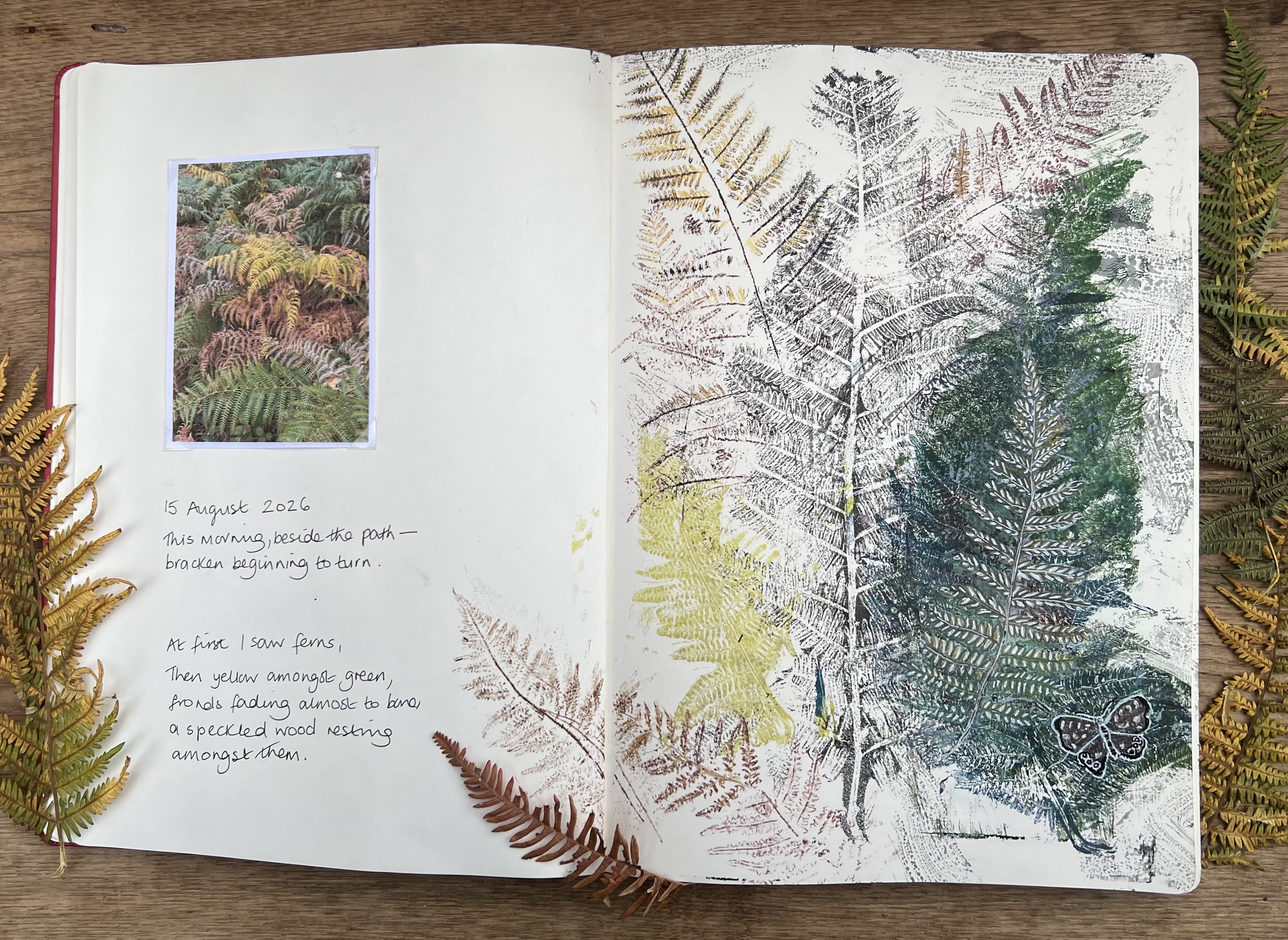
There is a temptation, when we begin paying closer attention to the natural world, to turn noticing into another kind of collecting, to look for the bird we have not seen before, the flower we cannot name, the unusual insect, the spectacular sunset or the landscape sufficiently beautiful to make us stop in our tracks, and perhaps, without quite realising what we are doing, to begin measuring the richness of our attention by the number of things we have managed to find. We take photographs, identify species, make lists, save places we would like to visit, and there is pleasure and value in all of this, of course, but lately I have been wondering whether attentive wondering asks something rather different of us, something quieter and perhaps more difficult: what if it does not help us to see more things, but instead helps us to see more in the same things?
This morning, walking among the ferns, I found myself noticing the colours.
At first there was simply bracken, so familiar that I might easily have passed it without really seeing it, another mass of green at the side of the path, part of the background against which other, apparently more interesting things might appear. But then there was yellow amongst the green, and ochre, and brown, and fronds fading until they were almost the colour of bone, the whole patch carrying different moments of the season at once. And there, resting amongst them, was a speckled wood butterfly, so beautifully accommodated by the colours and patterns around it that it seemed to belong not merely on the ferns but somehow within them.
Nothing about this was rare. There was no great spectacle, nothing I might have travelled somewhere especially to see, and perhaps that was precisely why it held me. The ferns had almost certainly been there yesterday, and the day before that, changing quietly without requiring my attention. What had changed this morning was not the world itself, but the quality of my attention to it.
I brought a few of the fronds home.
Later, laying them onto a gel plate and making prints from them, I began to see them differently again. The first impressions were imperfect, some too dark, some incomplete, the shapes appearing and disappearing beneath layers of paint, but the process made me look more closely at what I had collected: the repetition of the leaflets, the branching structure, the fine lines of the stems, the places where a frond had curled or begun to dry. What had seemed, from a few steps away, to be simply a patch of bracken had become colour, pattern, structure, change, and eventually something I wanted to draw and print and remember.
This happens surprisingly often when we give an ordinary thing more time than we think it deserves. A hydrangea I have known for years becomes unfamiliar when drought causes its leaves to hang and curl, and then, after rain and watering, gradually begins to resemble itself again; a rose flowering later than expected is no longer simply a rose, but this particular flower at this particular moment in the year, carrying within its petals the story of heat and weather and insects and time; lichen on a familiar surface, passed perhaps every day without thought, becomes an intricate landscape when I finally bring my attention close enough to see it.
Nothing new has arrived. The fern was already there, the rose was already flowering, the lichen had been slowly spreading whether I looked at it or not.
What changed was not the world, but the quality of my attention to it.
There is something curious about familiarity because it makes life possible while also making parts of life disappear. We could not move through the world if everything demanded our full attention, and so the gate becomes simply the gate, the tree beside the road becomes simply the tree, the sound of the river settles into the background and the path we have walked a hundred times asks less of us than it did when we first discovered it. Our minds become extraordinarily efficient at recognising what is already known and deciding, quite reasonably, that we do not need to examine it again, yet the familiar thing has not stopped changing simply because we have stopped looking.
The tree we think we know is opening buds, feeding insects, responding to drought, growing around old wounds, supporting lichens and mosses and fungi, receiving birds, losing leaves and thickening almost imperceptibly beneath its bark; the river we call the same river is never made of quite the same water, never carrying precisely the same reflections, sediment, light or living things; even the stone beside a familiar path is warming beneath the sun, cooling beneath rain, gathering moisture, sheltering small lives beneath it and slowly acquiring its own miniature communities of moss and lichen. All of this continues whether we notice it or not, which makes me wonder how much of the world we cease to see not because it has become less remarkable, but because we have become accustomed to its presence.
Perhaps one of the strange consequences of familiarity is that eventually the name begins to stand in for the thing itself. Fern. Oak. Raven. Lichen. Rose. Once we know what something is, there can be a subtle sense that the work of seeing has been completed, yet a name, useful and beautiful though it can be, is only a beginning. Knowing that something is lichen tells me something important about it, but it does not tell me the precise green of this particular patch after rain, why one edge resembles a coastline seen from high above, how many colours appear when I stop thinking of it simply as grey-green, or what memories and associations arise as I look. Knowing the name of a bird does not tell me how this particular bird moves through the landscape, where it pauses, what it watches, how it responds to my presence, or what I might notice if I return tomorrow and the day after that.
There is factual knowledge, and there is acquaintance, and I think we need both.
Attentive wondering, as I have come to understand it, begins somewhere in the space between them, in the small pause before we hurry to turn an encounter into information: observe, wonder, reflect, create. Not because every encounter needs to become a drawing or a piece of writing, and certainly not because everything we notice needs to become useful, but because making something — a few lines in a notebook, a sketch, a photograph taken with intention rather than reflex, a colour mixed on paper, the impression of a fern pressed onto a page — can keep us beside what we have seen for a little longer. It asks us to resist, just for a while, the desire to close the question with a name, and instead to remain with other questions: What is happening here? What have I not noticed before? What changes if I stay? What have I assumed I already know?
There is a gentleness in this that I increasingly value because it does not require us to go anywhere special. Wonder is so often presented to us as a response to magnitude — mountains, ancient forests, enormous skies, rare animals, extraordinary journeys — and of course such encounters can awaken something profound in us, but if wonder depends upon novelty, rarity or spectacle, then ordinary life will always struggle to provide enough of it. There will always need to be another place, another view, another experience, while the familiar world around us becomes increasingly transparent through repetition.
Attentive wondering offers another possibility: that depth might sometimes matter more than novelty, and that returning to the same garden, the same tree, the same stretch of river or the same path does not necessarily mean having the same experience. The first visit gives us the outline; later visits begin to reveal the variations. We notice what has disappeared because we remember it being there, recognise the first reddening leaf because last week it was green, hear the absence of a bird because its call had become familiar, notice the river rising because we have known it low. Slowly, almost without our realising it, a landscape stops being scenery and becomes something closer to a relationship, made not from a single dramatic encounter but from the accumulation of small acts of attention.
Perhaps this is why attentive wondering cannot be reduced simply to being observant. Observation matters, but there is something beyond observation in allowing the familiar world to become strange enough to question again, in loosening for a moment our certainty that because we recognise something we therefore know it. Children can sometimes do this effortlessly: a hole in a leaf is not damage but an opening through which the world can be viewed; a feather is not merely a feather but an object requiring examination from every angle; a stone may need to be carried home because of a pale line running through it that an adult would scarcely register. We do not need to imitate childhood or pretend not to know what we know, but perhaps we can occasionally recover that willingness to let an ordinary thing become particular again.
This fern, rather than ferns. This stone. This raven. This patch of light travelling across the surface of the river. Not examples of their kind, not scenery and not background, but individual encounters happening here, now, once.
There is something hopeful in this because it means that a richer experience of the living world does not necessarily require more time, more knowledge, more travel, more equipment or even more nature; perhaps, paradoxically, it requires less — less hurry, less assumption, less insistence upon finding something remarkable, less of the restless feeling that whatever might awaken us must be somewhere other than where we already are.
Perhaps the practice can begin simply by choosing one thing we think we already know and giving it our attention again: the tree we pass every morning, a weed growing through a crack, birds gathering on a roof, a leaf beginning to turn, the movement of water around a stone, the ferns beside a familiar path as summer begins almost imperceptibly to lean towards autumn.
Stay with it for a little longer than seems necessary, long enough for the first easy recognition to pass and something else to begin.
Look once, and then look again, and instead of asking what else there is to see, perhaps we might ask a quieter question:
What is here that I have stopped seeing?
Because perhaps attentive wondering does not make the world more interesting at all. Perhaps it simply allows us, every now and then, to rediscover something we had forgotten — that the world never stopped being interesting simply because we became accustomed to it.
Support Nature Speaks
Choose an amount
Or enter a custom amount
Nature Speaks has been growing since 2011. Each essay may begin with something small — a leaf, a feather, a bird or a familiar path — but behind it are hours of observation, reading, research, reflection and revision. I keep this writing freely available because I believe that beauty, curiosity and a deeper relationship with the living world should be open to everyone. If something you have read has stayed with you, or changed what you notice, a small contribution helps me continue this independent work. Thank you for reading, whether or not you are able to give.