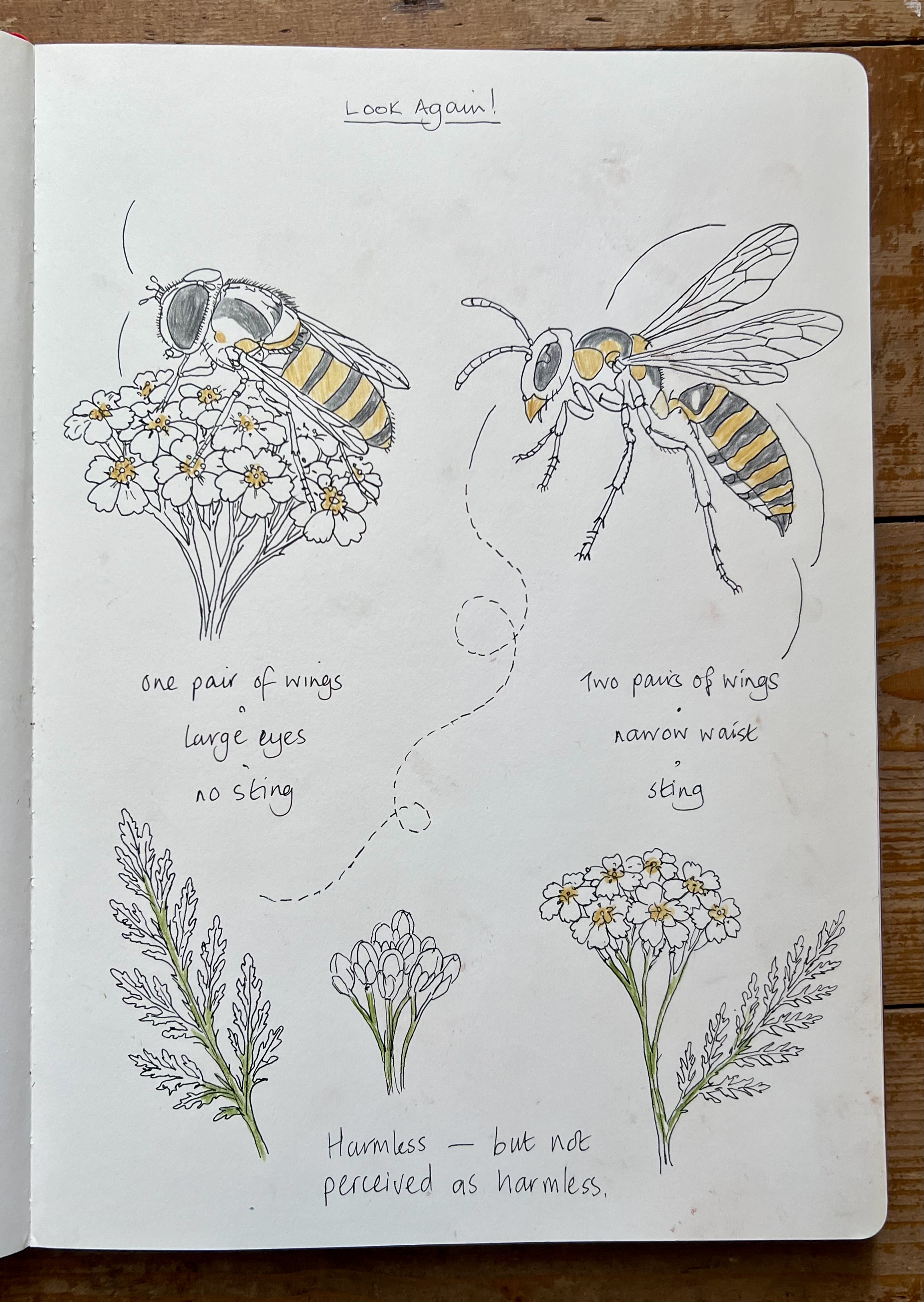
At first glance, the insect resting on the flower appears to be a wasp, its abdomen carrying those familiar bands of yellow and black which we recognise so quickly that the response often arrives before thought — a small recoil, a sharpening of attention, the instinctive sense that here is something best given space. Yet I have never thought of wasps as creatures intent upon harming us. They possess a sting, certainly, and will use it when they or their nest are threatened, but the ability to defend oneself is not the same as aggression, and perhaps it says something about our own way of looking that we so readily turn an animal’s means of protection into its defining character.
If we remain beside the flower for a little longer, however, another possibility begins to emerge. The eyes are unusually large, the antennae are short, and the body lacks the narrow waist we associate with a wasp; there is only one pair of wings rather than two, and the insect may rise from the flower and remain almost motionless in the air before darting sideways with a speed and precision that no wasp quite possesses. It is a hoverfly — harmless in the sense that it cannot sting us, yet carrying the colours of a creature that can, its safety resting partly upon the possibility that a bird, or perhaps a hurried human observer, will see the pattern and decide not to investigate too closely.
This resemblance is known as Batesian mimicry, although the word mimicry can make it sound like an act of conscious disguise, as if the hoverfly has looked upon the wasp and chosen its costume. What has happened is quieter, slower and far stranger: across countless generations, those hoverflies whose markings happened to resemble the warning colours of a stinging insect may have caused a predator to hesitate for just long enough to escape, and so a moment of uncertainty, repeated through deep time, gradually became a form of protection. The hoverfly does not know that it looks like a wasp, nor does the wasp know that another creature lives partly beneath the shelter of its reputation, yet the lives of the two have become connected through the perceptions and memories of the animals that encounter them.
It would be easy to tell this as a story in which the hoverfly imitates something frightening, but that would be to misunderstand the wasp as much as we first misunderstood the fly. Wasps are hunters, pollinators, nest-builders and attentive social creatures, woven into their ecosystems in ways we often fail to notice because our thoughts stop at the possibility of being stung. Their intelligence, too, is more intricate than their small bodies might lead us to expect. Research into certain paper wasps has shown that they can recognise the distinctive facial patterns of individual wasps within their social world, processing a face as a whole rather than merely memorising one isolated marking; other experiments have shown that some wasps can learn to distinguish images of human faces, although this does not mean that every wasp in an English garden is studying and remembering the people it meets. Even so, the discovery asks us to reconsider what may be taking place behind those unfamiliar eyes, and how easily we confuse a mind unlike our own with the absence of a mind altogether.
Perhaps, then, the hoverfly is not borrowing the appearance of danger so much as the appearance of defensibility — the visible suggestion that this small life cannot be taken without consequence. It carries no sting of its own, but it benefits from the boundaries established by another species, while the wasp, so often cast as the villain of the summer garden, goes about a life much richer than the single encounter through which we tend to judge it. One is harmless but looks armed; the other is armed but need not be harmful. Between them lies the uncertainty upon which mimicry depends.
This is where attentive wondering begins — not necessarily in finding something rare, but in allowing an apparently familiar creature to become uncertain again. The first glance gives us a name and a conclusion: wasp, danger, move away. The second notices the eyes, wings, antennae, waist and manner of flight, and discovers a hoverfly. A third glance may return us to the wasp itself and ask whether we have ever truly looked at that creature either, or whether we have allowed one defensive act, and our fear of it, to obscure everything else it is.
Looking closely does not simply correct a mistaken identification; it opens a small web of relationships. Within the yellow and black markings are predators learning what to avoid, harmless insects benefiting from those memories, wasps defending themselves and their colonies, flowers receiving visits from both, and generations of adaptation shaped by nothing more substantial than a pause — the fraction of a second in which one creature looks at another and wonders whether it is safe to come nearer. The living world is filled with such hesitations, misunderstandings and borrowed appearances, and perhaps our task is not always to resolve them immediately, but to remain with them long enough for the simpler story to fall away.
The next time something yellow and black settles upon a flower, I hope I will resist the urge to decide too quickly what I am seeing. I will look at the wings and the eyes, notice the antennae and the shape of the waist, and watch how it moves; but perhaps I will also remember that whether it proves to be a hoverfly or a wasp, neither creature can be understood through its colours alone. One carries the appearance of a defence it does not possess, while the other carries a defence it would usually rather not use — and both ask us, in their different ways, to look again.
Link for if you would like to read more about the research: Proceedings of the Royal Society