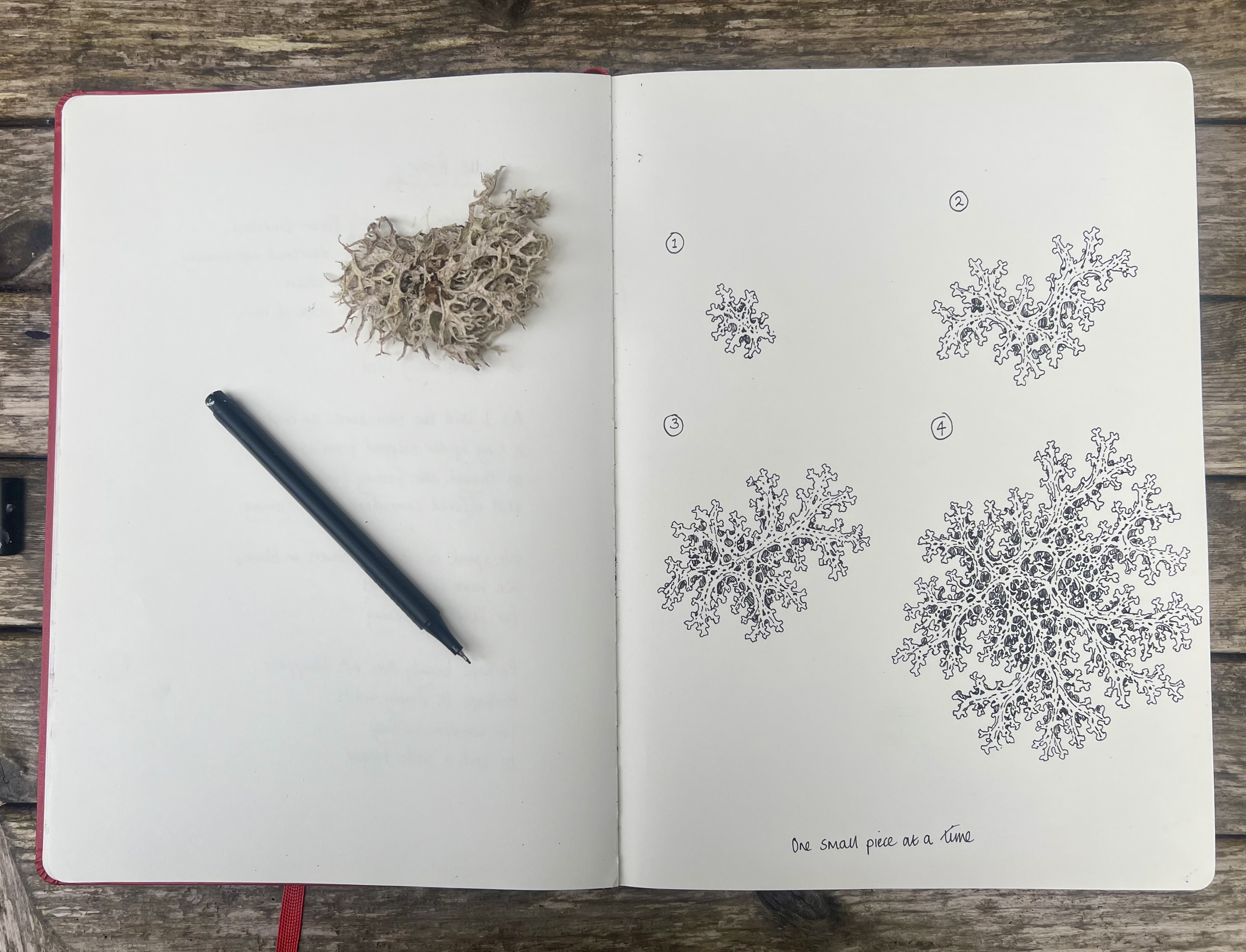
I have always found lichen one of the hardest things to draw, not because it lacks beauty, but because it seems to contain too much of it, each branch dividing into smaller branches, tiny cups emerging from delicate stalks, pale greys softening into greens, then silver, then cream, depending on how the light happens to catch them, so that there is no obvious place to begin, and the more closely I looked, the more complicated it became, until for a while I wondered whether I simply wasn’t good enough to draw it at all — and then I changed my approach.
I chose one tiny piece of lichen, no bigger than my thumbnail, and drew only that, following each branch with my pencil, noticing where it forked, where it thickened, where one tiny stem disappeared behind another, and when that fragment felt complete I moved to the next, and then another, until gradually, almost without realising it, the drawing began to grow; the lichen itself had not become any simpler, and the only thing that had changed was where I had let my attention rest. It struck me that this is often how nature teaches us to see, that we assume we must understand the whole landscape before we can appreciate it, when nature rarely asks that of us, inviting us instead into a single leaf, one feather, the curve of a shell, the veins of a petal, the branching of a piece of lichen, so that we begin with one small conversation and somehow the larger story starts to unfold on its own — which is perhaps why attentive wondering feels so different from simply observing, why it does not rush towards understanding but lingers with one small part until familiarity gives way to intimacy, until the world becomes richer not because there is suddenly more to see, but because what was already there begins, slowly, to reveal itself.
I realised, then, that I hadn’t learned a new way to draw lichen, but a new way to look, and I can’t help wondering whether this reaches far beyond sketchbooks, because there are times when life itself feels as intricate as a patch of old woodland lichen, when we look at the whole and feel overwhelmed by its complexity, convinced that we must somehow make sense of everything before we can take the next step, and yet perhaps the answer is the same — not to simplify the world, but to give our attention somewhere to begin, to rest with one small piece, to know it as well as we can without ever pulling it away from what it belongs to, and to trust that the rest will gradually find its place, for nature seems to work like this again and again, the forest discovered one tree at a time, a drawing grown one careful line at a time, and perhaps a life is lived in much the same way.