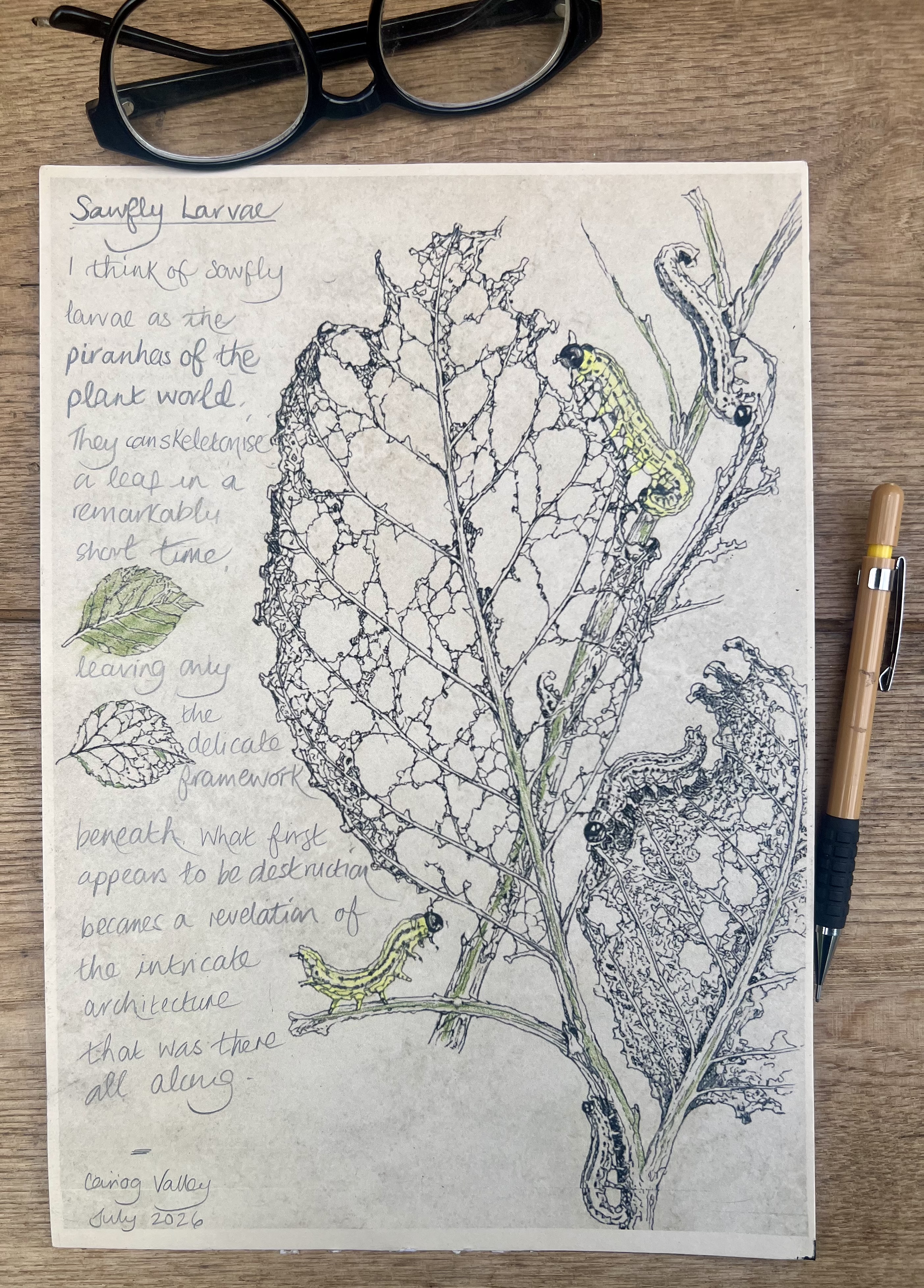
What caught my eye wasn’t the insects but the leaves, which no longer looked whole but delicately skeletal, their green tissue almost gone, leaving behind a fine network of veins through which the light could pass. It was only when I leaned closer that I noticed dozens of tiny green larvae moving steadily along the stems, each taking such a small bite that it seemed impossible they could be responsible for such a remarkable transformation. They reminded me of piranhas, not because they were fierce, but because of the astonishing speed with which a group can accomplish what a single individual never could. These are sawfly larvae, often mistaken for caterpillars, and in only a short time they are capable of reducing broad, healthy leaves to little more than their intricate skeletons.
My first response was to see only what had been lost, a familiar habit of mind: we notice the missing pieces before we notice the pattern they reveal, seeing a leaf that has been eaten rather than a process unfolding, so that it becomes easy to imagine nature as a place of damage and struggle. Yet the longer I watched, the more that first impression began to dissolve, for the leaves were not simply disappearing but becoming part of something else, their green tissue transformed into living bodies that would themselves become food for birds, spiders and countless other creatures, the energy held within each leaf simply continuing its journey, passing quietly from one form of life to another as it has done for millions of years.
Even the leaves themselves seemed to tell another story. Their delicate framework, usually hidden beneath a surface of green, had been revealed with extraordinary clarity, and what remained was unexpectedly beautiful, not despite what had happened but because of it, so that I found myself looking at the fine architecture of each vein in a way I never would have done had the leaf remained untouched. It made me wonder how often we mistake transformation for loss simply because we encounter it halfway through, since nature rarely divides the world into neat beginnings and endings; one life flows into another so continuously that the boundaries almost disappear, and what appears to be an ending is often simply a point of exchange, a moment when something passes quietly into a different form.
Perhaps attentive wondering begins with nothing more complicated than remaining with something for a little longer. If I had walked on after that first glance, I would have carried away a story about destruction; instead, I left with a sense of quiet continuity, the leaves become lace, the lace become food, and somewhere beyond the reach of my attention that food becoming birdsong, flight and another season’s unfolding. Standing there, I realised that the smallest creatures had gently unsettled the story I thought I was looking at — what had seemed to be the end of the leaves was, in truth, simply another beginning.
