Some places ask something of us before they will show themselves. They do not open all at once. They wait, patiently, for us to slow down enough to deserve what they hold.
Brantwood is one of these places.
The day was heavy with cloud, and Coniston Water kept disappearing and returning behind veils of shifting rain, as though nothing here were fixed, nothing quite finished. It felt exactly right for the home of John Ruskin, a man who understood that the world is not made of objects alone, but of light, of weather, of the quality of our looking.
I walked up the drive, past rhododendrons heavy with yellow bloom and ferns still damp from the last shower, and I had the curious sense that I was not simply entering a house. I was entering someone’s way of seeing.
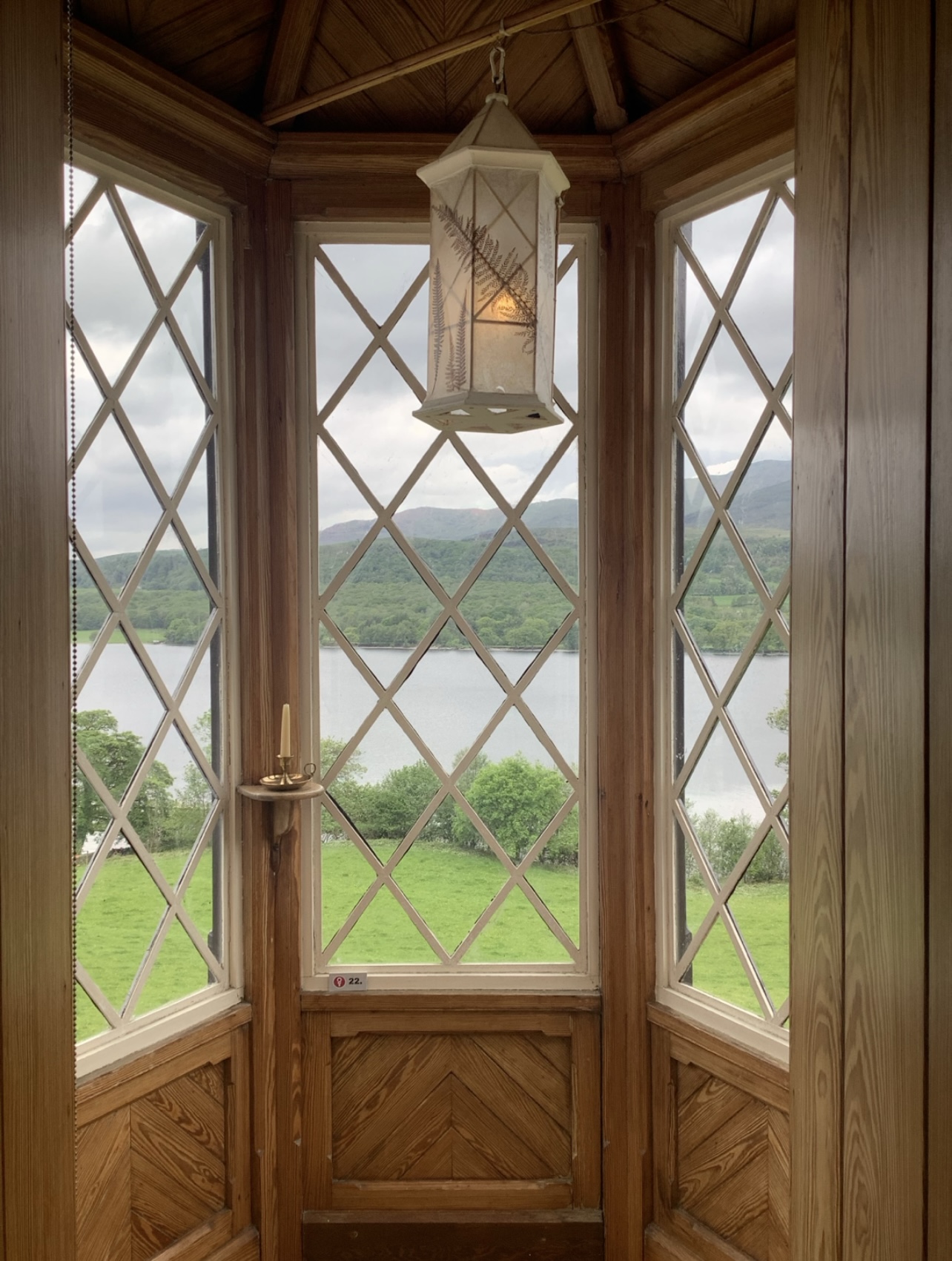
Inside, the windows held the lake like a painting that kept quietly repainting itself. The garden paths did not direct so much as wander, and even the rooms seemed arranged not for display but for pause, as though every object had been placed exactly where it might ask a visitor to stop, to breathe, to look again.
I found his desk. Ink pots, folded paper, a scattering of stones and shells gathered simply because they had seemed worth keeping. I did not expect to be moved by this, but I was.
Here was a man whose ideas travelled the length of a century, and yet what remains of him, in the end, is so little: a pen, a pebble, a leaf once admired and now pressed flat by time. It is always this way. The great figures of history were, before anything else, people who sat at tables, who looked out of windows, who bent down now and then to pick something up from the ground.
Ruskin wrote, “The greatest thing a human soul ever does in this world is to see something, and tell what it saw in a plain way.” It sounds simple, read quickly. Read slowly, it is not simple at all. To truly see requires patience, and humility, and a willingness to resist the mind’s fastest habit, which is to leap from seeing to naming, from mystery to explanation, before the mystery has finished speaking.
He was not alone in this conviction. His own drawing master, J. D. Harding, taught him something similar with a pencil rather than a pen: that the true principles of art are not invented by the artist at all, but discovered, slowly, in nature itself. Truth first, and technique after. Two men, then, one working in words and one in graphite, arriving at the same quiet instruction — look first, and look longer than feels necessary, and trust that the rest will follow.
Standing in these rooms, I noticed how rarely I do this myself. A tree becomes simply a tree. A lake becomes simply a lake. A path walked a hundred times becomes no path at all, just distance, covered without being seen.
But Brantwood does not allow this for long. The light on the water changed continuously, not once, and the fells altered colour as the clouds moved over them and kept moving. A wooden gate, softened by moss and half reclaimed by the hedge beside it, became beautiful for a moment, not because it had changed, but because I had stopped long enough to notice it.
This is what Ruskin knew, and what Harding taught him to practise with his hands: that attention is itself a form of care. To look closely at something is to grant it significance, to say, quietly, you are real, apart from me. You do not exist only for my convenience. I see you.

So much of life moves too quickly for this. We skim, we gather, we move on. But some places, and Brantwood is one of them, offer another way, suggesting gently that meaning often hides in what is slow, what is particular, what is easy to walk straight past.
I left feeling less as though I had visited a house, and more as though I had sat for an hour beside a quiet teacher, one who never raised his voice and gave no instructions, but who showed, through rooms and gardens and gathered stones, that the world grows larger the moment we give it our full attention.
At the window, one last time, I looked out over the water. The landscape has not changed since Ruskin’s day. Clouds still gather over the fells, rain still moves in veils across the lake, and light still falls and disappears and falls again. What has changed is us, and our willingness to stop, to stay a moment longer than we had planned.
To look, really look, at a tree, a stone, a view across water, or the handwriting of someone long gone, is to say something very small and very large at once: you matter, this moment matters, I am here.
I did not leave Brantwood with facts about Ruskin, though there were many to gather. I left with something quieter, something that stays. The world is always offering itself to us in small ways, in ordinary ways, in ways so easy to miss, and wonder, perhaps, is simply this: the moment our attention finally becomes equal to what was there all along.


