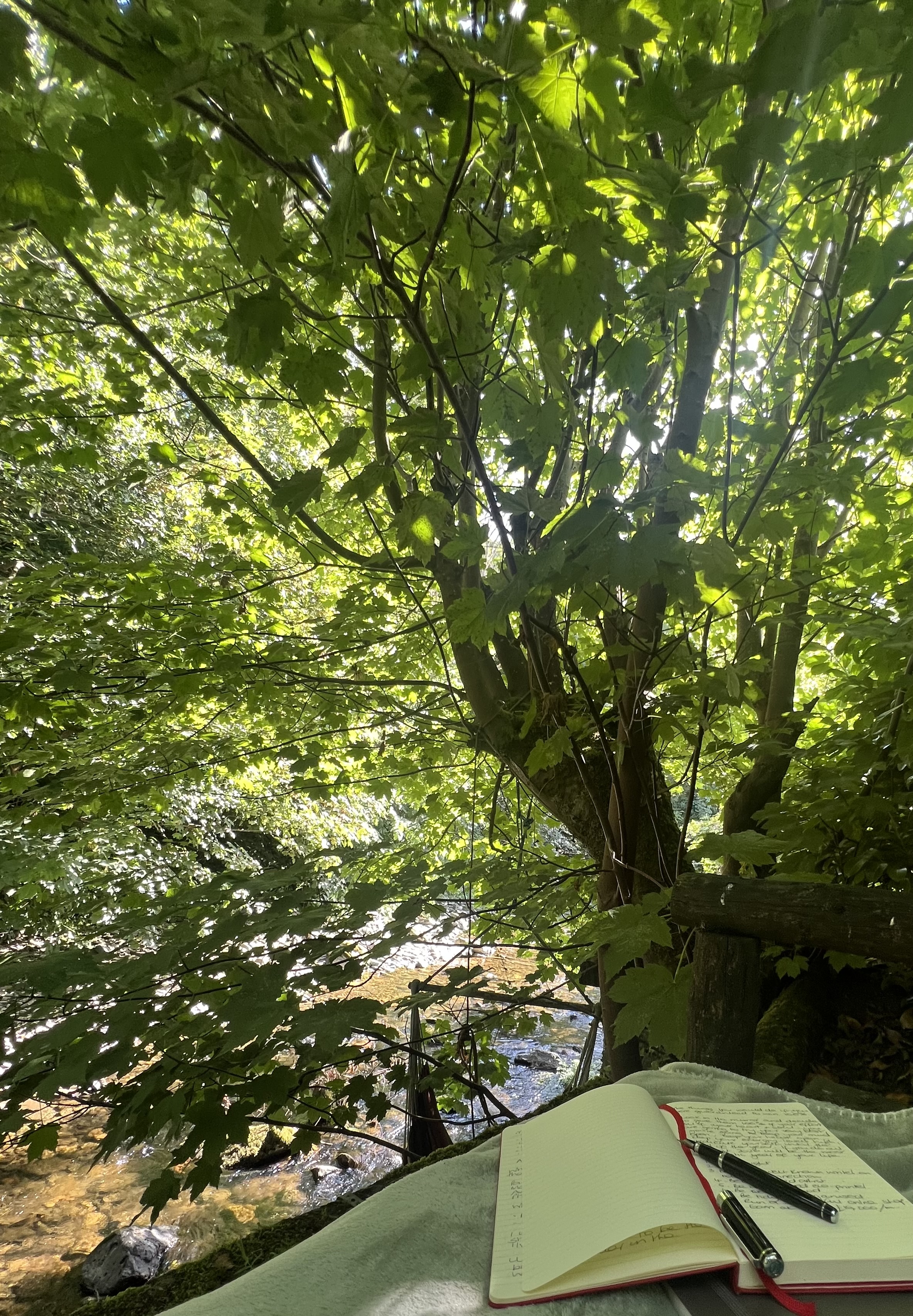
To reach this place, you have to bend a little, because the apple and pear branches hang low here, and over the years the gesture has become so familiar that I no longer think about it any more than I think about ducking beneath a low doorway. Four steps lead down, the garden falls away behind me, and there, beneath the green canopy, is the old bench and, beyond it, the river.
This has become a secret place, though not because it is hidden exactly. It is hidden in the way that certain corners of our lives become hidden: not through distance or difficulty, but because they ask us to slow down enough to enter them. I come here with a mug of tea, or a notebook, or sometimes with nothing at all except a little time and a willingness to sit.
Above the bench, the sycamore opens like a green parasol, its leaves catching the light and breaking it into small shifting pieces that fall across the page and my hands and the worn boards beneath me. From this seat, I have always looked upward into the undersides of the leaves. It is simply the geometry of the place. Their pale, veined surfaces face me rather than the sky, and after so many seasons they have become part of the furniture of this little sanctuary, as familiar as the river’s voice or the shape of the branches.
Then a breeze moves through the canopy, and something changes.
For a moment I stop seeing a tree and begin seeing a single leaf, its underside illuminated as though it has been turned deliberately towards me, and I realise that it is not empty at all. Along the ribs of the leaf and in the small sheltered folds where warmth gathers are tiny dark insects, so small that they might easily have remained invisible had the light fallen differently or had the breeze not arrived at precisely that moment.
They have been there all along.
They were there while I carried my tea down the steps and settled onto the bench. They were there while I opened my notebook and allowed my thoughts to wander. They appear here every year, at this same time, living out their intricate lives entirely independently of whether anyone happens to notice them.
And there is something quietly moving in this discovery, because attentive wondering so often gives us not something new, but something that was already present, waiting patiently at the edge of our awareness until a small shift in light or perspective suddenly makes it visible.
I find myself thinking of Jung, who believed that so much of life lies beyond the narrow circle of our ordinary consciousness, continuing its hidden existence until something causes us to turn and look. The underside of this leaf seems a small and perfect image of that truth, for concealed there is an entire world that neither announces itself nor asks to be discovered, but simply goes on being itself until, by chance or grace, our attention happens to fall upon it.
Perhaps every place we love contains such hidden rooms. Perhaps every familiar landscape has another landscape folded inside it, and every ordinary day carries within it some small undiscovered country, visible only to the person willing to remain a little longer and to look a little more carefully.

As I continue to look, I become aware of something curious, something so familiar that I almost overlook it. Before there is any conscious thought, before I have named what I am seeing or considered what kind of insects they might be, there comes the faintest sensation upon my skin, a small anticipatory itch, and I realise that my body has understood something a fraction sooner than my mind.
The body, it seems, often knows first.
It knows when rain is coming before the clouds have properly gathered. It knows the feeling of entering a beloved place before memory has found the words for it. And perhaps it also knows, in some quiet and ancient way, that there are small living things upon a leaf, because for thousands of years our ancestors learned to pay attention to precisely such details.
I find this strangely comforting, because it reminds me that noticing is not always an act of thought. Sometimes it is something gentler than that, something that rises from deeper within us, a recognition that arrives before understanding and invites the mind to follow a little more slowly behind.
And I realise then that these insects were never hidden at all. They were facing me the entire time, living their small and intricate lives above my head while I sat beneath them with my tea and my half-formed thoughts, returning year after year to this same leafy shelter, entirely unconcerned with whether I ever happened to look up and see them.
This, perhaps, is one of the quiet gifts of attentive wondering. It does not always lead us towards something new or extraordinary, but more often returns us to what was already there, patiently waiting at the edge of our awareness until a change in light, or a movement of wind, or a small softening of attention allows it to come into view.
I think again of Jung, who wrote that so much of our lives lies just beyond the threshold of consciousness, not hidden from us by intention, but simply waiting until we are ready to recognise it. The underside of this leaf seems to carry that same wisdom. An entire world has been suspended above my bench all this time, a world complete in itself, asking nothing of me except that I notice it.
Perhaps this is true of many things.
Perhaps every familiar place shelters an underside that we have not yet seen, and every ordinary day contains some small undiscovered country folded quietly within it. Perhaps there are thoughts, memories and possibilities within our own lives that are waiting with the same patience, facing us all along, requiring only a small turning of attention before they reveal themselves.
The breeze moves again through the branches, and the leaves tremble for a moment in the sunlight before settling once more into stillness.
The insects remain where they have always been.
Only my seeing has changed.

