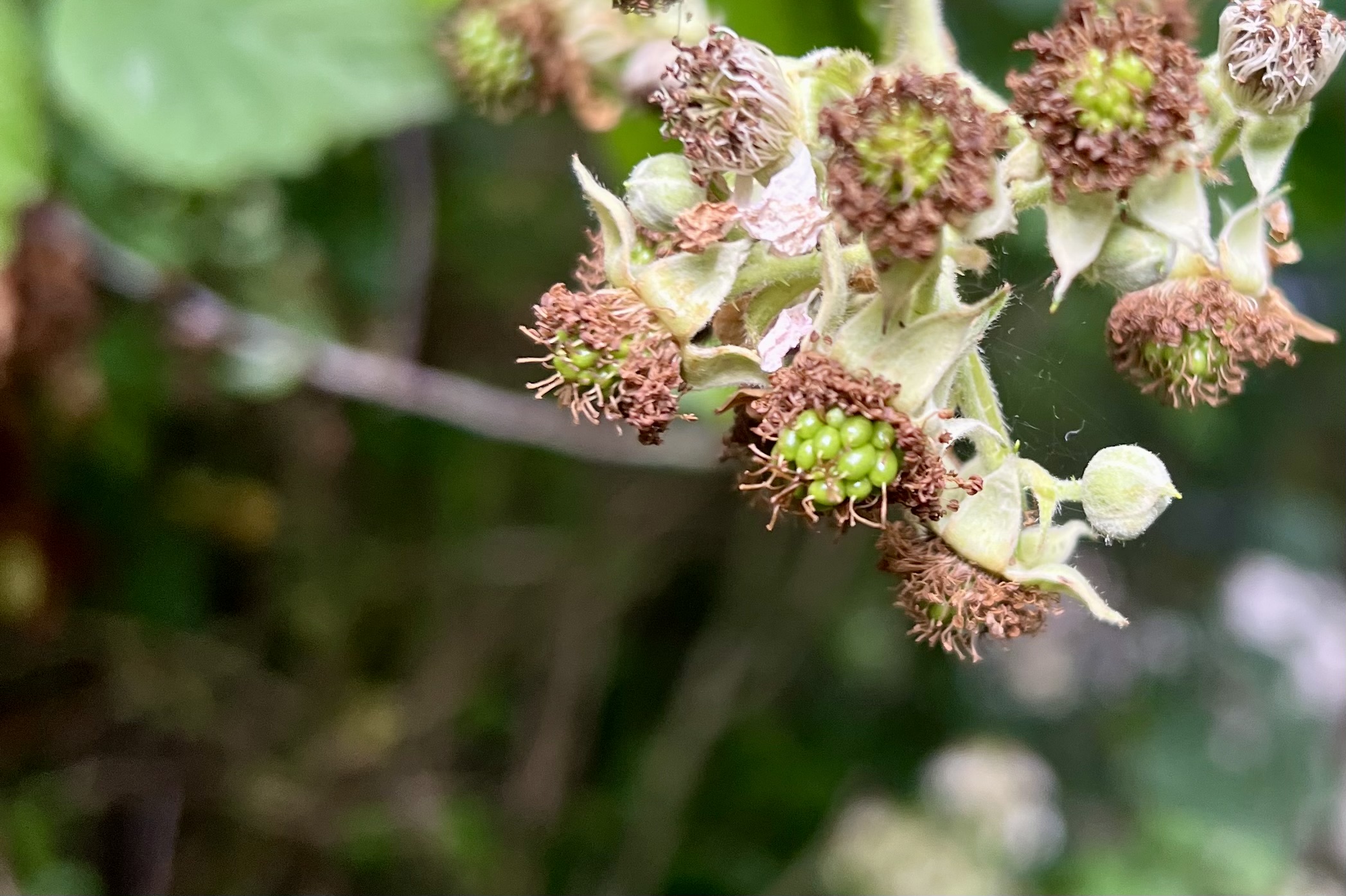
A blackberry flower is one flower, certainly, but only in the way a tapestry is one image, for it is woven from many small threads, each contributing something essential before disappearing into the whole.
The white petals are already gone from this one, dropped and scattered somewhere in the grass below, their work of drawing pollinators long since finished. What remains in their place is a ring of pale stamens gone brown now, curling in on themselves like a hand slowly closing around something it no longer needs, and right beside them, on the very same stem and in the very same breath of a moment, a knot of green beads has begun to push upwards, small and hard and faintly shining, exactly where those stamens did their one and only work.
This is not decay sitting next to growth, keeping its distance and minding its own business. It is one thing quietly becoming the next without ever fully leaving itself behind. First the petals had to fall, then the stamens had to release their pollen, and only then could the fruit begin to form, so that the brown threads are still completing their work even as the green blackberry is already swelling beneath them.
I stood for a while with this one cluster and let myself not move on to the next, and not photograph the whole hedge, and not gather it all into some tidier idea of summer, but remain instead with these spent threads still clinging on, papery and finished with their first purpose and yet somehow still attached, as though the plant has not quite let go of what it has already outgrown.
John Ruskin wrote of what he called the innocence of the eye, that rare ability to see before naming and to encounter a thing before our habits and categories hurry in and tell us what it is. It seems to me that the blackberry asks for precisely this kind of attention, because if we looked only quickly we would see a flower that has gone over, a blossom past its best, and move on. Only by lingering do we notice that this apparent ending is also a beginning and that the two are happening together.
Perhaps we are not so different.
The lives we have outgrown do not fall neatly away from us. We carry the curled, finished parts of ourselves right alongside the green beginnings, and we do not wait until everything is tidy before we grow. We grow with old griefs still attached, with former loves and earlier versions of ourselves still clinging on, because that is simply what becoming looks like when viewed from close enough.
By August this cluster will be dark and sweet and someone will eat it without a thought for the small green beads it once was, or the stamens before that, or the petals before that, or this exact overlooked moment I am asking you to notice with me now. Yet perhaps this is why attentive wondering matters, because every living thing carries its whole history within it. The blackberry is already becoming fruit and is still, at the same time, remembering its flower.
Rainer Maria Rilke once wrote that all becoming is, in some sense, a being before itself, a reaching towards what it has not yet fully become. Standing beside this bramble, I think I understand a little of what he meant. Nothing in the natural world seems ashamed of what it has been. The spent petals remain a while longer, and the new fruit rises quietly through them.
Perhaps we might allow ourselves the same grace.