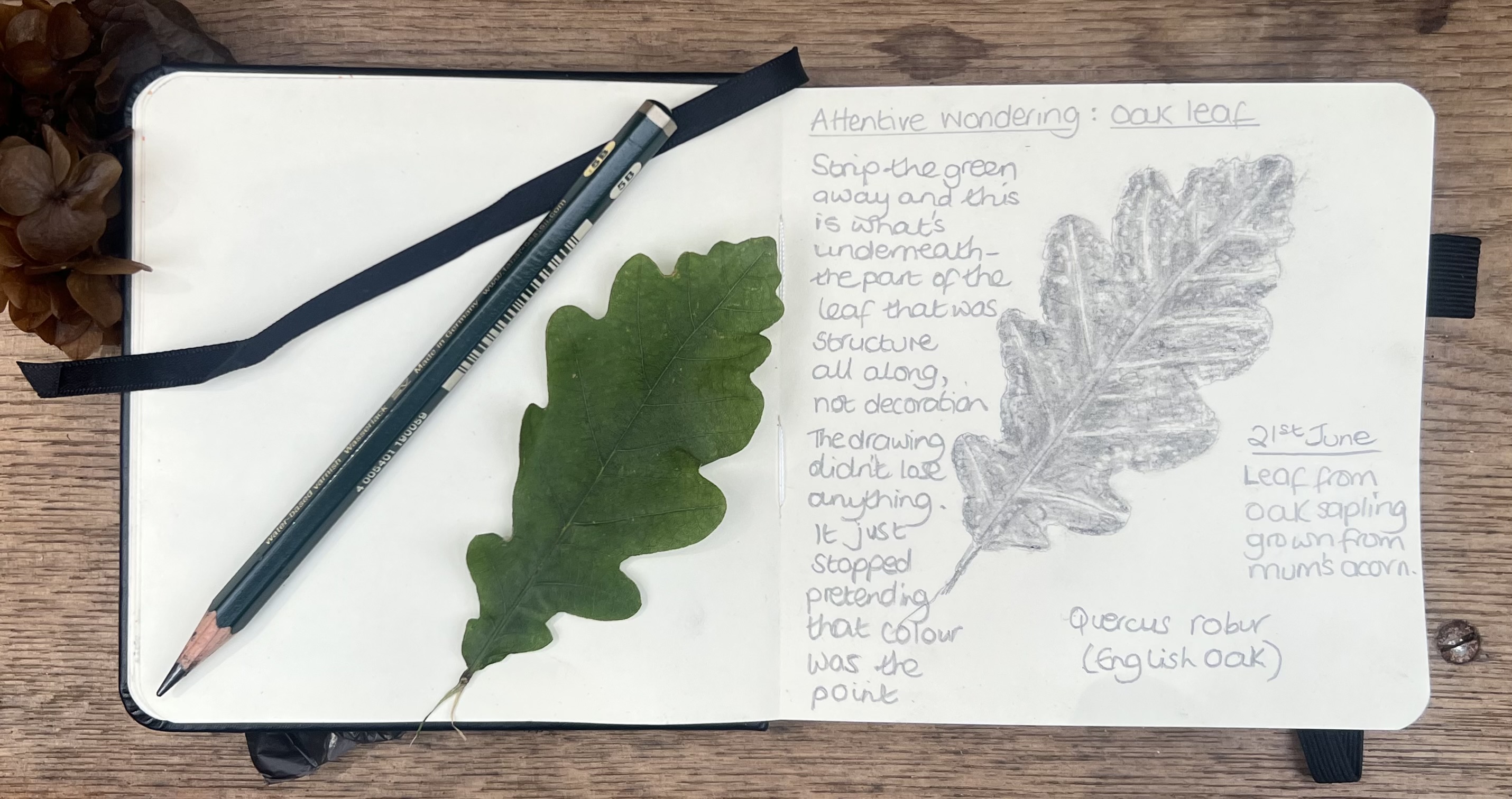
There is an oak leaf on my desk this morning, and beside it, a drawing of the same leaf in pencil. The leaf is still green, still slightly damp at the stem where I pulled it from the potted tree by the door – grown, over the years, from an acorn that came from my late mother’s oak. The drawing is grey, slower, already a little removed from the thing that made it. I have been looking between the two for the better part of an hour, and it strikes me that this – not the leaf, not the drawing, but the looking between them – is the actual subject of a nature journal.
People sometimes assume a nature journal is a way of recording what you have seen. A list of birds, perhaps. The date a flower first opened. A sketch of a leaf. Notes from a walk, written up afterwards so the walk isn’t entirely lost. And certainly it can be those things. Mine has entries like that – dates, names, small factual anchors I’m glad to have later.
But over the years I’ve come to feel that a nature journal serves a quieter purpose than recording. It is not so much a record of the world as a record of attention.
The slowing
When I sit down with a feather, a stone, a sprig of leaves, or a jar of lake water carried up from the shore, I am rarely trying to produce something impressive. I am trying to stay with one thing a little longer than I otherwise would. That’s really all it is. Drawing slows the eye. Writing slows the mind. And in that slowness, details begin to surface that were invisible only a few moments before.
A feather that seemed plainly grey turns out to hold a wash of blue near the quill. A leaf carries tiny pathways like rivers seen from above, each one running to a smaller one, down to veins too fine to draw. A stone held in the hand for long enough begins to tell you something about pressure, weather, and time – not because the stone has changed, but because you’ve finally given it enough of your attention to say so.
The object itself has not changed. What has changed is the quality of attention brought to it.
This is, I think, the whole trick of the practice, and also the hardest part to explain to people who haven’t tried it. We are not used to giving anything an hour. A feather, properly looked at, can hold half an hour easily. A patch of lichen, looked at closely enough, becomes a landscape – its own greys and ochres, its own terrain. A jar of lake water, left to settle and then studied, turns out to contain an entire hidden world that was there all along, simply moving too fast or too small to notice from the bank.
The more closely you look, the more the world seems to offer. It isn’t that the world becomes more generous. It’s that you finally stop walking past what it was already giving you.
A relationship, not an image
Perhaps this is why nature journaling feels so different from scrolling through photographs on a screen. A photograph can capture an image, instantly, and move on. A journal captures a relationship – and relationships, by their nature, take time to build and don’t resolve in a single frame.
The page becomes a meeting place between the observer and the observed. Something happens in the time it takes to draw a leaf’s serrated edge, or to find the right word for a particular grey, that doesn’t happen in the half-second of a shutter. You start, however briefly, to belong to the thing you’re looking at, rather than simply possessing an image of it.
When I look back through old journals, I don’t only remember what I saw. I remember who I was when I saw it. I remember the stillness of a particular morning by the lake, the scent of rain caught in the leaves overhead, the sound of birds moving through the canopy while I sat with my pencil and lost track of time. Digby, usually, somewhere nearby, equally unbothered by how long I was taking. The page becomes a doorway back into an experience that would otherwise have drifted away entirely, the way most ordinary mornings do.
This is also why I tell people not to worry about artistic skill, when they ask whether they’re “good enough” to keep a nature journal. A journal is not an exhibition. It is a conversation – between you and a feather, you and a leaf, you and an hour of your own life you decided to spend looking rather than scrolling. A rough sketch made with real attention will always hold more than a polished one made in haste, because the roughness is often where the attention shows.
A small, unfashionable resistance
There is something quietly unfashionable about all this. It asks you to pause, to look again, to notice what you would normally walk straight past. In a culture that prizes speed and volume – more images, more content, more of everything, faster – sitting still with one oak leaf for an hour can feel almost contrary. It is not a grand resistance. No one will notice you doing it. But it is a resistance all the same: a small, deliberate refusal to let the morning pass at the speed everything else insists on.
I don’t think this makes the practice precious, or removed from ordinary life. If anything it’s the opposite. The leaf on my desk came from a tree I can step outside and touch – one with its own particular history, grown from a single acorn that has come to mean more than an acorn usually does. The lake, by contrast, takes a drive to reach. But once there, it asks nothing else of me beyond the willingness to stop, and to stay stopped for longer than felt entirely natural at first.
What it’s actually for
So perhaps that is the real purpose of a nature journal. Not to collect information. Not even, particularly, to create art, though art sometimes comes of it. But to cultivate something rarer and more easily lost: the simple, increasingly precious ability to pay attention to one ordinary thing for long enough that it stops being ordinary.
The oak leaf on my desk will brown and curl within the week. The drawing beside it won’t. But neither of them is really the point. The point is the hour I spent between them – looking, then looking again, then noticing what the first look had missed. That hour is the actual journal entry. The leaf and the drawing are just what’s left of it, pressed flat on the page, waiting to let me back in.
The wild remembers. So do you.