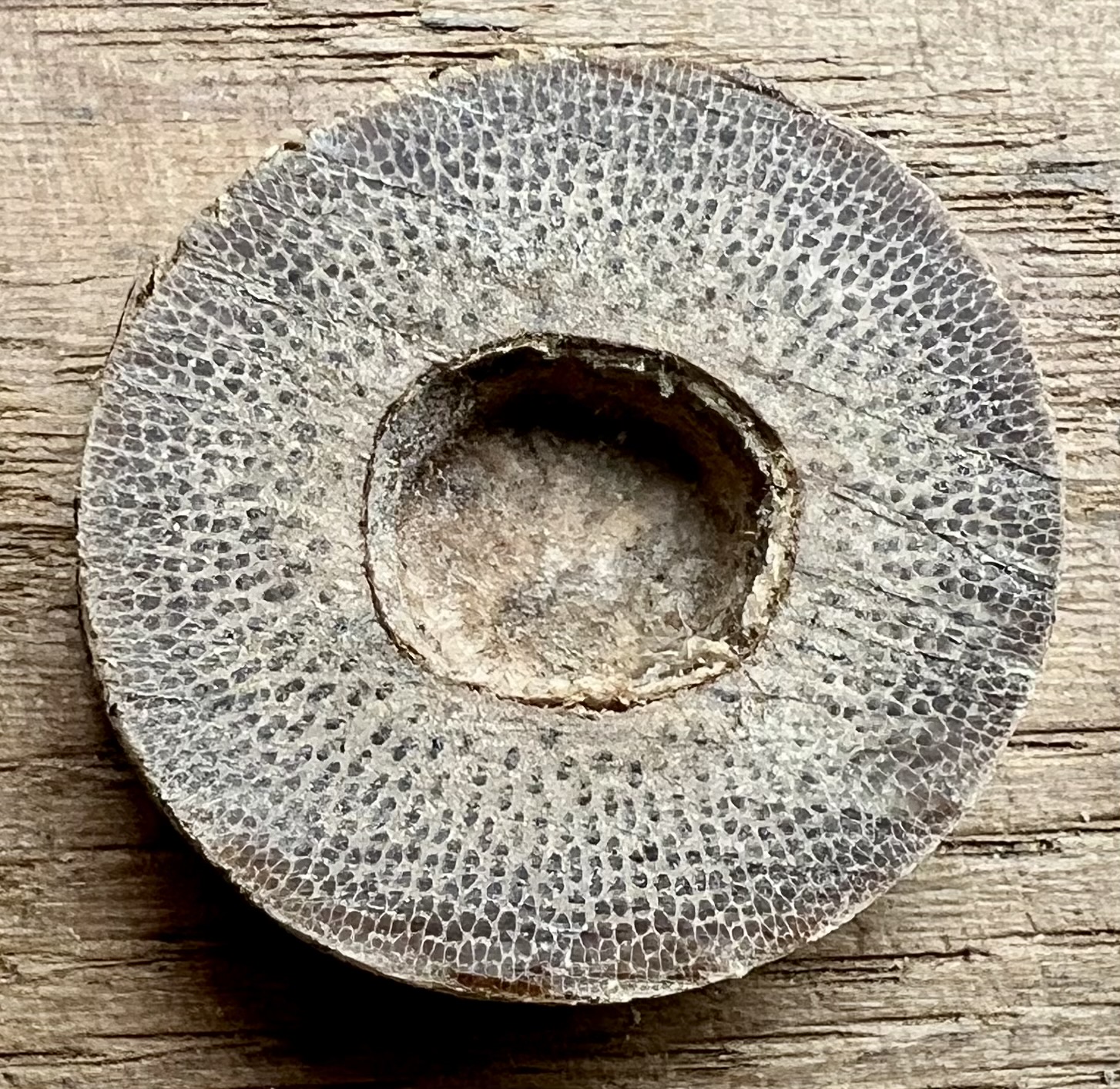
At first glance, this could be a cross-section under a microscope.
Or a fossil, pulled from rock.
Or a fragment of some distant world, photographed from above.
It is none of these.
It is the cut end of a piece of bamboo.
I had picked it up to make something and what I expected to find – a plain circle of pith and bark – turned out to be a landscape: chambers and fibres, a structure so precise it looked deliberate. I had simply never looked closely enough to see it.
The longer I looked, the more it kept changing.
A honeycomb, at first. Then the surface of coral. Then, oddly, the branching of a river delta seen from a plane window. The same pattern, repeating itself across scales, as if nature only ever has a handful of ideas, and keeps returning to them.
It made me wonder how much I miss simply because I think I already know what I’m looking at.
A piece of bamboo.
A feather.
A stone.
A sample of lake water.
We glance. We name it. We move on.
Attentive wondering asks something else of us – to linger a little past the point where looking starts to feel unnecessary. To resist the pull toward the next object, the next thought, the next small distraction.
And when we do, something happens almost every time.
The ordinary starts to give up its extraordinary nature.
Maybe that’s the real gift of attention. Not that it changes the world – but that it changes what we’re able to see in it.
This pattern was inside the bamboo all along.
What changed was that, for two minutes, I stopped and looked.
Invitation to notice
Find one ordinary object today and give it two full minutes of your attention. A leaf. A pebble. A feather. The mug by your elbow.
See what it gives up, once you stay long enough to ask.
The wild remembers. So do you.
