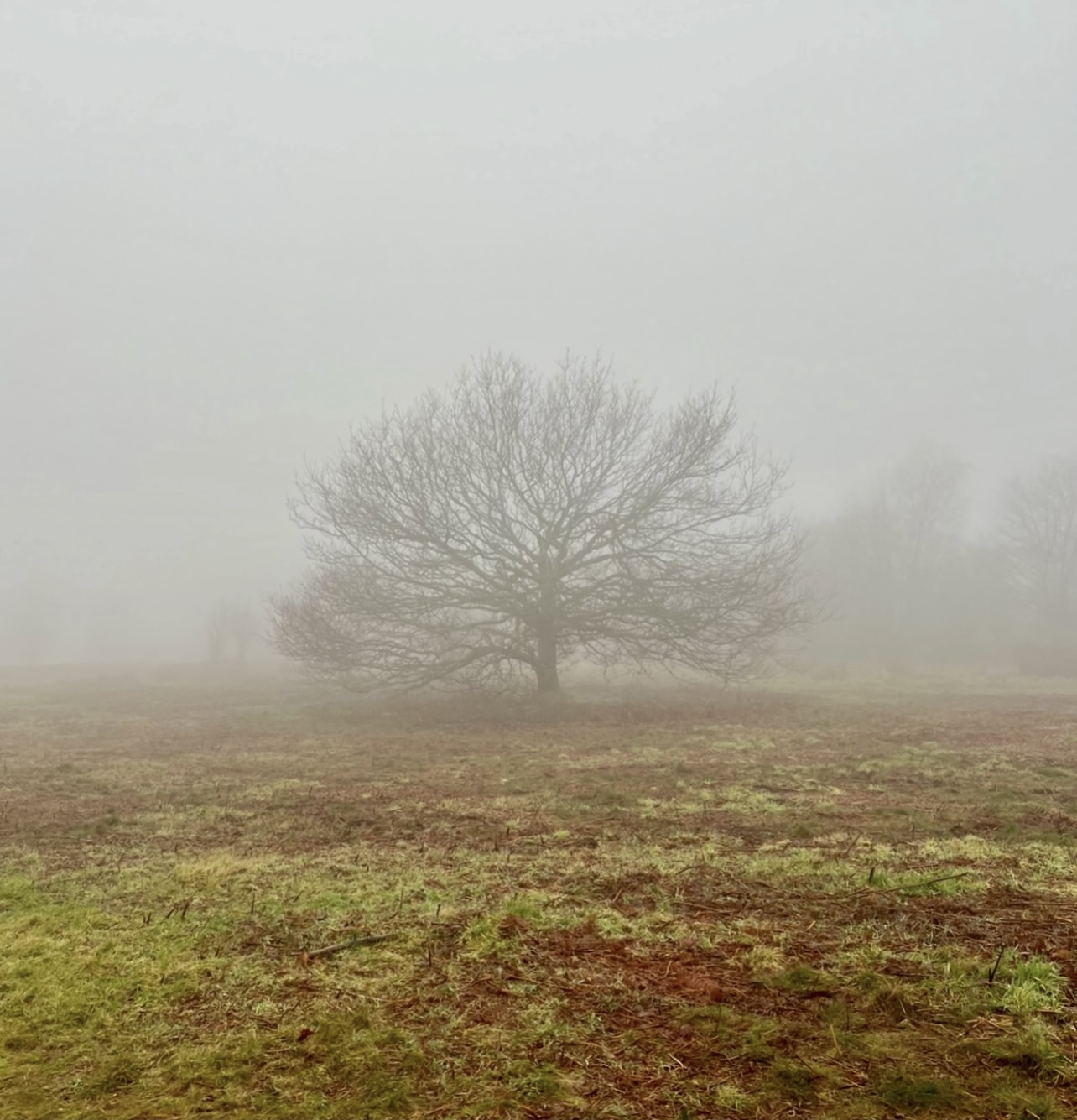
The tree appears slowly, the way important things sometimes do.
One moment there is only grey – grey field, grey air, grey sky pressed flat against itself – and then, gradually, a shape. A bare tree standing in the mist, its branches spread wide and low, patient as something that has been waiting for centuries and has decided this is fine.
You almost walked past it. You were thinking about something else.
* * *
There is a growing body of thought about what happens when a person stops in front of a tree. Not to photograph it, not to identify it, not to do anything useful with it at all. Simply to look, and to let it look back.
The Japanese call one version of this ma – the pause, the meaningful gap, the space between things where meaning collects like water in a hollow. It is not emptiness. It is the opposite of emptiness. The mist around this tree is not nothing; it is the atmosphere made visible, the air showing off, reminding you that the world between solid objects is also a world.
The tree, stripped of its leaves, is not diminished. It is clarified. In summer, a tree gives you greenery, shade, that pleasant generalised sense of nature. In winter, in fog, it gives you something rarer: its actual structure. The decisions it made over decades – which way to grow, which branches to extend, how wide to spread its arms against the prevailing wind – are all laid bare. A winter tree is autobiography in wood.
Researchers studying what happens in the brain during quiet contemplation of natural scenes have found that something measurable shifts within ninety seconds. Not just mood – though mood shifts too – but the quality of attention itself. The kind of focus we spend our days deploying, the directed, task-driven, email-answering focus, relaxes its grip. A softer awareness takes over. You are not thinking about the tree, exactly. You are thinking with it.
* * *
The man who says he cannot afford to stop for a tree is, usually, the man who most needs to stop for a tree.
His mind will offer him alternatives. I can look at it while walking. I’ll see it on the way back. I’ve seen trees. He has not seen this tree, in this mist, in this light, which will not exist again in quite this way once he has taken three more steps and his angle has shifted and the morning has moved on.
This is what nature asks of us, and it asks it very quietly: only that we be here, now, for the thing that is actually happening.
The fog changes the tree. The tree holds still inside the fog. There is something instructive about that – about holding still while the world rearranges itself around you.
How to actually see a tree:
Stop further away than feels necessary. The instinct is to approach. Resist it for a moment. Take in the whole shape first – the silhouette, the way it sits in its landscape, the space it has claimed.
Let your eyes go soft. This is not a metaphor. Physically relax the muscles around your eyes, the ones you tighten when reading a screen. The tree will not become blurry; the quality of your looking will change.
Notice what the tree is doing. All trees are doing something: leaning into a prevailing wind, reaching toward a gap in a hedge where light comes through, sending one branch in an entirely unexpected direction because of something that happened forty years ago. A tree’s shape is its history.
Then just stand there for a bit longer than is comfortable. Not long. A minute, maybe two. Long enough for the part of your mind that is always planning the next thing to fall quiet.
Come back in a different season. You will think you are seeing a different tree. You will not be wrong.
* * *
Eventually you walk on. The tree fades back into the mist. In five minutes it will be invisible again, and the field will be just a field, and the morning will be just a morning.
But something has shifted, by a small and unquantifiable degree. Something behind your eyes is slightly less clenched than it was.
The tree is still there. It was always there.
You just, this once, looked.
