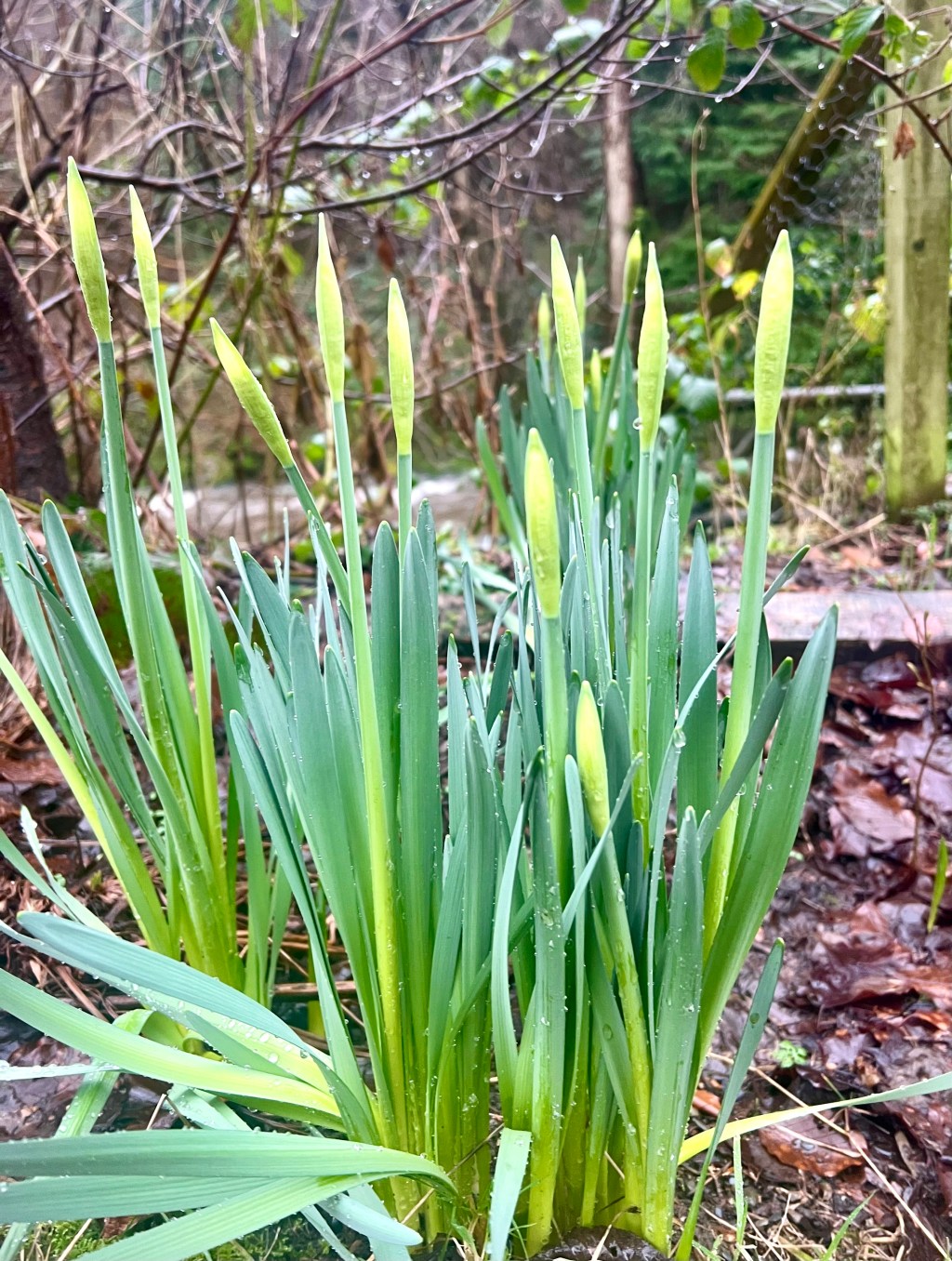
There are winters that feel like weather, and winters that feel like a slow occupation, settling not only into the fields and hedgerows but into the mind itself, until the days begin to merge into one another, indistinguishable in their greyness, their dampness, their weight. This has been one of those winters. The rain has been relentless in the most unremarkable way, arriving without drama, without storms that feel cleansing or decisive, simply continuing, day after day, soaking the ground, thickening the paths into mud, pressing the light flat, until the landscape begins to look as though it has been washed too many times, its colours faded.
And something similar happens inside us too. Prolonged bad weather does not only alter the outdoors; it alters our perception. The imagination becomes cautious. The body begins to move through the days with a quiet endurance. Even hope can start to feel like something slightly naïve, a luxury belonging to other seasons. We do not decide this. It happens gradually, through the accumulation of small disappointments, through mornings that begin in darkness and end in it, through the sense that the world has narrowed.
Then, without warning, a small thing interrupts this story.
In the shops, the first daffodils appear. Bunched together, still closed, their heads bowed, their green stems tightly wrapped as though they have not yet fully arrived, as though they are waiting to be certain it is safe. Yet even like this, they are unmistakable. Their colour is already there, contained but undeniable, a bright yellow held inside the folds of winter.
Yellow in the grey.
It is almost absurd how affecting it is, how quickly something in the chest lifts at the sight of them. Not because daffodils are rare, not because we have forgotten they exist, but because part of us, after weeks of dull skies and damp days, has started to live as though the season might never shift, as though this greyness is simply the way things are now. We do not consciously believe this, yet the mind is suggestible, and repetition is persuasive. When the same kind of day arrives again and again, it becomes easy to mistake it for permanence.
And then, a few days later, the true moment comes, not indoors under supermarket lighting but outside, in the garden, where the first shoots are already pushing through the soil. At first they are only spears of green, easy to miss if we are not looking, but soon they thicken, and then, almost suddenly, the first flower opens, the trumpet unfurling as though it has been practising this act of emergence for months. That same yellow appears again, but now rooted, now alive in the earth, now belonging fully to the world.
It is a small miracle, and perhaps the most moving thing about it is its lack of performance. The daffodil does not announce itself as a symbol. It does not insist on meaning. It simply rises. It simply opens. It simply becomes what it was made to be, and in doing so it quietly changes the atmosphere around it, not only in the garden but in us.
Alain de Botton writes: “You normally have to be bashed around a bit by life to see the point of daffodils, sunsets and uneventful nice days.” There is truth in this, because hardship has a way of refining our sight. It strips away the casualness with which we treat ordinary beauty. It teaches us that what we call small joys are not small at all. They are nourishment. They are medicine, not in any dramatic sense, but in the way that warmth is medicine when you have been cold for too long.
Perhaps this is what hope often is. Not optimism, not a forced brightness, not the attempt to persuade ourselves that everything will be fine, but something quieter and more trustworthy: a small interruption in the belief that the heaviness will last forever, a gentle reminder that life continues beneath the surface, that the world is still preparing its return. The daffodil does not argue with winter. It does not resent the grey sky. It simply rises anyway, with a kind of calm insistence.
And this is where attention becomes everything.
McGilchrist writes about attention as something far more significant than a mental function, because attention is not merely what we do, it is how we meet the world, and the world we experience is shaped by what we are able to notice. Attention can narrow, and when it narrows, life narrows with it. In long spells of bad weather, attention often becomes practical and defensive. We look for inconvenience, for difficulty, for what must be endured. We begin to live in a world made mostly of problems to solve and discomforts to manage. This is understandable. It is how we cope. Yet it quietly reduces our sense of reality, as though we are living inside a smaller room than the one we actually inhabit.
Then the daffodil appears, and something widens again.
The yellow is too vivid to be ignored. It draws the eye, and in drawing the eye it draws the mind outward. It interrupts the inner monologue, that steady stream of commentary and forecasting, and for a moment we are simply looking. Not thinking about the future. Not reviewing the past. Just looking. And in that moment of genuine looking, something returns: spaciousness, softness, a sense of contact.
We notice the clean shape of the petals, the way they flare like a star around the trumpet, the way the stem holds itself upright with a quiet confidence. We notice too the contrast around it, the tired grass, the bare branches, the colourless sky, and the daffodil seems even brighter because it has emerged from such plainness. It does not erase winter, but it changes our relationship with it, because it reminds us that winter is not emptiness, it is concealment. It is a season of hidden work.
It is tempting to believe that meaning arrives through dramatic events, through answers, through transformations that feel clear and decisive, but often meaning returns in a smaller way, the way spring returns: gradually, almost shyly, through signs that are easily missed if we are rushing. A green shoot. A bud. A flower opening. Hope is not always a soaring feeling. Sometimes it is simply the ability to recognise that life is still moving, that something is arriving, that colour is still possible.
The daffodil does not solve anything. It does not undo fatigue or grief or the dullness of too many wet days. But it offers a different kind of reassurance, not the reassurance of certainty, but the reassurance of rhythm. It reminds us that things change, that the world turns, that the grey does not own the whole year. And perhaps most importantly, it reminds us that beauty is not an extra, not a decorative addition to life, but a form of sustenance, something that feeds the parts of us that cannot be fed by explanation.
Yellow in the grey.
A small rebellion, a small flame, a quiet insistence.
A reminder that winter is a season, not a sentence.
And that hope, like the daffodil, often begins not with a great revelation, but with something simple rising through the cold earth, asking only to be noticed.
 Nature Speaks
Leave a comment