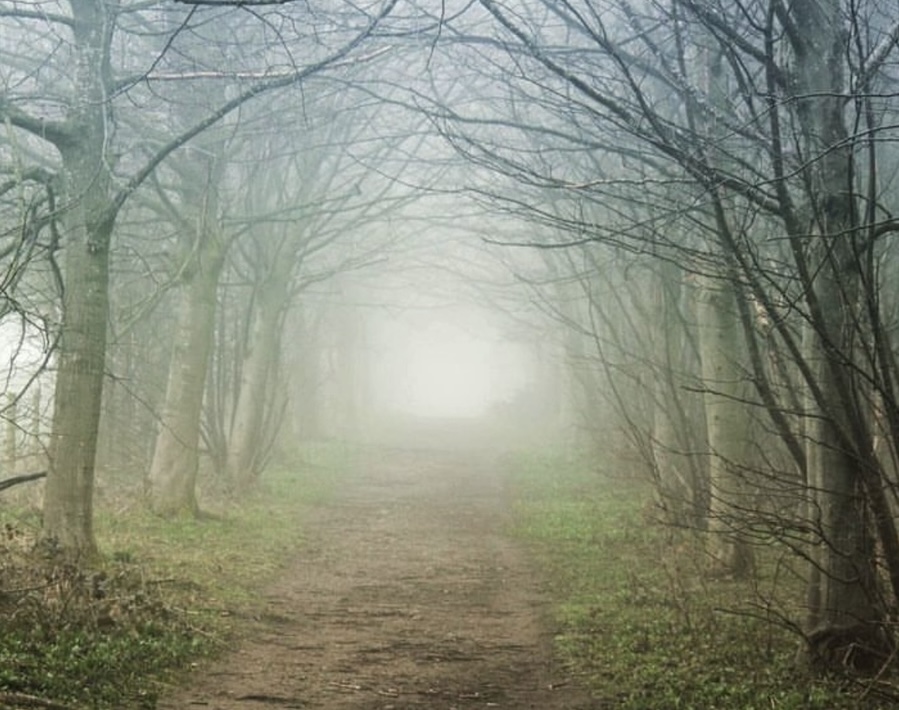
There are moments when we stop without having intended to, moments when the body pauses first and the mind only later realises that movement has ceased. This often happens outdoors, perhaps on a path softened by recent rain, where the ground has darkened and the air carries a quiet density, and the sound of footsteps gradually fades until there is only stillness and the low, continuous presence of what surrounds us. Nothing particular has been chosen. We have simply stopped.
And almost at once, the mind begins to speak.
It remarks on what is seen, on what is felt, on what might happen next. It remembers other moments, anticipates those still to come, evaluates what is happening now. One thought follows another in a fluid, uninterrupted movement that feels at once familiar and wearying. This activity is not a mistake. It belongs to the ordinary functioning of the human mind. From a psychological point of view, this is what the brain does. To produce thoughts is not a sign that something is wrong. It is simply a sign that we are alive.
What becomes painful is not the presence of these thoughts, but the intimacy we have with them.
When someone has lived for a long time under fear, judgement, or control, certain thoughts tend to return with particular insistence. Through repetition, they gather weight. They no longer appear as passing mental events but as statements about reality itself. I am not enough. I cannot change. I have nothing to offer. At such moments, the mind does not merely think. It closes in. The boundary between what is thought and what is real becomes less distinct, and the inner voice takes on the tone of certainty.
Yet even then, something else continues quietly.
The body remains upright. Breathing goes on, discreetly and faithfully. Sensations are present, sometimes barely perceptible, sometimes clearer. The contact of the feet with the ground. The temperature of the air on the skin. The distant sounds that arrive and fade without asking anything of us. When attention turns, gently and without effort, toward these simple elements, not in order to escape thought but to widen awareness, a small shift may occur.
Thoughts continue to arise.
A thought appears, perhaps urgent, perhaps discouraging. It presents itself forcefully. It asks to be believed. And if it is noticed, simply noticed, without being followed and without being pushed away, its nature begins to change. It loses a little of its compactness. It becomes less solid. Another thought follows, then another, each one appearing and dissolving in its own time. Nothing needs to be forced. Nothing needs to be corrected. Clinically, one might speak of distance. In lived experience, it feels more like space.
In this space, something quietly important becomes apparent.
We are not required to silence our thoughts in order to regain a sense of freedom. Nor are we required to replace them with more reassuring ones. The mind rarely responds well to confrontation. It responds better to clarity. When thoughts are seen for what they are, mental events that are transient, conditioned, often repetitive, they lose some of their authority. They may continue to speak, but they no longer govern.
Nothing spectacular takes place.
The future does not suddenly become clearer. Identity does not reorganise itself in a single moment. But the experience of being alive becomes a little more breathable. There is room again. We are no longer entirely inside the stream of our thinking. We are also aware of the bank.
From here, movement becomes possible. Not because confidence has appeared, but because pressure has eased. One can remain standing, feeling the body, listening to the mind without obeying it, allowing thoughts to come and go as they always do. And perhaps, when the moment feels right, one step is taken. Not toward a fully formed new self, but toward a slightly different way of inhabiting the present.
This is often how change begins.
Not as a decision.
Not as a rupture.
But as a gentle reorganisation of attention.
A change in relationship.
A little more space between what is thought and what is lived.
And for someone who has felt trapped for a long time, this quiet space already contains the beginning of freedom.
 Nature Speaks
Leave a comment