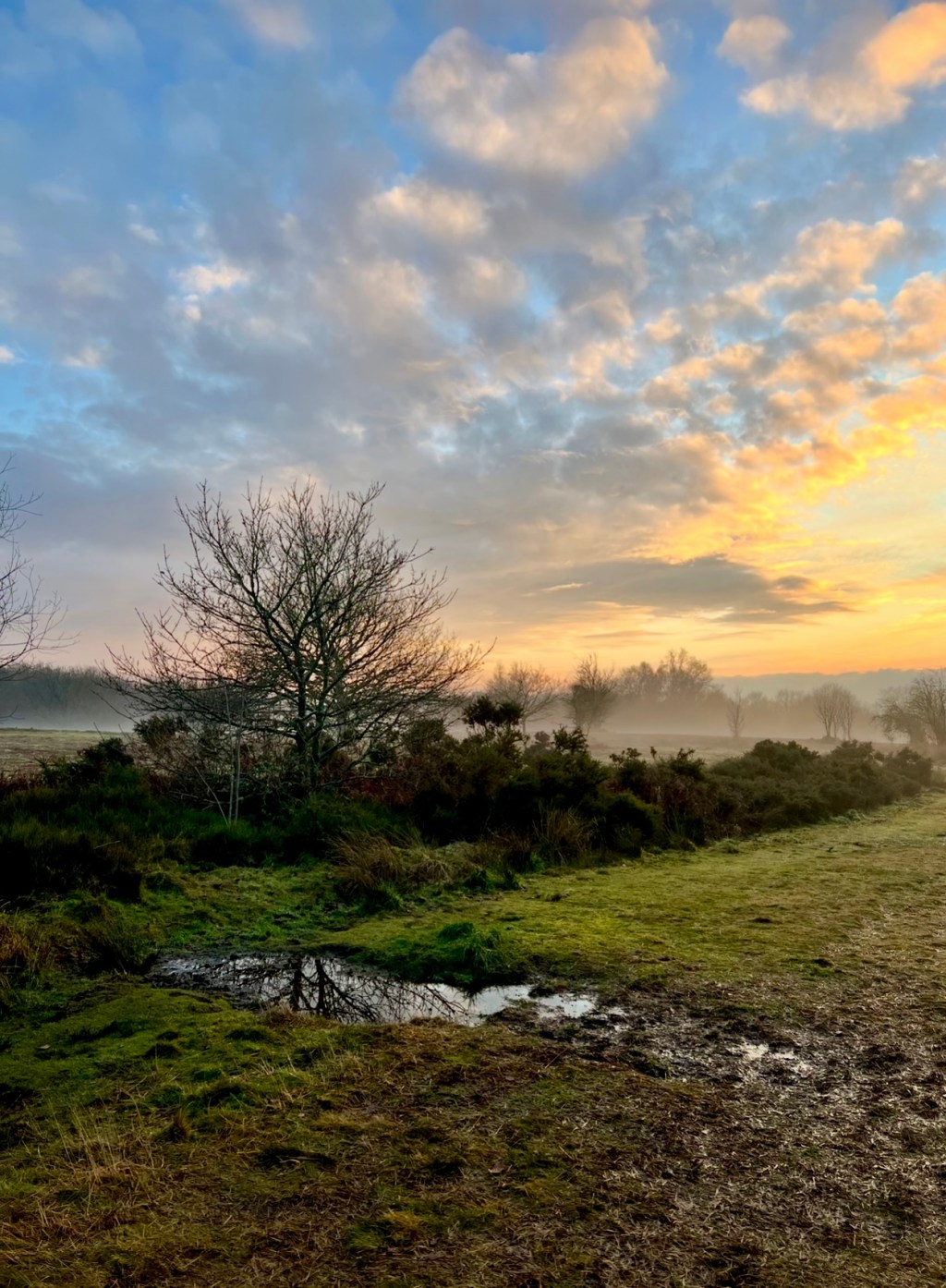
He stops without having planned to. The walking has been enough. The ground beneath his feet is damp, still holding the rain of recent days, no longer able to absorb it all, so the water waits on the surface. When he stops, the sound of his steps fades, and with it something else begins to ease.
Thoughts continue, naturally. They always do. They comment on what they find: the pale light on the grass, the cold in the air, the state of his shoes if he steps closer to the puddle. They wander further – toward the day ahead, toward something unfinished from yesterday, toward a low, indistinct concern that has no clear name. He notices this movement. It is not so much him thinking as the mind doing what minds are made to do: producing, associating, anticipating.
We often believe that calm means the disappearance of thought. But the mind is not designed for stillness; it is designed for activity. Expecting silence from it is like expecting the heart to stop beating in order to feel at peace. What can change, however, is not the presence of thoughts, but the way they are held.
Standing there, he does not try to interrupt the flow. He does not argue with it. He allows the thoughts to move as the mist moves between the trees, as the breath moves in and out of the body. Gradually – without effort, without any clear moment of transition – their urgency diminishes. His attention shifts. He becomes aware of breathing, of the quiet regularity of the heart. The body, which has been waiting patiently in the background, comes back into view.
His gaze settles on something small: a leaf, half-rotted, its edges darkened, carrying the season that shaped it. He sees it simply. He also sees the others. There is no need to choose, no need to improve the scene. Attention rests where it rests.
From time to time, a thought arises. He hears it as he hears a distant sound in the landscape – present, but no longer central. There is distance, but not withdrawal; presence, but not immersion. Somewhere in this balance, a quiet understanding forms. Thoughts are not intruders. They are events – fleeting, repetitive, lawful – part of the mind’s natural ecology.
Research tells us that the brain is constantly active, even when we believe we are doing nothing. It wanders, predicts, rehearses. This is not a defect. But here, for a moment, that activity no longer occupies the entire field. The world widens. The mind resumes its proper scale.
Nothing more is required from the moment. It does not offer answers, nor does it promise relief. And yet there is a subtle sense of sufficiency. The concerns he arrived with have not vanished. They remain, waiting. But they no longer dominate. Proportion has been restored.
This is often how calm appears – not as emptiness, but as balance. Not the absence of thought, but a gentler relationship with it.
He will leave, of course. The walking will resume. The familiar mental noise will return, as it always does. This is not a failure; it is simply the continuation of life. But something will remain: the memory of a moment in which nothing needed to be fixed, when attention rested on what was already there.
This is not escape. It is return. A small sanctuary, discovered not by stepping away from the world, but by meeting it without haste.
The wild remembers. So do you.
 Nature Speaks
Leave a comment