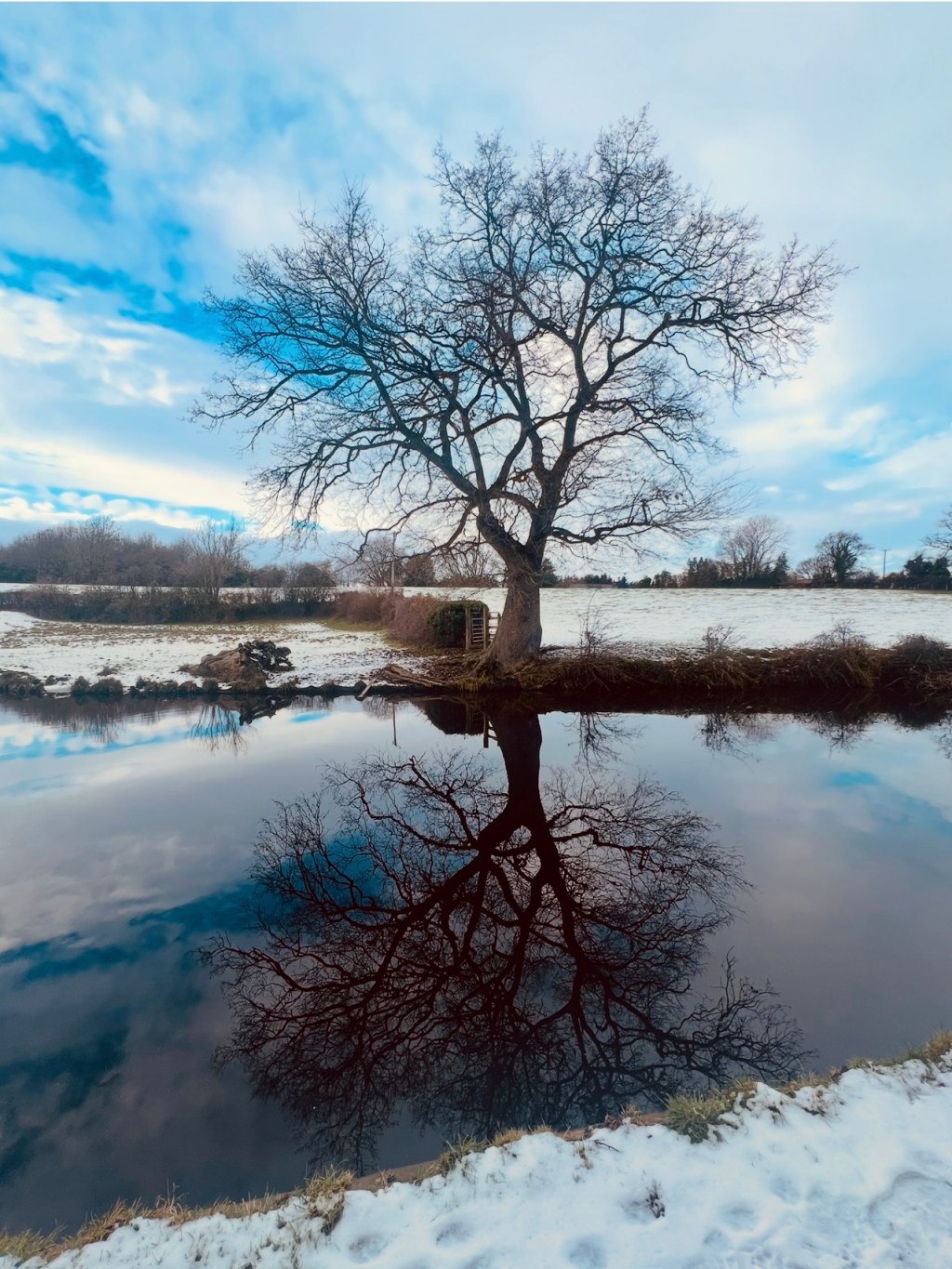
There is a moment in winter when a person stops walking, and in stopping notices that something has changed, not so much in the landscape itself as in the way attention settles upon it. The sound of footsteps on frozen ground and dead leaves, which until then had accompanied each movement, falls silent, and with this small interruption a different quality of presence begins to emerge.
The air is cold, steady, unremarkable, and the scene remains largely unchanged. The canal runs alongside, widening gently, its water held within its banks and moving so slowly that its motion is barely perceptible. Unlike a river, it does not rush or wander; it receives reflections rather than carrying them away. The surface holds the pale sky, the dark shapes of trees, the occasional drift of snow, all of it remaining for a moment longer than expected.
A bare tree stands nearby, its branches stark against the light. If one looks for long enough, its form begins to shift in perception, not symbolically but visually: the roots seeming to lift, the branches inclining downward, an inversion that is noticed and then left alone, without interpretation.
This is not silence, strictly speaking, but a thinning of sound. The usual background of movement and intention recedes, and what remains does not insist on being noticed. The path does not instruct where to go next. The canal does not suggest purpose or destination. Even the sky appears restrained, offering its light cautiously, as though reminding us that clarity does not always arrive suddenly.
We often describe such moments as empty. In fact, what is present here is not emptiness but space – a space in which the mind continues, at first, to behave as it always does. Thoughts arise about the cold, about time, about memory, about what comes next. This is not a disturbance; it is simply the ordinary activity of thinking.
Gradually, it becomes possible to notice that these thoughts are occurring without requiring engagement, that they can be heard without being followed. One thought replaces another, loosely connected, some trivial, some familiar, some unexpected, and instead of forming a narrative they begin to resemble a quiet traffic, passing through without direction.
Attention widens. Breathing becomes perceptible. The body’s weight is felt standing still. A single leaf on the path draws the eye, darkened and softened by moisture, half decomposed. It is seen clearly, and then the others are seen too, scattered without order. There is no wish to move on, only to remain, briefly, in this position of seeing.
From time to time, another thought appears, and it is noticed in the same way as the reflections on the canal’s surface – present, stable for a moment, then replaced. There is both closeness and distance: presence without absorption.
Nothing remarkable happens. And yet something settles.
Perhaps this is why winter scenes like this affect us so quietly. They do not promise insight or change. They do not attempt to impress. They simply endure, shaped by time, returning to this subdued state whether we pay attention or not.
And in doing so, they offer a modest invitation: to stop, to stand, and to experience, if only briefly, what it is like to be here without needing the moment to become anything else.
 Nature Speaks
Leave a comment