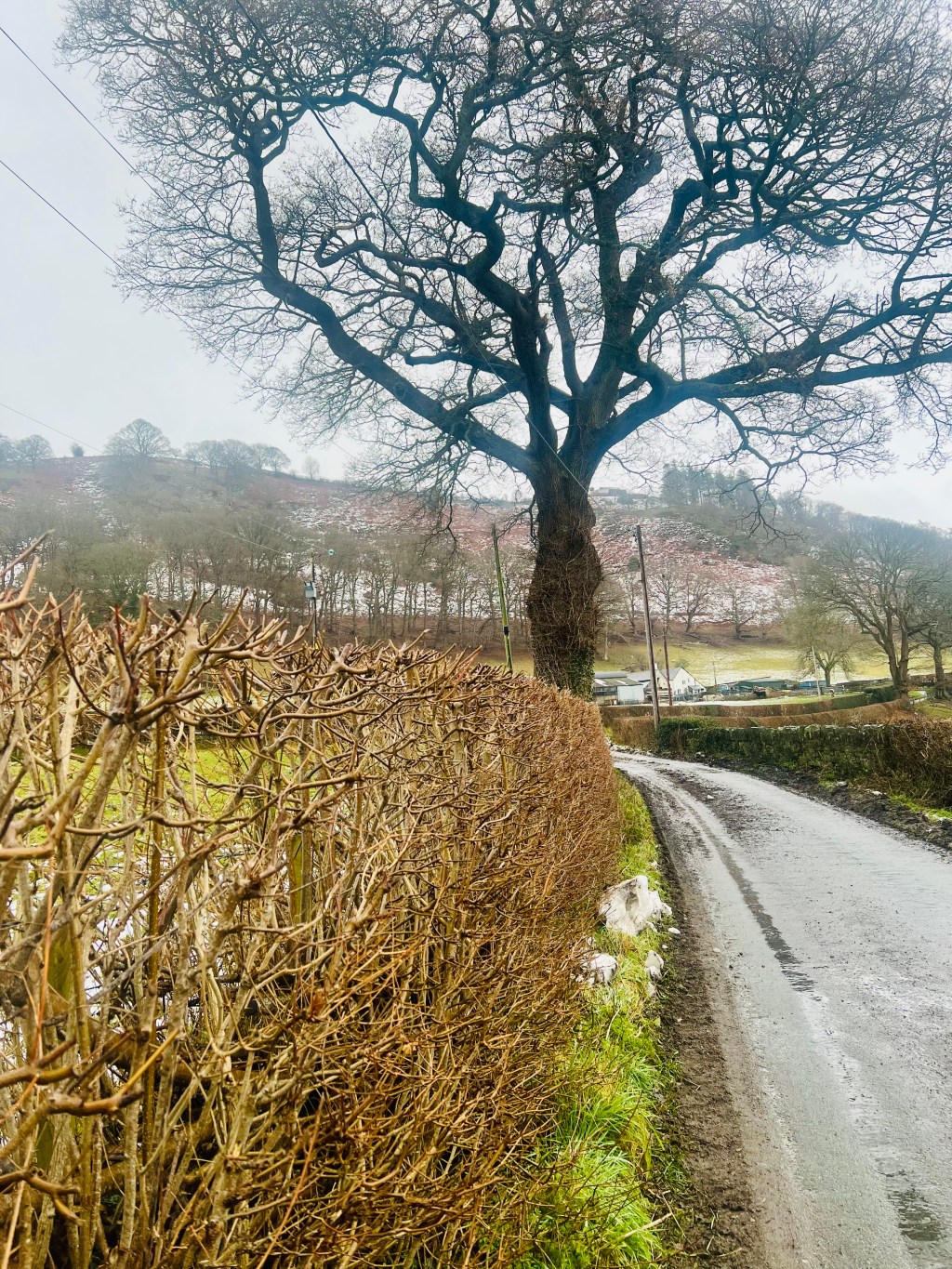
I stop, as I often do, beside the same stretch of hedge.
There is nothing remarkable about it. Hawthorn mostly, threaded with bramble, a scatter of last year’s leaves still caught in the mesh of twigs. I have passed it many times without noticing more than its outline. Green in summer, bare in winter, simply there.
Today I take out my sketchbook.
I am not looking for a drawing.
I am trying to see.
At first, nothing settles. My eye moves too quickly, naming rather than meeting. Leaf, thorn, shadow, stem. It takes time for that restlessness to quieten. Only when I stop trying to do anything does one small detail begin to hold me. The way a single leaf has curled inward, its edge browned and slightly translucent, the veins still faintly green beneath the surface.
I draw it slowly. Not well. Not confidently.
The line falters. I correct it. I let it falter again.
What matters is not the page filling, but something else happening. A subtle shift from grasping to attending. The leaf resists me. It refuses to be simplified. Each time I think I have understood its shape, it shows me another small turn, another unevenness, another quiet insistence on being exactly what it is.
This takes longer than expected.
At some point, I realise I have stopped thinking about the drawing altogether. I am simply with the thing in front of me. The hedge recedes. The morning stills, winter holding everything a little closer. Even time feels less linear, more pooled.
Later, when I close the sketchbook, the page does not feel finished. But something else does.
I walk on, aware that I will pass this hedge again. Perhaps tomorrow, perhaps next week. I will see it differently now. Not because I have captured it, but because it has corrected me.
It seems to me that this is what we are losing. Not images, not information, but the capacity to stay long enough for the world to answer back.
Moments like this are small, almost inconsequential. A hedge. A leaf. A few minutes of slowed attention. And yet it is precisely these moments that feel increasingly rare.
We move through a world dense with images and explanations, and still feel we are skimming its surface. We know the names of things more readily than their presence. We encounter representations faster than we encounter reality itself. Something in our way of seeing has become hurried, and we feel the loss, even if we struggle to name it.
The art critic John Ruskin noticed this danger long before our own moment of acceleration. Writing in the nineteenth century, he warned that when seeing becomes careless, everything that follows is diminished. For Ruskin, learning to draw was never primarily about skill. It was a moral education, a way of training the eye to submit to what is there, rather than impose what it expects to find. “To see clearly,” he wrote, “is poetry, prophecy, and religion all in one.” It was not metaphor. It was responsibility.
More than a century later, the psychiatrist and philosopher Iain McGilchrist gives contemporary language to this same unease. His work suggests that modern culture privileges a narrow mode of attention. Fast, abstract, disembodied, and controlling. This way of attending is extraordinarily powerful. It allows us to analyse, categorise, and manipulate the world with precision. But it is poorly suited to meaning, relationship, or wisdom.
When this mode of attention dominates, we begin to mistake representations for reality itself. Fluency starts to feel like understanding. Speed replaces judgment. The subtle, relational qualities of experience, those that cannot be grasped quickly, are pushed to the margins.
Contemplative art moves in the opposite direction.
It does not aim to explain.
It does not seek to optimise.
It does not hurry to conclude.
Whether through drawing, writing, or returning again and again to the same place, contemplative practice asks for a different quality of attention. One that is receptive rather than acquisitive. It allows itself to be shaped by what it encounters, rather than forcing experience into a ready made frame.
This is why such work can look modest, even inconsequential, beside louder cultural forms. It deals in small gestures. A repeated line. A familiar path. A quiet observation. But these gestures are not escapist. They are reparative.
They repair our capacity to dwell.
They restore trust in language that has not been rushed.
They return the body to culture through slowness and skill.
In a time increasingly shaped by disembodied intelligence and accelerated production, contemplative art reminds us that meaning cannot be generated on demand. It must be grown. Through return, relationship, and care.
A few days later, I pass the hedge again.
I do not stop this time.
I do not take out the sketchbook.
The light is different. Thinner now, slipping sideways through the branches. The leaf I drew has already loosened its hold. I could not find it again even if I tried. That seems right.
What remains is not an image, but a change in pace. I notice how quickly my eye still wants to move on, how easily it reaches for what it already knows. And I notice, too, that I can interrupt that movement. Just slightly. I can allow something to take its time instead.
The world does not offer itself all at once. It never has. It waits, patiently, for the quality of attention it deserves.
So much of what surrounds us now asks to be grasped immediately, named quickly, turned into something else. How rarely we are invited to linger without purpose, to stay without producing.
I walk on, aware that nothing has been solved. There is no method here, no instruction I could pass on intact. Only a practice of return. To the same places, the same questions, the same act of looking again.
Perhaps this is enough.
To resist the urge to hurry.
To allow the world to remain larger than our explanations.
To learn, slowly, how to see.
 Nature Speaks
Leave a comment