A New Year’s Day Long Read
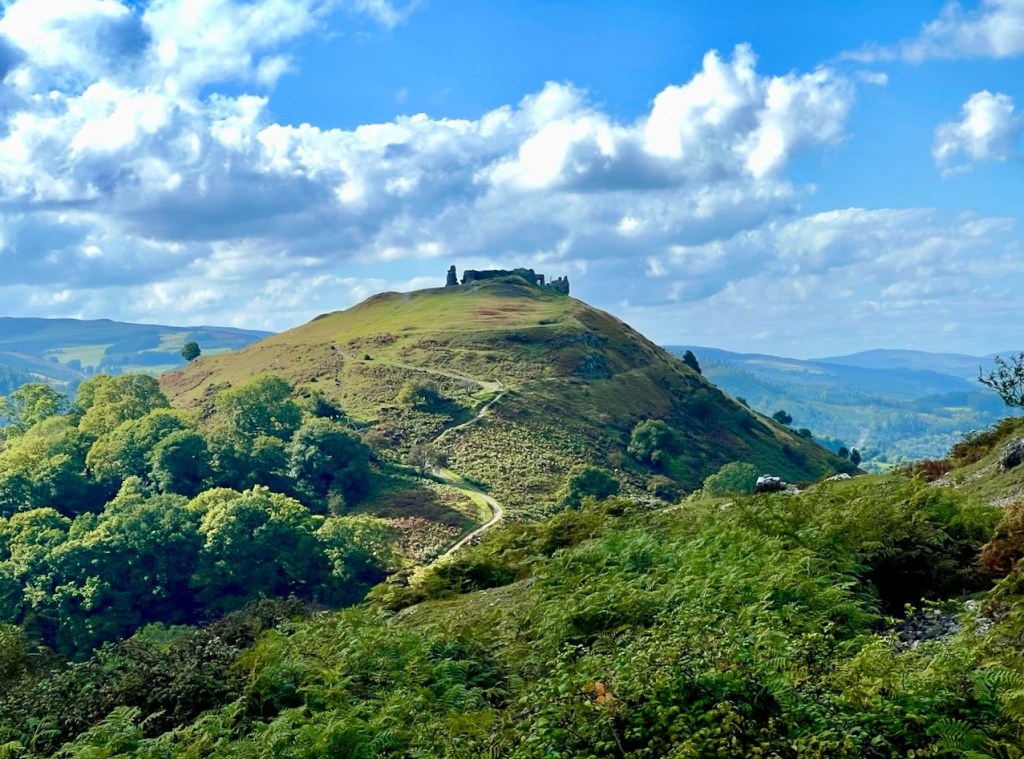
What draws the eye first is not the ruin itself, but the long sweep of the hill that carries it. The slope rises in a gradual arc, its folds softened by heather, bracken, and grass, and from a distance the summit appears closer than it is, as though inviting us to climb yet keeping a gentle distance. The ruins of Castell Dinas Brân sit at the crown, their shapes worn by weather and time, but still clear enough to hold their place in the imagination. Seen from the valley, they resemble a gesture halfway between presence and disappearance, a reminder that endurance does not always require completion.
The path winds upward in a pale curve that is almost a line of thought drawn into the land itself. It is not straight, nor abrupt, but turns just as the hillside turns, adapting itself to the contours rather than resisting them. As we begin to walk, we feel the incline pull at the muscles of the legs and the lungs start their quiet work. The climb is not long, but it asks for attention. Each step brings us incrementally upward, and with every few paces the air changes, becoming cooler and clearer, carrying with it the faint scent of damp grass and distant woodsmoke from the valley. There are moments on this path when conversation naturally falls away, and what remains is the rhythm of footfall and breath, a steady cadence that does not need improvement.
From here the view unfolds slowly. Fields layer themselves in broad brushstrokes of green and brown, trees gather in rounded forms, and hedgerows trace the outlines of long-settled boundaries. In winter light the land seems at once older and newer, older in the patience of its forms, newer in the way weather reshapes colour from hour to hour. Nothing here shouts for attention, yet everything holds a presence that deepens as we keep walking. We may find, without quite meaning to, that our pace slows, not from tiredness but from curiosity, as though the path is not only taking us upward, but also drawing us inward.
The ruins themselves appear gradually. First a line of stone against sky, then the suggestion of a wall, then the unmistakable arch that once framed a doorway. We come close enough to see that what remains is neither whole nor broken, but somewhere between. These fragments do not pretend to completeness, and yet they contain a kind of integrity that does not depend on fullness. We walk through what was once a room, though its function is no longer known to us, and feel how air moves differently through a space that once held voices. The imagination works easily here, not to reconstruct, but to sense the density of time. We do not need to picture the lives that moved within these walls to feel that life continues around them, shaping and reshaping the ground they occupy.
If we let ourselves linger, we begin to notice that the ruins are not empty. Small plants find purchase between stones, their roots holding tightly to the crevices where soil has settled. Moss gathers in places where moisture rests longest. Lichen spreads slowly across surfaces we rarely touch. Wind passes through but does not erase; rain falls but does not wash away everything; frost arrives and leaves and arrives again, each time rearranging surfaces so subtly that we rarely see the change until years have passed. The ruins are not static; they are in conversation with everything that touches them. What seems inert is in fact quietly responding.
There is a moment, perhaps, when we realise we are standing not only on a hilltop, but within continuity itself. The stones beneath us were shaped by hands we will never know. The land beneath the stones was shaped by forces older than language. The air that fills our lungs has passed through trees lower down the valley, and those trees grew from seeds that fell in seasons before we were born. Nothing here is singular. Nothing here is isolated. The ruin holds a memory of structure; the hill holds a memory of emergence; the wind holds a memory of passage; our bodies hold memories we cannot always name. To stand still is to be positioned within these threads, whether we are aware of them or not.
It is tempting to think of ruins as symbols of decay, yet they can also be understood as symbols of transformation. What was once interior is now exterior. What once separated inside from outside now joins them. What once protected now reveals. And what once held walls now holds air and light and shadow. The ruin is not simply what remains; it is what remains open.
Sitting for a while against a half-wall still warmed by the faint winter sun, we might notice how breath and place begin to align. Inhaling, we feel the slight chill of altitude that clears the mind without insisting on clarity. Exhaling, we feel the body soften, as though the hill itself is holding us steady. There is no demand here to learn, no requirement to draw conclusions. It is enough to listen. The wind carries voices we cannot decipher; a bird crosses the sky with a call that fades before we can recall it precisely; the rustle of bracken below shifts in patterns that do not repeat.
These sounds do not tell us what to think, but they invite us to be present. They remind us that awareness is not achieved by force, but by willingness. We do not need to analyse the history of the place to feel its resonance. We do not need to articulate its meaning to sense that it matters. Sometimes attention is its own answer.
When we stand again to leave, the descent feels different from the climb. The valley opens before us like a breath released, and life below appears unchanged, yet we carry with us an altered sense of pace. The mind, which moments ago may have been filled with plans and recollections, now settles more easily into observation. It is not that the world has transformed, but that we have stepped for a moment into its slower current.
The path leads us back down the hill, and with each step our connection to the everyday strengthens again. Yet something of the height remains. The memory of wind on skin. The sight of valleys layered in quiet light. The feel of stone warmed by sun and cooled by time. These impressions stay with us not as tasks to remember, but as traces of presence that continue beneath thought.
The hill remembers, not because it holds every detail, but because it continues to stand through change without losing its form. In attending to it, we remember something too: that endurance can be gentle, that attention is a form of care, and that life continues with or without our noticing, but grows richer when we choose to notice.
Life goes on, moment by moment, and gently our awareness returns to where our feet meet the ground, to the movement of breath, to the quiet invitation the world offers when we give ourselves enough time to listen.
The wild remembers. So do you.
 Nature Speaks
Leave a comment