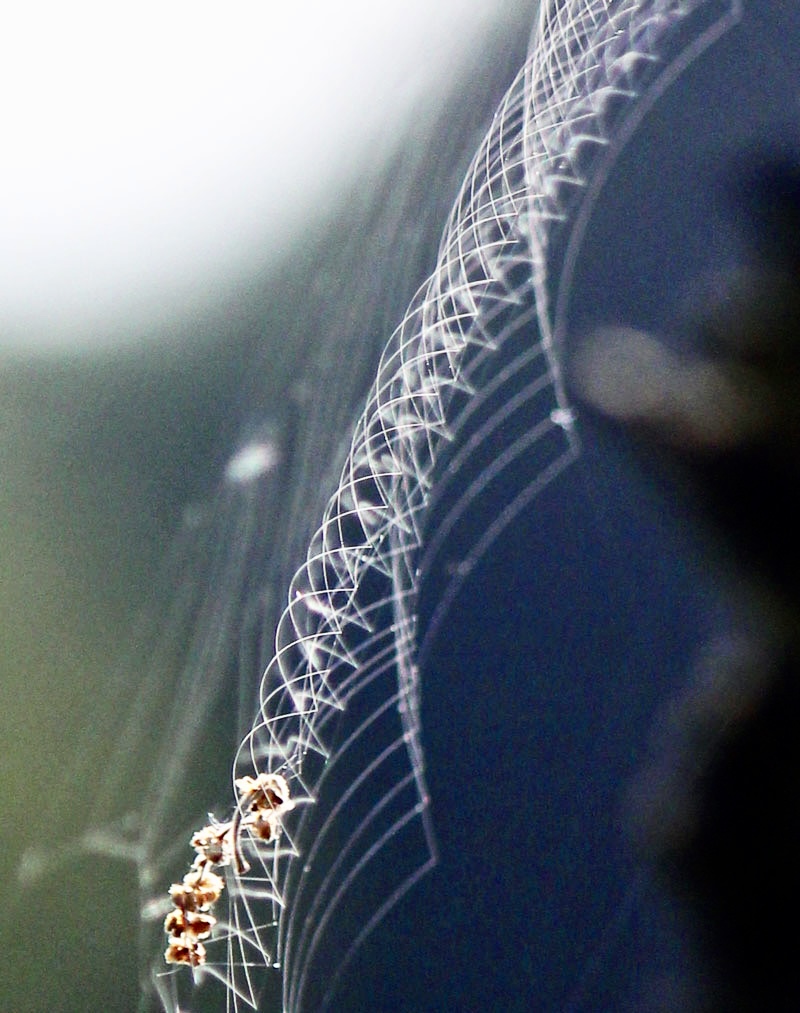
In the quiet geometry of a spider’s web lies a hidden wisdom – a repeating pattern that nature uses to build life itself. This guided reflection explores how that same fractal intelligence lives within us too, shaping our intuition, imagination, and instinct – and how noticing it might gently change the way we move through the world.
It begins with a pause. A step off the path. The kind of moment so small you might miss it if you were moving too fast. There, caught between two stems in the stillness of morning, a spider’s web trembles – threads glistening with dew, trembling in the faintest breeze. At first it seems delicate, a fragile thing suspended in space. But if you linger – if you let your gaze soften and stay – something shifts. What looked like fragility reveals itself as order, as pattern, as memory woven into silk.
The wisdom in repetition
In Good Nature, the botanist Kathy Willis writes about the fractal intelligence that runs through the natural world. Fractals are patterns that repeat at different scales, a quiet mathematics of life. We see them in the branching of rivers, the spirals of shells, the leaf veins of oak and maple. Look closely enough, and the same geometry reappears: from the curve of a fern’s frond to the structure of our own lungs. Nature seems to favour this kind of repetition – a rhythm that builds complexity from simplicity.
The spider’s web is one of these fractals, though it is born not from conscious calculation but from instinct – a living algorithm spun from the body of a creature no larger than a fingernail. Each thread follows a rule that has been refined over millions of years. Each spiral, each radial line, is part of a pattern that is older than memory.
It is easy to think of intelligence as something that happens in the brain – a product of thought, reason, analysis. But nature shows us a different kind of knowing: one that is embodied, instinctive, felt. The web is not “designed” in the way a human architect plans a bridge. It is remembered – an ancestral memory stitched into silk.
A mirror of our own minds
This kind of intelligence is not foreign to us. We are, after all, part of nature’s pattern. Fractals exist within us too – not just in our bodies, but in the ways our minds move. Intuition, for example, is not a single flash of insight. It is a series of subtle recognitions repeating beneath awareness: tiny signals, echoes of past experience, patterns we have seen before but forgotten we know.
Imagination works in the same way. One idea spirals outward into another, branching into new possibilities. Creativity is not invention from nothing, but the patient unfolding of what is already there. And instinct – that deep, bodily wisdom we so often ignore – is the thread that holds it all together, guiding us toward balance, safety, meaning.
When we see the spider’s web not just as a structure but as a mirror, we begin to understand something essential: that our most natural ways of knowing do not arrive through force or control. They emerge, like the web, from a quiet attunement to pattern. They are not acts of will, but of participation.
Learning from the web
What might it mean to live more like the spider? To weave our days with the same trust in what is already known? Perhaps it begins with listening – not the strained kind of listening that tries to extract answers, but a softer listening that allows them to arise.
The more we attune to the patterns around us, the more we start to feel them inside. A walk along a winding path echoes the branching of neurons. Watching waves unfurl teaches us something about the rise and fall of our own thoughts. Observing the repetition of forms in nature reminds us that repetition is not stagnation – it is how life learns, refines, evolves.
And this shift – from thinking of ourselves as separate observers to recognising ourselves as participants – changes how we approach the world. Problems become threads to follow rather than walls to break through. Decisions feel less like leaps into the unknown and more like natural steps along a path that is already forming. We begin to trust that, like the spider, we know how to weave – even if we don’t yet see the final pattern.
Living fractally
This way of seeing is not just a poetic idea; it has real consequences for how we live. When we honour the fractal intelligence of nature, we begin to slow down. We stop forcing outcomes and start cultivating conditions. We allow complexity to arise instead of trying to engineer it. And perhaps most importantly, we learn to trust the intelligence that lives beneath our thoughts – the deep, ancient knowing that our culture too often dismisses as mere “gut feeling.”
The web teaches us that small, repeated actions – even those that seem insignificant – can create something vast and resilient. That beauty emerges from process, not perfection. And that we are not separate from the intelligence that shapes rivers and roots and galaxies. We are shaped by it too.
So the next time you encounter a spider’s web, pause. Notice how the morning light catches its threads. Trace the spiral with your eyes. Feel the symmetry and the spaces in between. And as you do, sense the deeper pattern that lives within you – the one that has been there all along, waiting to guide you back to yourself.
A mindful practice: Weaving awareness
Find a place in nature where patterns reveal themselves – a leaf’s veins, a branching stream, the curve of clouds. Sit quietly for five minutes and let your attention rest on what you see. As you breathe, notice how the pattern repeats in small ways and large. Then gently turn your awareness inward: where might similar patterns be unfolding in your own life, your thoughts, your choices? What is repeating? What is growing from those repetitions?
Trust what you notice. You are not separate from the pattern. You are part of the weave.
