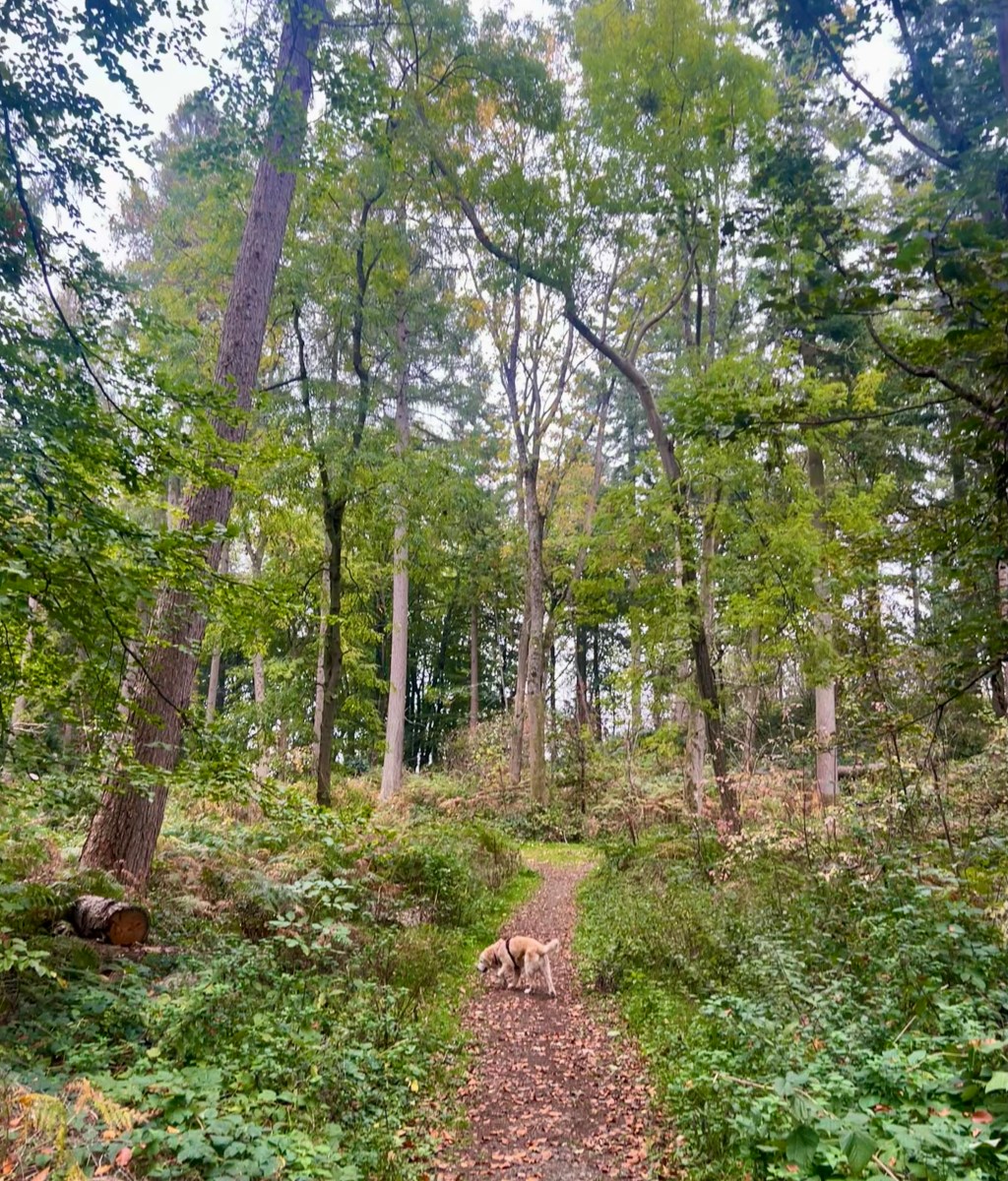
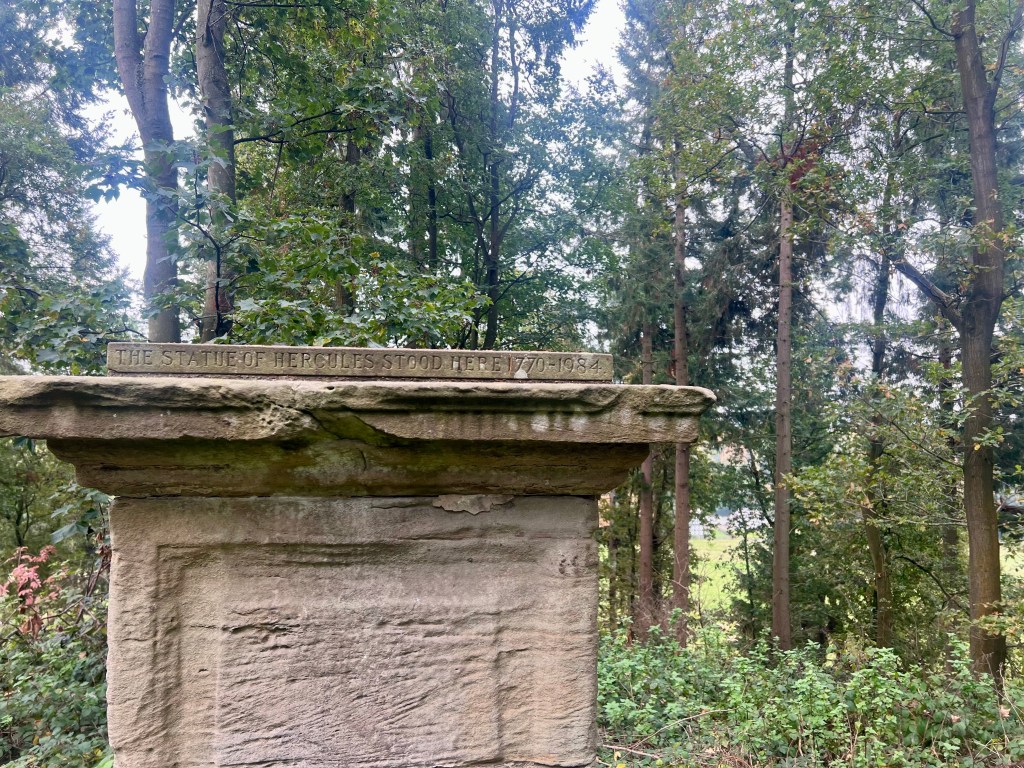
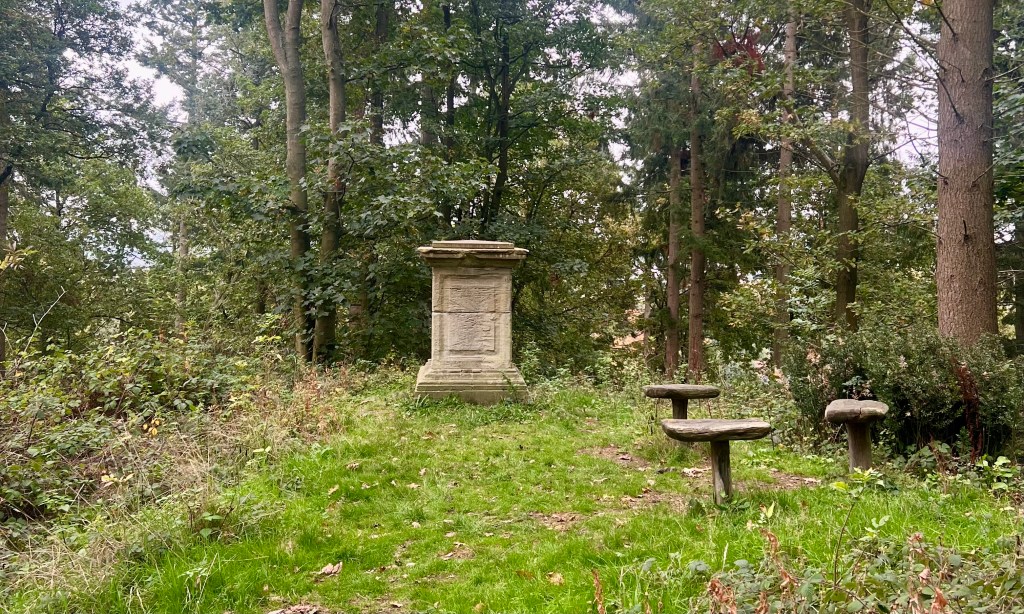
I pause on a familiar woodland path in the grounds of Chirk Castle, where the ground softens into leaf litter and the air carries the damp, green hush of autumn. I’ve walked here for years – sometimes quickly, sometimes with the slow, wandering pace of someone who knows the way by heart. And always, there it is: a solitary plinth rising from the grass, square and stern as if still holding its breath. Lichen has settled into its carved edges, and the inscription along the top – “The statue of Hercules stood here 1770–1984” – is worn but legible, a quiet testament to what once was. Nothing crowns it now but drifting leaves and open air. Yet the shape of that absence feels deliberate, weighted, almost present. Something powerful occupied this space – and its leaving has a gravity all of its own.
A little further along, a weathered sign on a gate warns: ‘Do not feed the horses’. But there are no horses here. Not today. Not for many seasons. The field beyond lies empty but for a few sheep nosing through the damp grass. Deer are rare now, only occasional visitors to the edge of the woods. I remember when horses grazed here – their slow, steady presence part of the landscape’s rhythm – and I’ve heard that once, long before that, wild horses roamed these slopes. The sign remains like a small echo, pointing to a life the land once held but no longer needs. Even in their absence, their memory grazes the edge of things.
We think of landscapes as permanent – castles standing for centuries, gardens carefully planned, monuments intended to endure. Yet they are always shifting, always in motion, always forgetting. Footpaths close in beneath bramble. Streams carve new courses. Boundaries dissolve. Even stone disappears, pulled slowly back into the earth’s patient embrace.
Somewhere in the woods beyond this path, a statue once stood: a Roman god watching over the trees. His name lingers still in the name of the place – Mars Wood – though no trace of him remains. He is gone, and no one can say how or when. Perhaps he was toppled in a storm. Perhaps he was stolen. Perhaps he lies now beneath the roots of an oak, his shield crumbled, his gaze turned upward to the soil.
Landscapes forget, but they also remember. A hollow track remembers hooves. A scatter of old trees remembers the edge of a long-lost boundary. The name of a field remembers a life once lived. These traces are subtle, but they endure – clues left behind by centuries of movement and change.
And absence, I think, tells its own kind of story. It shows us what mattered once – what was tended, valued, and believed permanent – and how time quietly undoes those certainties. The missing statue, the vanished herd, the empty plinth: all of them are records, too. Not of what remains, but of what has been.
When we walk with attention, we learn to read these silences. The land’s memory is not written in ink but layered into soil and stone, etched into the contours of a hillside, whispered through a place name that no longer makes sense. It is not a memory that clings; it is one that transforms – folding the past into the present until they are inseparable.
I walk on, leaving the old plinth behind – a landmark I’ve known for as long as I can remember, yet one that still has the power to make me pause. I notice the subtle dip in the path where animals once passed, the trees marking the forgotten edge of a field, the empty gate where horses no longer graze. I listen not only to what the land shows me, but to what it hides. Because the land is always speaking – not just in what it holds, but in what it lets go.
This essay grew from years of wandering the woods and fields that unfold around Chirk Castle – landscapes I’ve explored since childhood and returned to season after season. Each walk reveals something different: a sign with no horses, a name with no statue, a space where something once stood. Over time, these absences have become part of how I listen to the land, teaching me that memory lives not only in what endures, but also in what is quietly lost. It belongs to Nature Speaks – an ongoing practice of paying attention to the subtle ways landscape, imagination, and memory shape the inner life.
 Nature Speaks
Leave a comment