Where attention becomes art
“Art does not reproduce the visible; it makes visible.” – Paul Klee
When we look long enough, the world begins to look back. A leaf, a wave, the line of a shoulder – each holds more than its surface. Art begins, not with skill or materials, but with attention: the kind of attention that pauses long enough for the world to speak through us.
The artist, like the contemplative, learns to see with a patience that reveals hidden life. To create is not to capture but to reveal – to draw out what is already there, waiting in the quiet. Cézanne once said that everything in nature could be understood through the cylinder, the sphere, and the cone. He was not simplifying the world but searching for its living geometry, the rhythm beneath appearances. His apples, mountains and clouds seem to breathe; they hold the pulse of the same enduring order that carries through stone and flesh.
This desire to see beneath the surface is ancient. The poet John Keats called it negative capability – the ability to rest in mystery “without any irritable reaching after fact or reason.” When he watched birds picking at seeds, he imagined himself entering their movement, feeling what it was like to be a bird. “I pick with them,” he wrote. In that act of empathy, the boundary between self and world dissolved. He was not looking at nature; he was with it.
“The world is full of magic things, patiently waiting for our senses to grow sharper.” – W.B. Yeats
All deep observation begins with this sharpening. At first, we notice shapes and colours, the simple rhythm of light and shadow – the curve of water against stone, the slope of a tree leaning into wind. This is exact sense perception: seeing without naming, attending without possession. It sounds simple, but it asks for stillness. We have to let the world arrive in its own time, unhurried by our need to know.
If we stay long enough with what we see, imagination begins to stir – not the fanciful kind that escapes the world, but one guided by it. We begin to notice the correspondences that live quietly beneath appearances: the spiral of a shell repeating in a seed head; the curl of a wave echoed in a lock of hair; the rise and fall of our own breathing reflected in the tide.
Leonardo da Vinci studied these patterns obsessively. He drew water tumbling through gutters, swirling down drains, pouring through air. In those drawings, water becomes a teacher. Its gestures are the same gestures that move through us – the spiral, the wave, the sphere. The same invisible forces that shape a riverbed shape the muscles of the back, the line of a shoulder, the whorl of a fingerprint.
The German poet Novalis once wrote, “Everyone can see that the human body is a molded river.” To see this is to realise that nothing in us is fixed. The body, like the world, is process. Our bones hold the memory of water; our movements trace invisible currents that belong to the same element that carves valleys and fills clouds. Everything is in flux. Everything is water.
The artist who sees in this way begins to move beyond imitation into participation. They no longer stand outside what they depict. Observation becomes empathy; empathy becomes a kind of merging. The painter, the dancer, the writer – all enter the same stream of becoming.
Rilke once wrote, “Perhaps all the dragons in our lives are princesses who are only waiting to see us act, just once, with beauty and courage.” When we look with such beauty and courage – without demand, without fear – the world reveals its gentler face. We realise that art is not the act of mastering form, but of allowing form to appear. The gaze softens, not from fatigue, but from trust.
To see in this way is to practice what Goethe called exact sensorial imagination – a way of thinking with the senses, of feeling our way into the inner life of things. Through it, the imagination becomes disciplined by the real, and the real becomes luminous through imagination. The painter looks long enough that form begins to move; the poet listens so deeply that words rise like fish to the surface.
“I want to touch people with my art,” said Vincent van Gogh. “I want them to say: he feels deeply, he feels tenderly.”
Tenderness is what makes perception fertile. It is what turns mere seeing into communion. When we look this way, we no longer analyse the world from a distance; we are drawn into its pulse. We start to think in living images – not in abstractions, but in gestures that move and breathe.
Eventually, even imagination itself becomes too dense a veil. The artist enters a quieter state of beholding, where the mind grows still enough for something wholly new to appear. Here, thought, feeling, and will begin to merge. The world no longer stands before us as object, nor do we stand apart as subject. There is only one continuous movement – the fire of being perceiving itself through us.
To create from this place is an act of love. The painter’s line, the poet’s phrase, the sculptor’s curve – all are ways of touching the living world, of participating in its unfolding. And what arises is not self-expression but revelation: something that could not have existed without this meeting of inner and outer life.
Writing, too, can become this kind of seeing. The so-called “stream of consciousness” – used by writers like Virginia Woolf and James Joyce – lets language move like water, flowing between inner and outer worlds. It is less about control than surrender, less about crafting sentences than becoming porous. To write this way is to listen to life thinking itself through you.
Cézanne said, “The landscape thinks itself in me, and I am its consciousness.”
That sentence could be the quiet mantra of every true observer – artist, poet, gardener, or walker of rivers.
Because to look deeply is not only to see more clearly, but to belong more deeply. Patience grows. Gratitude deepens. The familiar world regains its radiance: the glint of light on a puddle, the shadow of a crow across a field, the slow dance of mist above water.
Art is not a luxury of the gifted; it is the natural language of attention. When we learn to attend in this way, life itself becomes the canvas – and every breath, every ripple, every tender act of seeing adds to the great painting that is already being made.
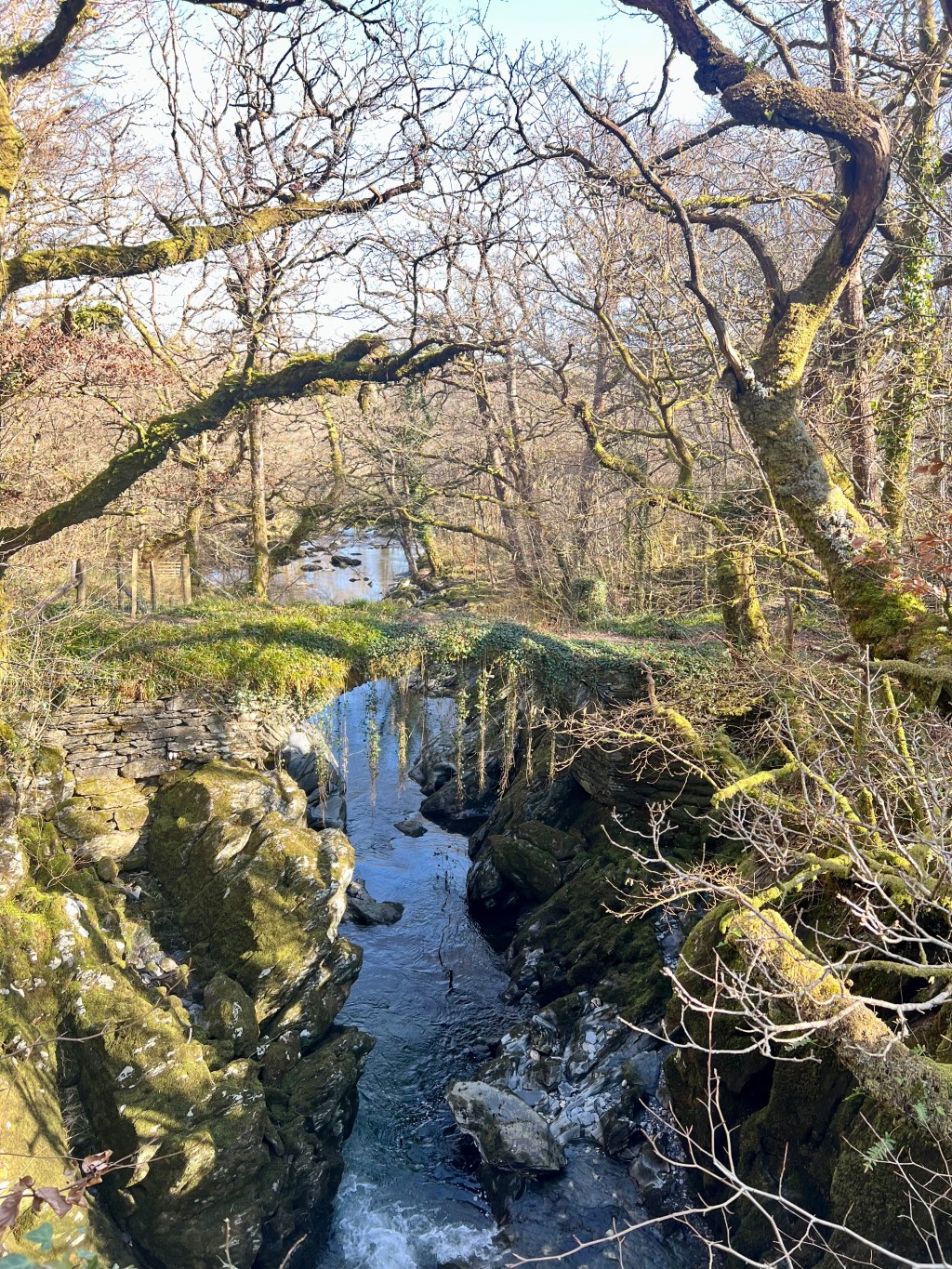
We do not stand at the riverbank, measuring its current.
We are the river, learning how to flow.
 Nature Speaks
Leave a comment