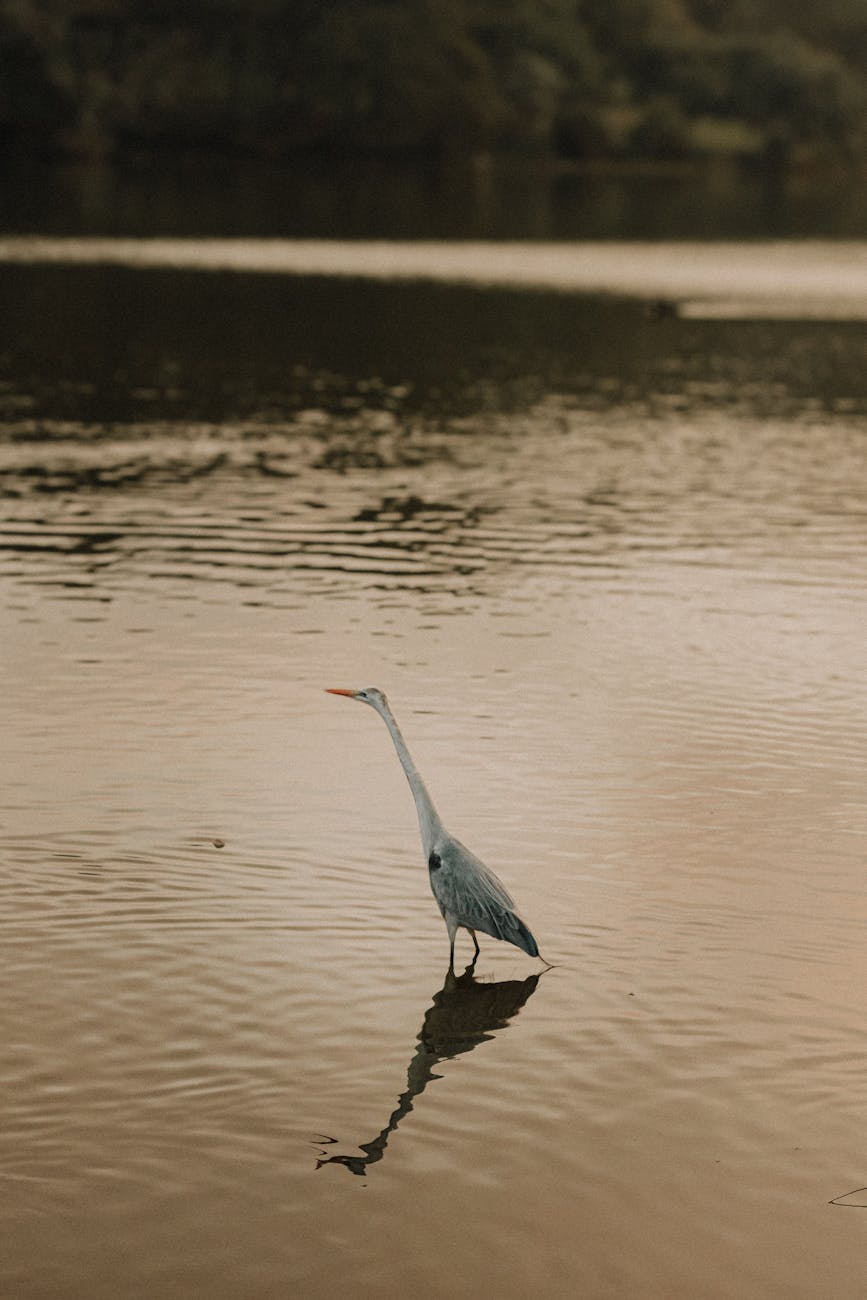
This weekend I’ve been listening to the quiet wisdom of the season. By the lake, a heron teaches the skill of stillness. At my feet, a fallen leaf speaks of the art of letting go. Each offers a way back to nature’s rhythm – one through rest, the other through release. The heron and the leaf are different teachers, yet their lessons entwine. Stillness and surrender – both are ways of belonging more deeply to the world.
There is a heron that waits at the edge of the lake. Not moving. Not rushing. Just waiting. I pass it often, and each time I feel the quiet gravity of its patience. The whole bird seems tuned to stillness, its body a long-held note, unbroken and unhurried. It does not ask itself what else it should be doing. It simply embodies the pause.
We so easily forget that life is not only movement. The natural world is built on intervals of rest as much as on bursts of activity. Trees stand bare through the long months of winter, conserving energy below the surface. A fox stretches along the sheltered edge of a hedge, half-asleep in the warmth of September sun. Even the soil lies dormant, its hidden life biding time until the season turns. What appears as inactivity is, in truth, the ground of renewal.
In our culture, busyness has become a badge of honour. We equate worth with productivity, fill our days with noise and motion, and grow uneasy in moments of stillness. Yet the wild world whispers a different rhythm. The heron remembers. The trees remember. Even the fox remembers, curling into stillness in the middle of the day. The lesson is not simply that rest is permissible, but that it is essential – the interval between notes that allows music to exist at all.
To do nothing deeply is not laziness. It is trust. It is listening to the slower pulse beneath all things, the rhythm that holds growth and decay in balance. This weekend, perhaps we might take our cues from the wild. To sit without agenda. To wander without urgency. To rest without guilt. For in doing so we return to a wisdom older than our calendars: that stillness is not an interruption of life, but the ground upon which life depends.
A Conversation with a Fallen Leaf

One September afternoon I stooped to pick up a golden leaf that had just settled on the path. It was brittle and light in my hand, its veins still faintly green at the base, as if reluctant to release the last traces of summer. Turning it over, I found myself wondering whether it felt sadness in falling. To my surprise, the leaf seemed to answer.
Falling was not sorrow but fulfillment. It had spent its months gathering light, turning sun into sugar, feeding the great body of the tree. Its task was complete. The descent was not a failure but the last movement in a longer dance.
I pressed further, as we humans do when confronted with endings. Wasn’t it hard to let go, to fall away from the branch that held it, from the sky that once surrounded it? The leaf seemed almost amused. Letting go was how it returned. It would not fall into nothing. It would fall into soil, into decay that would feed the roots of its own tree, into a darkness that carried life forward. Decline was not the opposite of growth but part of its logic.
The wind lifted the edges of the leaf as though punctuating its words. Change was not to be feared. Even in falling, there was beauty. Even in ending, there was continuation.
I stood for a moment longer, the leaf resting quietly in my palm, its voice now fading back into silence. Then I let it slip from my fingers, and it landed softly where it belonged – among others, already forming the first layer of next year’s earth. I walked on, carrying with me the sense that nothing in nature is wasted: not a season, not a life, not even a fall.
