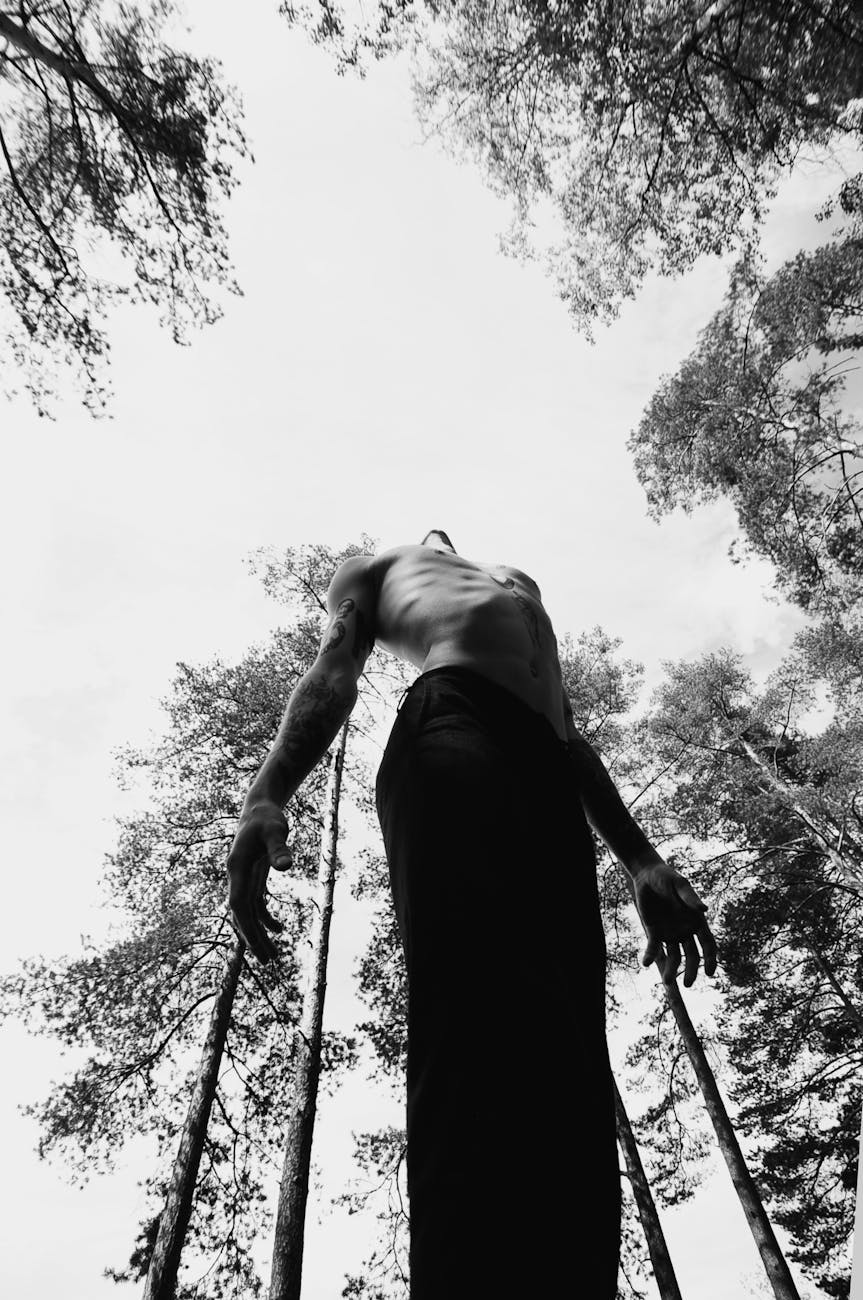
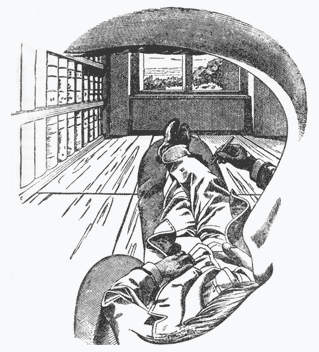
Douglas Harding’s little book On Having No Head begins with a confession. Walking alone in the Himalayas, he realised, quite suddenly, that above his shoulders there was nothing. His body remained – arms swinging, feet moving – but where his head should have been, there was only sky, only mountains, only the wide and shining world.
The description sounds strange at first. Impossible, even. But the experience is not foreign. Many of us have known it in fleeting ways, though we rarely name it.
Think of standing at the edge of a lake in the stillness of dawn. The air is damp with mist. A fish moves beneath the surface, rippling circles outward. You watch so deeply that your awareness of yourself dissolves. The horizon begins not far away, but here – where your face might have been. There is no head. Only water. Only light. Only belonging.
Most of the time, we carry our heads heavily. Not in the physical sense, but in the weight of self-awareness. We walk through the world rehearsing conversations, measuring appearances, guarding the fragile sense of who we are. It is exhausting, though we hardly notice until something interrupts it.
Nature has a gift for interruption.
A robin lands suddenly close by, cocking its head with fearless curiosity. For a moment, your inner commentary falls silent. You simply see. You are seen. The distance between “you” and the bird vanishes into one attentive field of being.
The trees never seem to strain under the burden of self-regard. They do not ask if they are tall enough, graceful enough, worthy enough. They stand, headless, utterly present. And when we spend time among them, some of their stillness seeps into us.
Harding suggested a simple experiment. Try looking for your head. Turn your attention inward to where your face should be. What is there?
At best, a blur of nose if you cross your eyes. Otherwise, nothing. No face. No edge. Just openness. Just the world pouring in.
And if you try this outdoors, the effect deepens. Look up at the sky. Notice how it does not begin “out there,” far away, but right here, flowing into the place where you thought your head was. Watch a crow wheel across the field – its flight cuts directly through the empty space of awareness, without obstruction. The landscape does not surround you. It happens where you are.
To see this way is not to erase yourself, but to loosen your boundaries. It is to recognise that you are not sealed off from the world but continuous with it.
When there is no head, there is no distance. The dawn does not rise before you. You are part of its rising. The stream does not flow in front of you. It flows through the same presence in which your seeing happens.
This is what wonder truly is: not the appearance of something extraordinary, but the sudden absence of the barrier that usually stands between you and the ordinary.
Harding’s discovery is not a philosophy to master, but a way of remembering. A reminder that perception can be lighter than we think, that our sense of self can be softer, more porous, more akin to the way a tree lives or a bird sings.
The next time you step into a woodland path, try leaving your head behind. Let the branches spread into the space where your face would be. Let the light filter through you, not toward you. For a few moments, see as the forest sees – without a head, without a centre, without interruption.
You may find, in that gentle vanishing, not emptiness but return.
The wild remembers. So do you.
 Nature Speaks
Leave a comment