There are stories that live in us like seeds. Ancient, fragile, indestructible. They sprout when the mind grows still enough, when the heart grows restless enough. One such seed was planted two and a half millennia ago, in a cave of the imagination.
Plato – through the questioning voice of Socrates – asks us to picture prisoners chained since birth, forced to face a stone wall. Behind them a fire burns. Between the fire and their backs, others pass, carrying statues of gods, carved shapes of men and beasts. Shadows play across the wall, and these shadows are all the prisoners know of the world. They name them, argue about them, weave meaning into their flicker. The shadows become reality itself.
But Socrates insists: this is not life, not truly.
“The process,” he says, “is not the turning over of an oyster shell, but the turning round of a soul – passing from a day which is little better than night, to the true day of being.”
The story is less about a cave and more about the human heart – our trembling before change, our longing for light, our suspicion of those who bring it.
The Engraver’s Cave
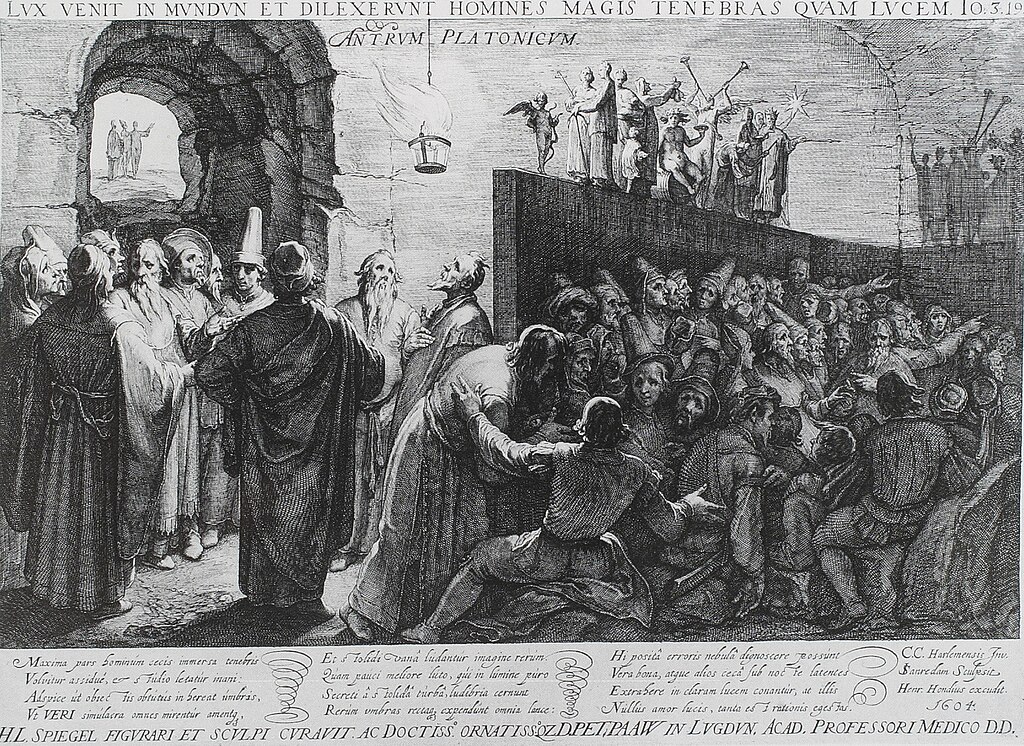
Seventeen centuries later, in the Dutch town of Assendelft, an artist’s hand gave Plato’s vision a body. In 1604, Jan Saenredam pressed ink into paper and etched the allegory for others to see. His engraving shows Cupid and Bacchus standing among the figurines whose shadows mesmerize the chained. Behind the barrier, philosophers stand in conversation – once prisoners themselves, now free to face the fire and the world beyond it.
The engraving is haunting not because it is foreign, but because it is familiar. We recognise ourselves in the prisoners, whose lives are circumscribed by shadows. We recognise ourselves in the freed, whose eyes – raw with light – cannot return to the dark without breaking.
The Risk of Daylight
To leave the cave is not without peril. The first sight of the sun is not revelation but pain. Plato understood that illumination wounds before it heals. And those who remain behind – secure in the certainty of shadows – often meet the messenger with hostility.
“Most people,” he wrote, “are not just comfortable in their ignorance, but hostile to anyone who points it out.”
How much easier it is to keep believing what we already know, even when it confines us. How much harder it is to turn the soul, to risk the vertigo of light.
Beyond the Flicker
The allegory endures because it is not about a distant cave but about the daily one. Each of us lives among shadows – the opinions we mistake for truth, the stories we inherit unexamined, the images that mediate rather than reveal.
And each of us is invited, again and again, to turn a little toward the source of light. To loosen the chains of habit. To test whether the world we have always known is the whole of the world.
Once glimpsed, the wider reality cannot be forgotten. The air tastes different. The sky feels impossibly large. The shadows, though they may still play across the wall, lose their power to persuade.
A Gentle Truth
Perhaps enlightenment is not a final state but a series of tender turnings – small courages of perception. To notice when we are living in shadow. To risk the brightness, even when it hurts. To remember that the sun does not ask for our comfort, only our willingness to see.
And maybe this is why the natural world is our oldest teacher. Trees do not shrink from the light but grow toward it. Rivers do not resist their course but carve valleys in patience. The dawn does not apologise for dazzling our eyes; it simply opens the day.
The cave is never only a place in Plato’s mind. It is here, in ours. And the choice it offers is timeless: shadow or light, habit or truth, the familiar dark or the frightening freedom of day.
The wild remembers. So do you.
 Nature Speaks
Leave a comment