A blackbird is singing somewhere beyond the garden, and for a few moments she continues with what she is doing, aware of the sound in the same distant way that she is aware of the light at the window. There are messages to answer and a piece of work she had hoped to finish yesterday, so when she eventually puts down what she is holding and turns towards the open door, she does so with the faint sense of having allowed herself a distraction. The song carries across the garden, pauses, begins again, and she notices how quickly she has accounted for listening as time taken away from something else.
She wonders when she became so accustomed to requiring a reason for the things that make a day feel inhabited. A walk needs to provide exercise or clear her mind, reading ought to contribute to her work, and even the pleasure of drawing a leaf can acquire the expectation that something useful should come of it. These purposes are often welcome, particularly when there are bills to pay and work that matters to her, yet she recognises how easily they extend into every available space, until an hour spent without a visible result begins to feel like an hour she will have to explain.
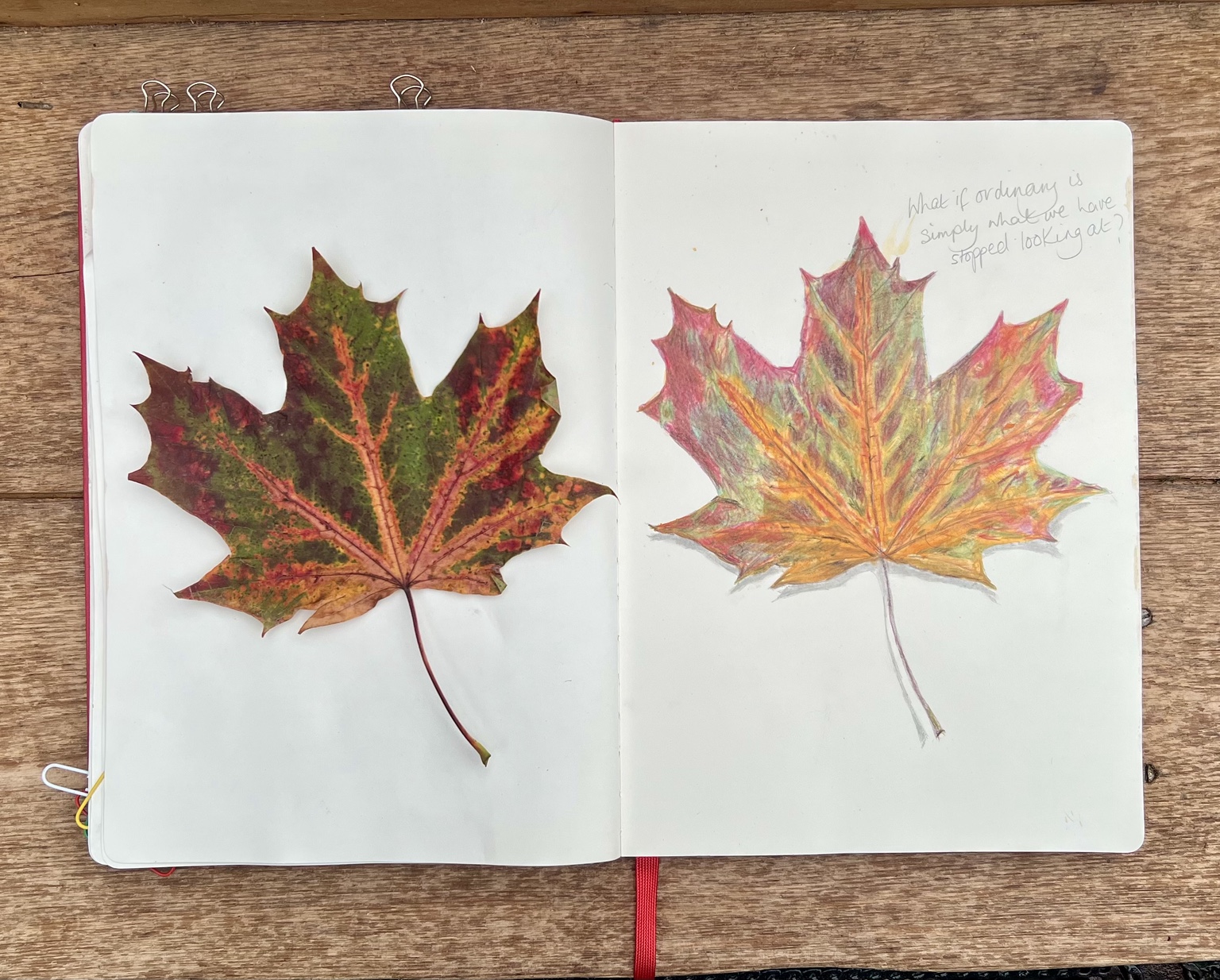
On the table lies a small drawing she began the previous evening, beside the leaf itself, which has curled further overnight and now casts a different shadow across the paper. Looking at the two together, she can see where she struggled to follow the turn of an edge, correcting the line several times before leaving it alone, and she remembers the frustration of being able to see something more clearly than she could draw it. She could obtain a more accomplished image in moments, yet the drawing holds an encounter she would otherwise have missed, including the discovery that the leaf was less symmetrical than she had assumed and that its veins changed direction around a small damaged place.
What interests her is how much happened during an activity whose result remains so modest. Her attention kept moving between the paper and the leaf, and each return disclosed something that her first impression had overlooked, until the object she thought she knew became increasingly particular. The drawing may eventually be put away in a folder, but she suspects she will look differently at the next leaf she picks up, carrying forward something acquired through the patient, occasionally irritating business of trying to see this one.

There is relief in having tools that save time, especially when they release us from work that leaves us exhausted, and she is grateful for the help that makes parts of her own life easier. Still, she finds herself wondering how she decides which experiences to hand over, and whether speed has sometimes made the decision before she has considered what the activity means to her. If she gives away the searching, the choosing, the uncertain attempt to find words for something she only half understands, she may also give away the circumstances in which her understanding could have grown.
She recognises something similar in conversation, when she catches herself preparing a reply while the person opposite her is still speaking. She can be attentive to the subject and yet miss the hesitation that changes its meaning, the moment when a familiar account of events becomes an admission the speaker had scarcely intended to make. To hear it requires a willingness to remain uncertain for a little longer, allowing another person to disturb the understanding she had brought with her. There are conversations she remembers years afterwards because someone gave her that room, listening while she arrived at words she could never have prepared alone.
Perhaps part of what troubles her about the demand to be continually effective is how little room it leaves for this unfinished condition, although so much of being human seems to happen within it. We learn while our hands are still clumsy, discover what we think in the effort of saying it, and come to understand someone through encounters that repeatedly alter our first impressions. Even rest can require a patience we have forgotten how to offer ourselves, especially when we have become used to meeting our own tiredness with another plan for improvement.
At the open door she can feel the cool air moving across her hands, and somewhere beneath the blackbird’s song there is the smaller sound of leaves stirring against the fence. The work is still on the table, with all the reasons she has for wanting to do it well, but she remains where she is until the bird falls silent. When she goes back inside, her eye catches the curled leaf beside the drawing, and she finds herself wondering how often she has finished a day by counting what she completed, while leaving out almost everything that made her glad to have lived it.
Make a one-time donation
Nature Speaks has been growing since 2011. Each essay may begin with something small — a leaf, a feather, a bird or a familiar path — but behind it are hours of observation, reading, research, reflection and revision. I keep this writing freely available because I believe that beauty, curiosity and a deeper relationship with the living world should be open to everyone. If something you have read has stayed with you, or changed what you notice, a small contribution helps me continue this independent work. Thank you for reading, whether or not you are able to give.
Donate