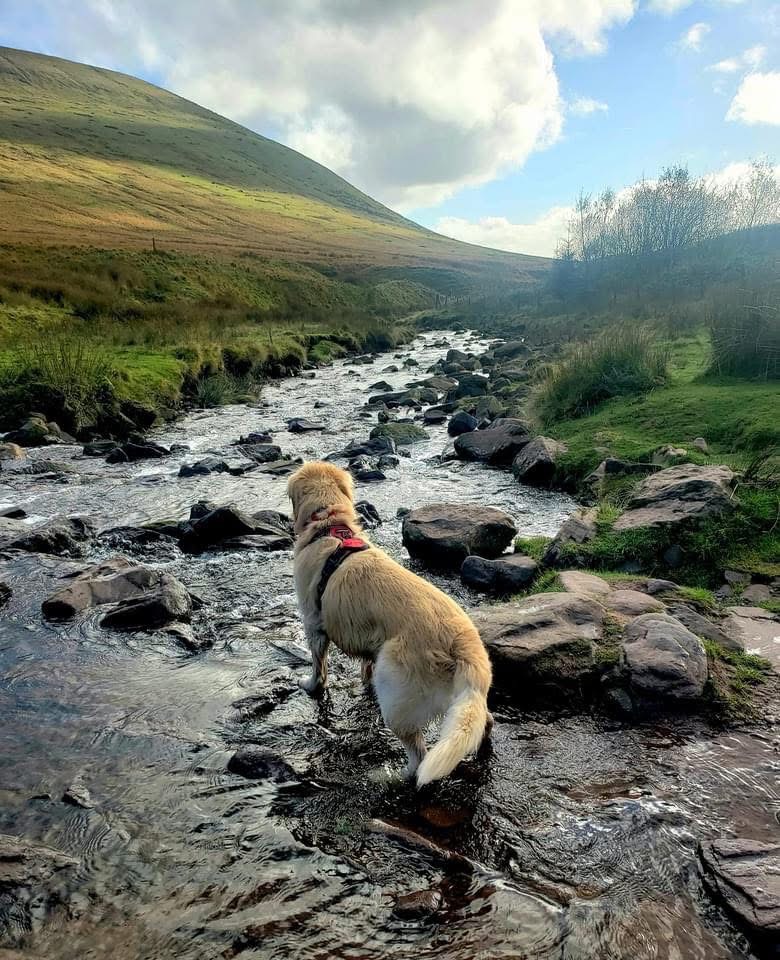
A long-read reflection for a quiet weekend morning.
“Until one has loved an animal, a part of one’s soul remains unawakened.” – Anatole France
Modern life often feels far from the wild. We live by calendars, carry glowing rectangles in our pockets, navigate concrete streets instead of deer paths. Yet beneath it all, our bodies and minds are ancient. We are mammals still, with deep instincts shaped over hundreds of thousands of years living close to earth and animal kin.
Anthropologists remind us: 99% of human history was spent as hunter-gatherers. Our nervous systems evolved not in cities but in forests, savannas, along rivers. When you feel calmer in a meadow or on a mountain trail, it is not romantic nostalgia. It is biology remembering. Psychologist Stephen Ilardi, in The Depression Cure, writes: “Our brains are exquisitely well adapted for an environment that no longer exists.”
Yet that environment lives on in our senses. Watch how your body responds to a bird’s sudden call. Notice how your ears turn toward rustling leaves before you’re even aware of it. These are ancestral gifts: vigilance, attunement, a reciprocity with the living world that once kept us alive.
Even the simple act of walking barefoot on earth – what researchers call “grounding” – has been shown to stabilise mood and inflammation. A 2015 review by Chevalier and colleagues suggests that contact with soil and natural electric fields can reduce chronic stress markers. The animal within us still knows how to belong.
We are also wired for connection beyond our own species. Pet a dog, and your oxytocin rises; your heart rate steadies. Watch a bird at a feeder, and mirror neurons in your brain light up in resonance. As Jane Goodall has said: “We are not apart from the animal kingdom; we are part of it.”
This kinship is deep in our stories. Indigenous cosmologies have long understood animals as teachers, relatives, even creators. Modern neuroscience echoes this wisdom. Studies suggest that animal-assisted therapy benefits trauma survivors, not just emotionally but biologically. We are social mammals; our circle of belonging can be wider than humans.
Carl Jung believed that repression of our instinctive side harms the psyche. He wrote: “Natural life is the nourishing soil of the soul.” Ignoring our inner animal leaves us rootless, anxious, unmoored. The return is not regression but integration – remembering that our intuition, our capacity to play and rest, our need for connection are ancient gifts.
And there is more: the wild self is creative. Many breakthroughs come when we step outside, take a walk, look at birds. Neuroscience calls this the “default mode network,” a brain state active during rest and daydreaming. But maybe it is simpler: the animal in us, given space and sun, remembers how to imagine.
Consider the fox crossing a winter field, the migrating geese overhead, the hum of bees in summer. Their lives are not metaphors, but realities – yet they awaken something in us. A memory of when we lived closer to the pulse of seasons. A reminder that, beneath the noise of our age, we still belong.
The wild in us is not gone; it waits. And when we answer – with time outdoors, with attention to the more-than-human world, with humility before other lives – it offers a homecoming.
For further wandering: E.O. Wilson’s Biophilia explores our innate love for life; Jane Goodall’s Reason for Hope reflects on kinship with animals; research on oxytocin and grounding (Beetz et al., 2012; Chevalier et al., 2015) shows how ancient instincts still shape health; Jung’s essays on the instinctive self remain timeless.
 Nature Speaks
Leave a comment